Everything's Coded in the Bank Feed. Why Does Anyone Need to Review the Books?
Share


Key Points
A founder asked our team a fair question recently: if every transaction is already coded in the bank feed, and QuickBooks builds the P&L and balance sheet automatically from that coding, why does anyone need to review the books at month-end?
It deserves a straight answer. A coded bank feed tells you where cash went this month. A reviewed close tells you whether your financial statements are complete, in the right period, tied to the underlying records and consistent with last month – and that second question is the one your grant officer, your investors, your auditor and your own cash forecast are all going to ask, usually at the least convenient moment.
What the bank feed can see
Bank rules and automated categorization have gotten very good, and we use them hard. More transactions land in the right account on first touch every year, which makes our bookkeeping work go much faster and leaves our team with more time to focus on critical thinking.
A bank feed only reports money that actually moved through the bank account during the month, though. A lot of what makes financial statements accurate never shows up there:
- Bills you owe but haven't paid yet, and services you've received but haven't been invoiced for
- Annual insurance, software and retainers paid up front that belong to future months
- Customer cash received before the work is delivered
- Payroll taxes and benefits withheld but not yet remitted
- Equipment purchases that belong on the balance sheet, and the depreciation that follows them
- Inventory, and the cost of goods sold that should move with every unit you ship
- The split between loan principal and interest, owner draws and real expenses, and transfers between your own accounts or entities
- Credit card statements, merchant settlements and payroll reports that need to tie to what was posted
None of these are exotic, yet every one of them is invisible to a bank feed. And every one of them changes your P&L, your balance sheet or both. Your accounting software will generate a P&L based on whatever has been posted, but the software on its own can't know whether what was posted is complete or is sitting in the right month. That judgement is a person's job – the controller.
What a controller does on top of the bookkeeping
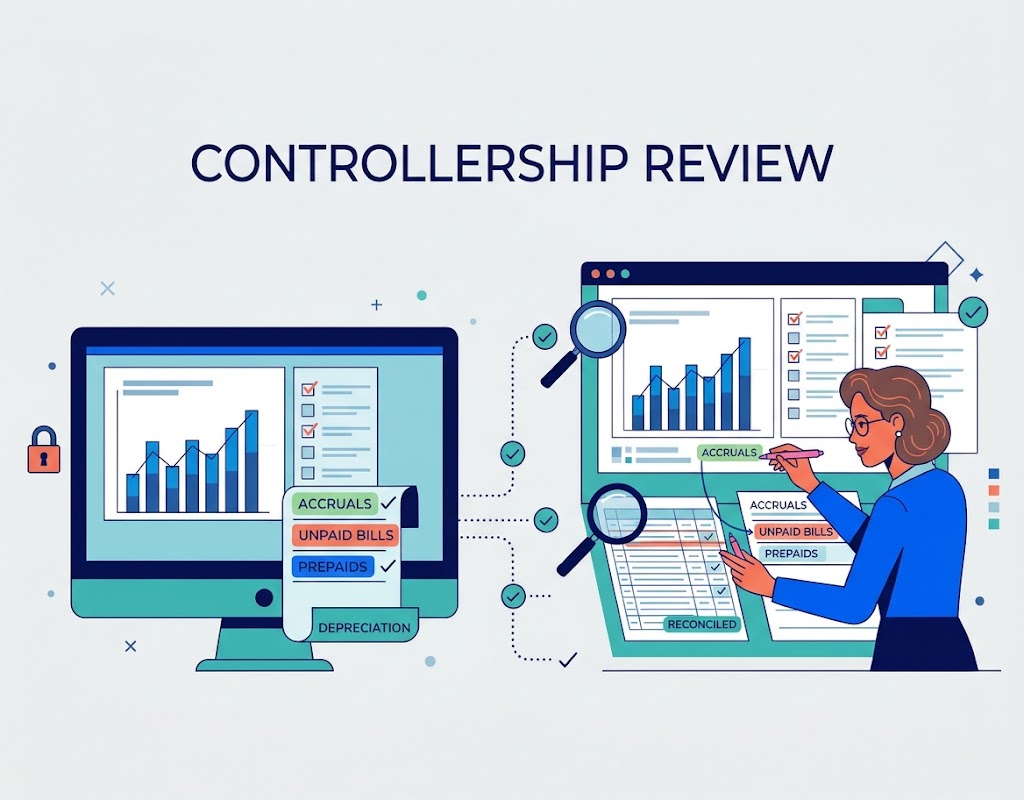
Bookkeepers record the transactions. A controller reviews what was recorded, books what the feed can't see, closes the period and signs off that the statements hold up. In practice, the monthly review looks something like this:
- Reconcile every balance sheet account to an outside statement or a supporting schedule: cash and credit cards, and also loans, payroll liabilities, prepaids, deferred revenue, fixed assets and inventory.
- Book the accruals, deferrals and other adjusting entries that never pass through a bank account.
- Check cutoff, so revenue and expenses land in the month they belong to.
- Compare this month against last month and against budget, line by line, and get an explanation for anything that moved more than the business did.
- Look for coding drift, where the same vendor lands in three different accounts across three months which can skew a trend line you're using to make key decisions.
- Sign off and lock the period, so no retroactive changes can sneak into the historical records without someone approving it first.
Importantly, the person who posts a transaction shouldn't be the only person who checks it. Auditors call that segregation of duties, federal grant rules call it internal control, and most owners just call it a second set of eyes.
One more point we've learned to make early with new clients. When your controller sends back a list of corrections, that list is the control doing its job. In the first month or two of an engagement it can be long, because the review is catching what slipped through before anyone was looking. Each correction should turn into a rule or a process fix, and the list should get shorter month over month – if it doesn't, that's a conversation we want to have with you.
Who's counting on a reviewed close
Here's where controllership earns its keep. Every one of these downstream uses assumes somebody already checked the books.
Grants and government awards
If you receive federal grants or cooperative agreements, the standard is written down. The Uniform Guidance at 2 CFR 200.302 requires a recipient's financial management system to provide "accurate, current, and complete disclosure of the financial results of each Federal award or program," and states that "all records must be supported by source documentation." The next section, 200.303, requires recipients to "establish, document, and maintain effective internal control over the Federal award."
For defense and research companies pursuing SBIR or STTR Phase II awards, the bar goes up again. The SBIR program's own accounting tutorial explains that many agencies rely on the Defense Contract Audit Agency for a pre-award survey of your accounting system, built around ten requirements from Standard Form 1408. DCAA reports seeing the most errors in four of them: separating direct from indirect costs, timekeeping, interim determination of costs charged to a contract, and excluding unallowable costs. A bank feed alone knows nothing about the distinction between any of those four, and your business is on the hook when grant auditors find incorrectly reported costs that the government won't reimburse.
Investor and buyer due diligence
Investors and buyers don't just settle for the financial statements you initially hand them, even audited financials. Writing for the Association for Corporate Growth, Craig Arends of CLA's private equity practice points out that buyers typically don't rely solely on audited or reviewed financial statements, and that a sell-side quality of earnings report may include "key findings regarding the company's internal control structure, management and accounting team, and accounting information systems." Diligence grades the finance function – with an intentional focus on process controls – along with the numbers it produces.
Our clients have felt that firsthand. Gareth Hosford, then CFO & COO of OMORPHO, put it plainly: "If we didn't have SPRCHRGR's expertise, I think when it came down to deal due diligence, we would potentially be exposed." His colleague Evan Reynolds, Head of Finance & Strategy, added the investor's side of it: "Once you have third party investors involved, they're going to want that third party reassurance that working with an outside party like SPRCHRGR brings."
Audit readiness
An audit goes faster and costs less when the auditor finds reconciled accounts, documented support and a locked period waiting for them. At Meals on Wheels West, on-site auditor time dropped from the two or three days it used to take down to one day as a direct result of the process controls we implemented for them, as Chief Administrative Officer Kevin McNulty told us: "I shared my amazement with our auditor, who expressed admiration for SPRCHRGR's streamlining of record keeping and contribution of materials that made their job easier and less time-consuming." The Telluride Film Festival cut its auditors' on-site time in the same way from a full week down to two days after partnering with SPRCHRGR.
Monthly review is also one of the cheapest fraud controls a small company can buy. The Association of Certified Fraud Examiners' Occupational Fraud 2026: A Report to the Nations cites fraud examiners' estimate that organizations lose 5% of revenue to fraud each year, finds that the typical case runs 12 months before anyone detects it, and reports that smaller businesses suffer the highest median losses of any organization size. A controller who asks every month why a balance moved is one of the best ways to prevent a year of fraud losses that nobody would have otherwise noticed.
Cash flow forecasting
A cash forecast starts from your balance sheet: what you have, what you owe, what's owed to you and when each of those turns into cash. If unpaid bills were never recorded, customer deposits are sitting in revenue or payroll liabilities are understated, the forecast itself starts from the wrong number and the projected cash flows will be off in every week thereafter.
The margin for that kind of mistake is thin. JPMorgan Chase Institute research covering nearly 600,000 small businesses found that the median business holds enough cash to cover 27 days of typical outflows, and a quarter of them hold fewer than 13. When you're running that close to the edge, one large unrecorded bill can turn into an overdraft, missed payroll, or worse.
The decisions you make every month
The best reason most owners invest in a finance team in the first place is so they can run the business off the numbers. Gross margin by channel, cost per project, payroll as a percentage of revenue and monthly burn are only as reliable as the consistency of the coding underneath them – if a recurring cost lands in cost of goods sold one month and operating expenses the next, the trend line moves even though nothing in the business changed. Leaders make important hiring, pricing and spending calls off those margins and trend lines so consistency and accuracy are paramount.
Jeff Ono, Founder and Managing Partner of Pause Studios, described the before and after better than I can: "Before we brought in SPRCHRGR, we had junior varsity accounting." And after: "We now have major league accounting, which enables us to operate more efficiently, make better decisions, and remain compliant."
What it costs, and what it's worth
A controller review costs real time and money, so for a company watching every dollar it's fair to ask what you're getting for it. I think the right way to price it is against the downstream cost of skipping it – a disallowed cost on a federal award, a retrade on valuation or a stalled raise during diligence, an audit that runs 2-3x longer than it needs to, a surprise cash flow squeeze, or six months of decisions built on a margin that was never real. In the companies we work with, any one of those tends to cost more than a full year of regular controllership review baked into the monthly accounting cycle.
On the other hand, if you're pre-revenue, with no outside investors, no grants and no lender asking for statements, a lighter cadence (for instance, quarterly reviews instead of monthly) can make sense until the business dynamics change.
Five questions to ask about your own close
- Does someone other than the person who posted the transactions review the close before it's final?
- Is every balance sheet account reconciled to a statement or schedule each month, and could you hand those reconciliations to an auditor tomorrow?
- Do you get a written explanation of the big month-over-month swings along with the reports?
- Is the period locked after close, and would you know if someone changed something in a closed month?
- If a grant officer, investor or buyer asked for the support behind any number on your P&L, how long would it take you to produce it?
If more than one of those answers makes you uneasy, it's worth a conversation. Our article on how we code your books walks through the bookkeeping side of the work. Controllership is the review that makes the finished statements something a grant officer, an investor, an auditor and your own leadership team can rely on – and if you're heading toward any of those conversations, let's take a look at your close together.
This post is general information, not accounting, tax or legal advice. Talk to your advisors about your specific situation.
Share