Share


Built for: Presidents and CEOs, treasurers and finance committees of chambers of commerce, trade associations and other membership organizations, roughly $1.5M to $15M a year, with the books in QuickBooks Online and members in a CRM.
What it answers: Which members renew, by the year they joined and the tier they pay; the dues at risk in the next 90 days; what every event earns once staff time is counted; where the money comes from; and what to put in next year's budget.
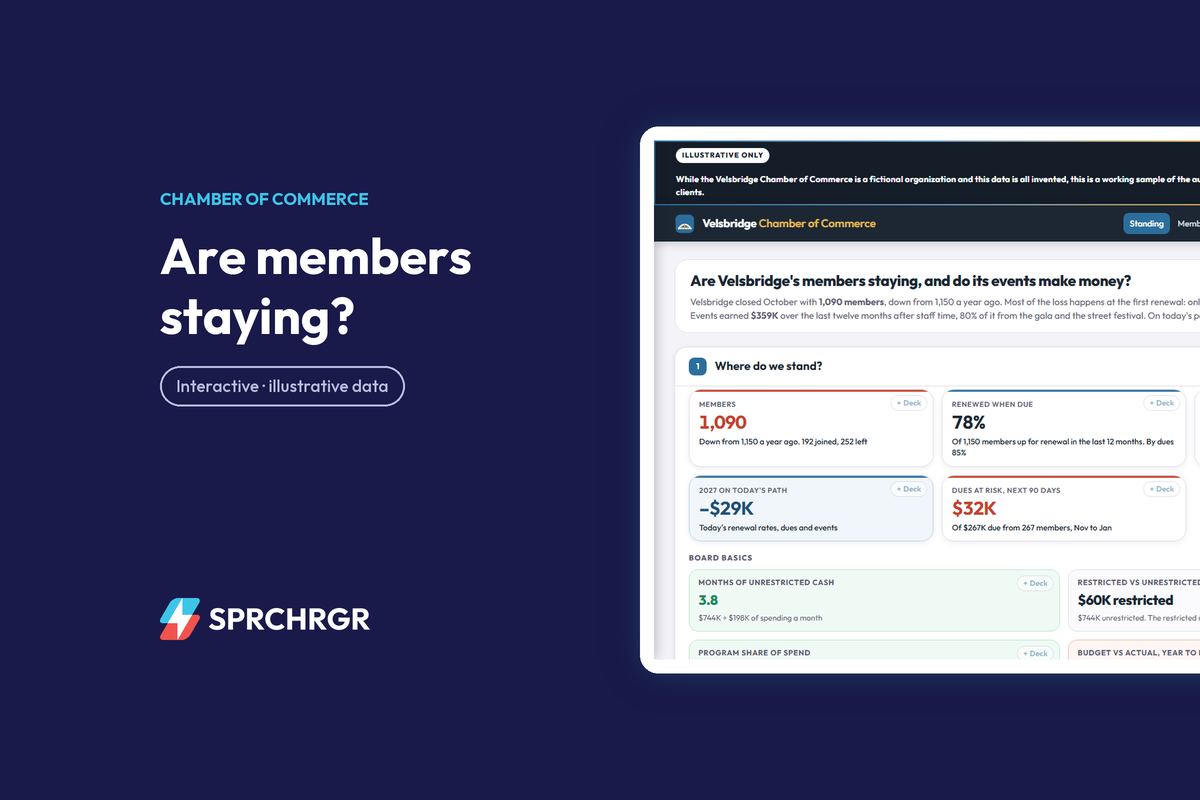
See it live: Chamber membership and events demo · a made-up chamber with invented numbers
"Are members staying, and do our events actually make money?"
Every chamber board asks it in November, with next year's budget on the table, and the P&L doesn't answer it. Here's how I'd walk a chamber president and treasurer through it, using a sample dashboard we built for a made-up chamber in a made-up city, the Velsbridge Chamber of Commerce.
Velsbridge runs on about $2.3M a year. A little over 40% comes from dues, paid by about 1,100 member businesses in five tiers, from a $350 Starter tier for one-to-five-person shops up to a $5,500 Champion tier for the big employers. The rest is events, sponsors, an annual partner program, and royalties from endorsed member-benefit providers. A small foundation, with its own books, runs a summer jobs program for students.
Start with who renews
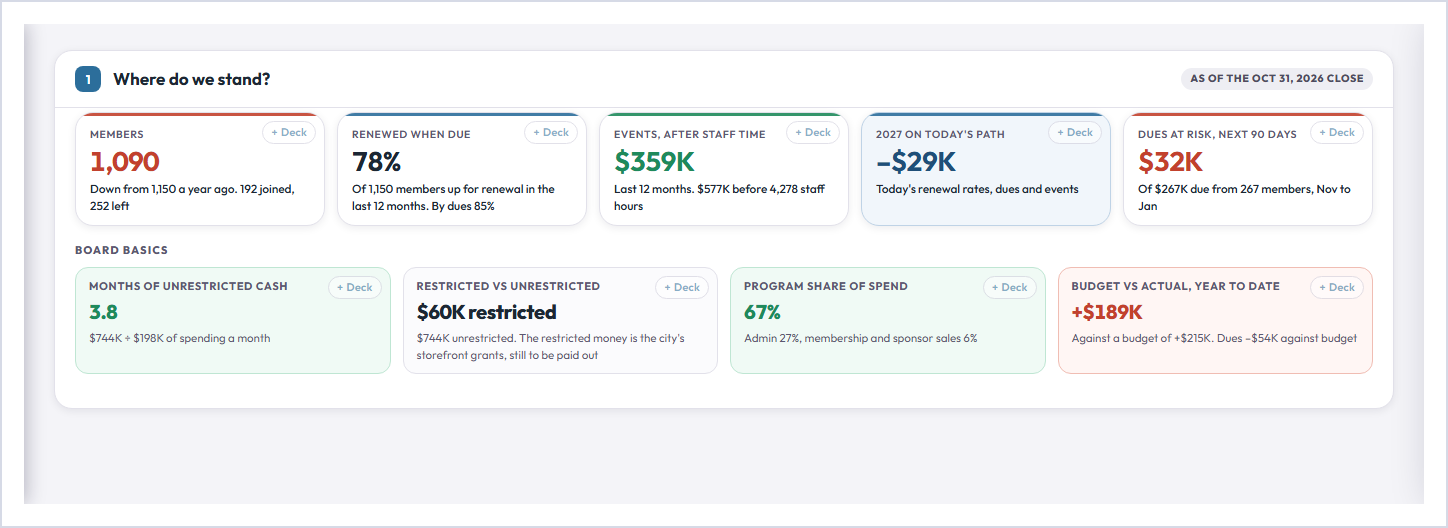
Velsbridge closed October with 1,090 members, down from 1,150 a year ago. It kept 78% of the members who came up for renewal, and 85% of the dues, because big members renew more often. That looks fine against the 80 to 85% chambers quote. It hides where the loss happens.
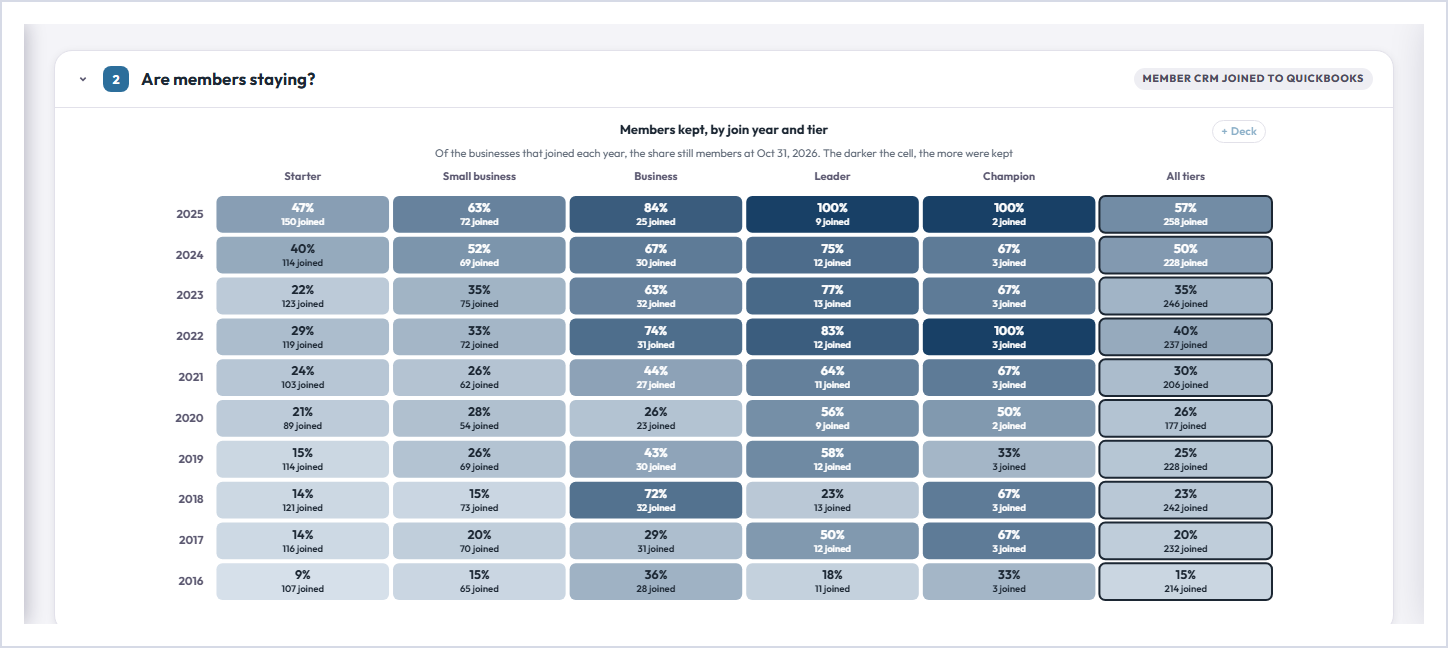
This is the chart I'd put in front of the board. Each row is a year of new members, each column a tier, each cell the share still members today. The Starter column fades fast; the bigger tiers hold.
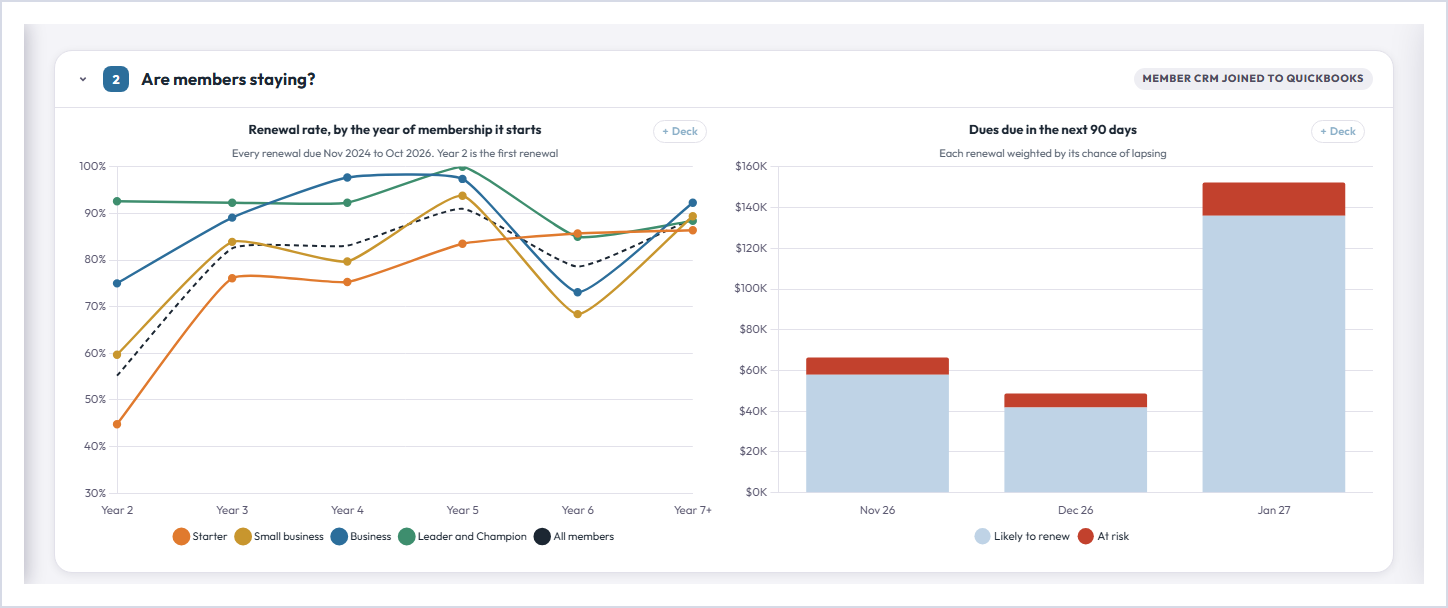
Only 45% of Starter members and 60% of Small business members renew for a second year. Past that first renewal, Starters stay at about 75% a year. Members don't drift away; they leave at the first renewal.
That's also what happened to last spring's membership drive. It signed 74 businesses at half price for the first year, and only 35% renewed at full price. Of the members who joined that same spring at full price, 49% renewed. It's most of why dues are $54K behind budget.
Then the near term. Over the next 90 days, 267 members owe $267K in dues, and about $32K of it is at risk. The table under the chart names the renewals to call first, sorted by dues at stake: two Champion members due in January, one of them coming up on its first renewal, and a handful of Leader and Business members in their first year.
Then look at every event after staff time
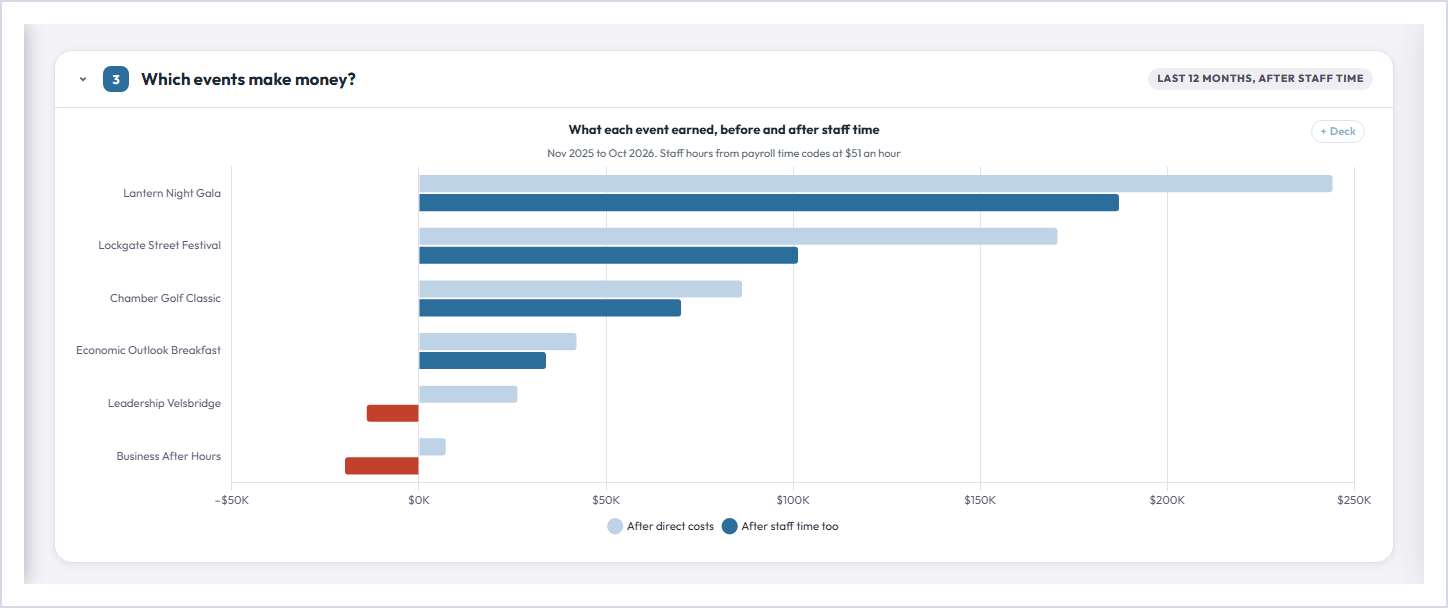
Most chambers know what the gala grossed. Fewer know what it earned once the venue, the food and the staff hours are counted. This chart shows both for every event over the last twelve months, with staff hours from payroll time codes at about $51 an hour, all in.
Events earned $359K after staff time. The Lantern Night Gala and the Lockgate Street Festival made 80% of that. Golf and the Economic Outlook Breakfast earn their keep.
Two don't. The 11 Business After Hours mixers clear $7K over food and venue, then take 528 staff hours, so they lose about $20K. Leadership Velsbridge clears $26K and loses $14K the same way.
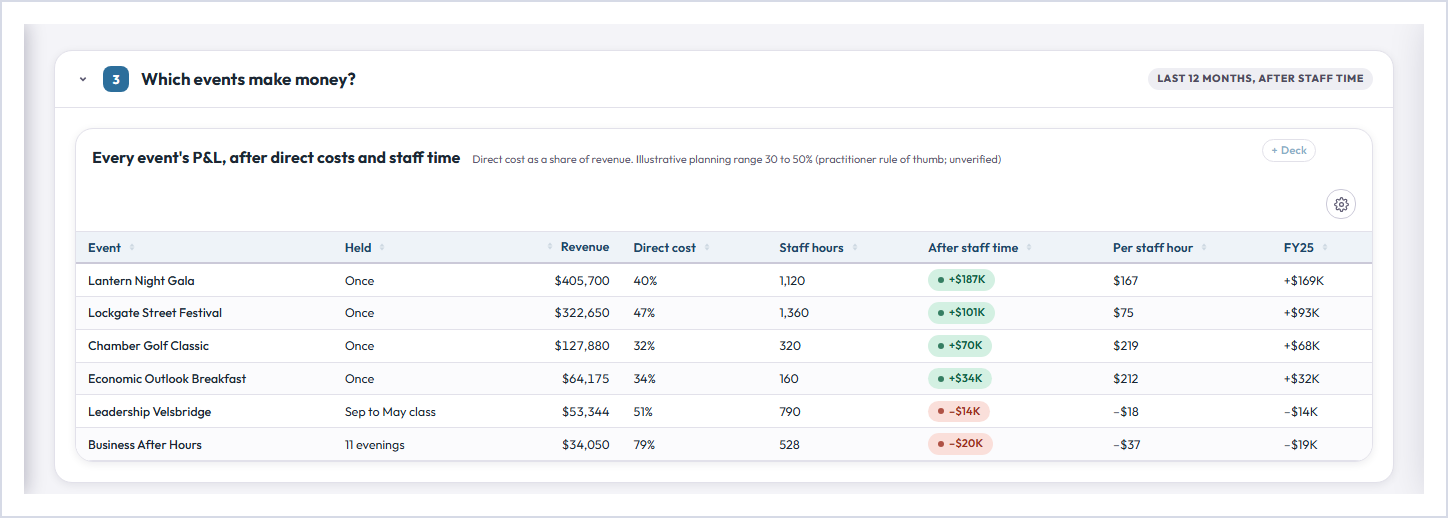
Here's the part that surprises boards. Cutting either one makes next year worse, by about $6K for the mixers and $9K for Leadership, because the staff are paid either way and you lose what the event cleared. The answer is to fix them. Hold the mixers at member venues, with the host covering food and drink, and they add about $10K. Let program alumni run the Leadership sessions and charge the next class $1,950 with a second sponsor, and it adds about $9K. Together the two fixes free about 408 staff hours.
Where the money comes from
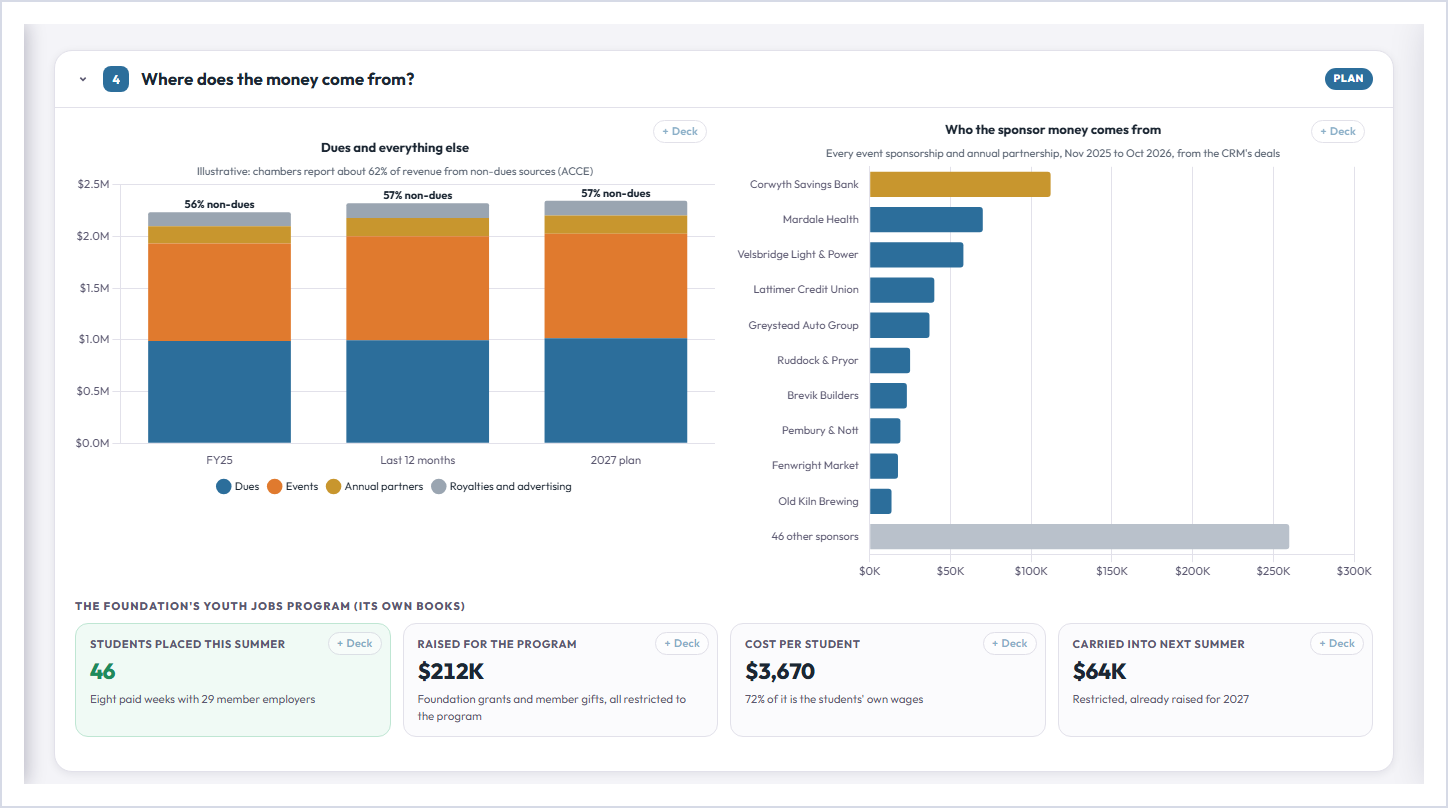
Non-dues revenue is 57% of the total, a little under the roughly 62% chambers report. Most of it is sponsor money: $675K over the last twelve months from 56 businesses. One bank, Corwyth Savings Bank, gave $112K of it, about 17%, and the top three gave 36%. If the bank stepped back next year, 2027 would be $112K worse and cash would drop to about $449K. Sign the top three for two years before the gala, and grow the sponsors below them.
The foundation sits on the page as one panel. It placed 46 students with 29 member employers this summer at about $3,670 each. It has its own books and its own restricted money, and it's never added into the chamber's numbers.
What I'd put in the 2027 budget
On today's path, 2027 ends about $29K short, and unrestricted cash dips to about $561K at the end of the year, under the board's floor of three months of spending, $590K. Cash at Velsbridge always runs down in December, before the gala and partner money arrives in January and February.
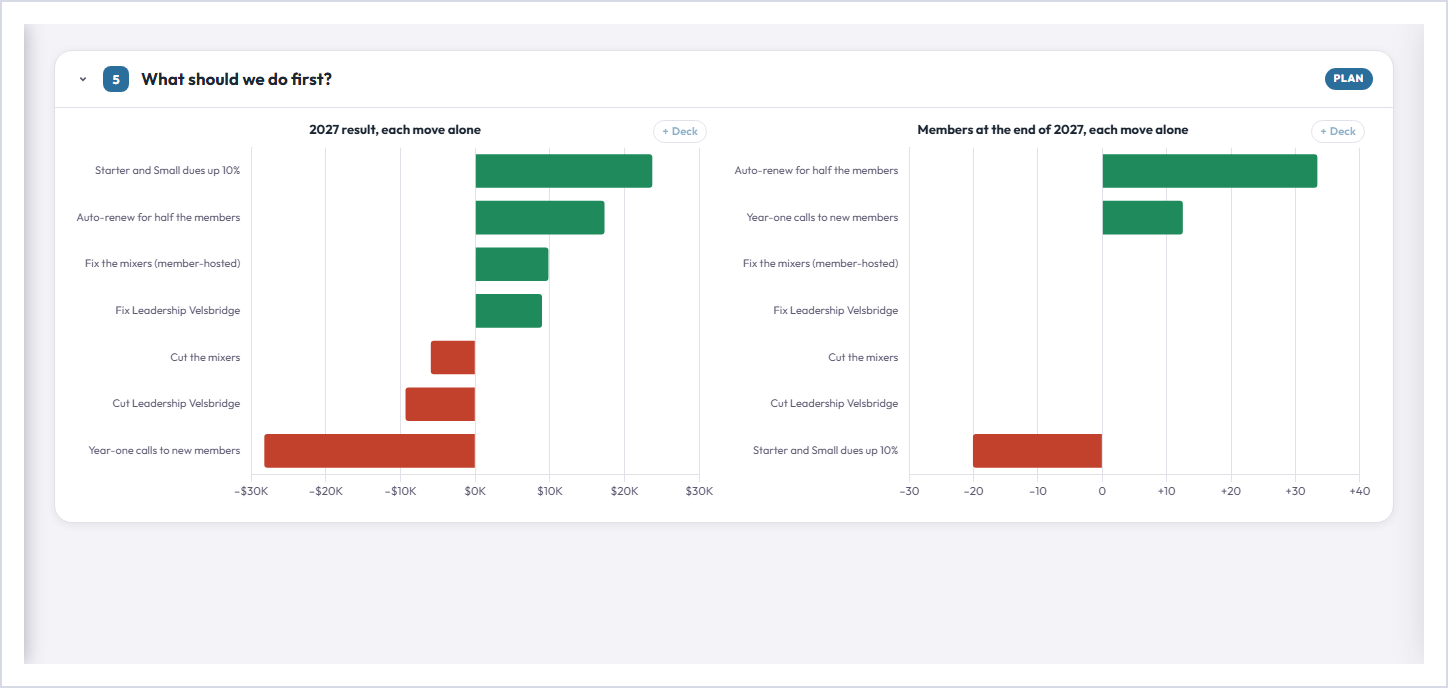
Keep the members you sign before you sign more. Moving half the members to auto-renew, with a card on file at sign-up and at renewal, adds about $17K in 2027 and keeps about 33 more businesses. Calls to new members at month three and month six keep about 13 more. Paid for with a new hire, those calls cost about $34K and lose money in year one. Paid for with the 408 hours the event fixes free up, they cost a fraction of that.
Dues haven't moved since January 2022. A 10% rise for Starter and Small members adds about $24K and costs about 20 members. The board should make that trade with its eyes open.
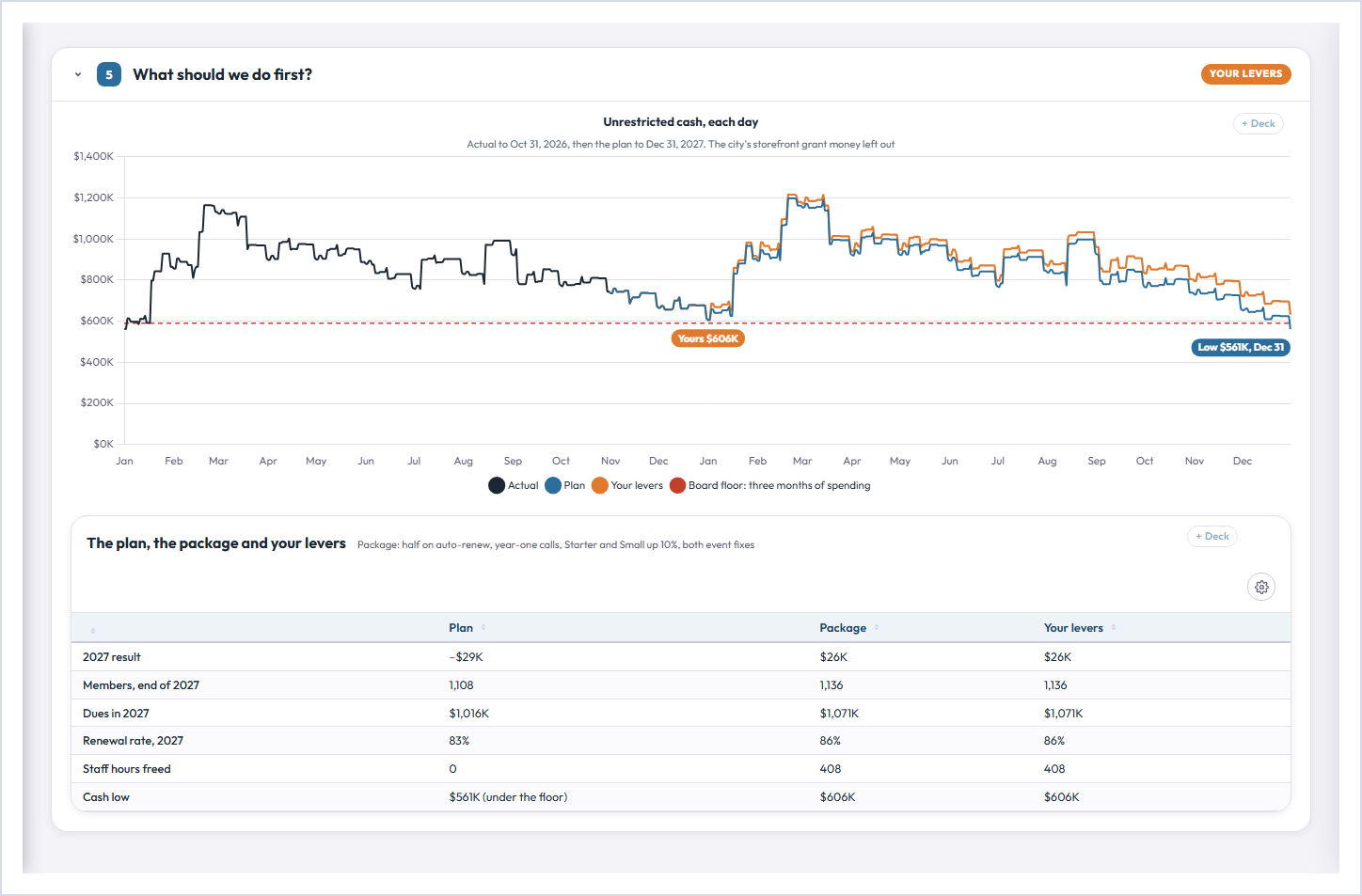
All of it together, with both event fixes, ends 2027 about $26K ahead with 1,136 members, and cash stays above the floor at about $606K.
Why not just do this in a spreadsheet
You could, once. The hard part is keeping it true. The heat map needs every member's join date, tier, renewal date and auto-renew flag from the CRM, joined to the dues in QuickBooks. The event P&Ls need event classes and staff hours coded in payroll. Someone has to know the drive was half price. And when a board member asks where $32K at risk comes from, someone has to stand behind it.
That's what CFOptimize for Nonprofits does. We connect your member CRM, QuickBooks and payroll, keep the data in a secure warehouse that refreshes itself, build the board view around the questions your board asks, and sit with your finance committee as a part-time CFO. Meet with our team.
Mark
The Velsbridge Chamber of Commerce, its foundation, the city, and every member business, sponsor and event named here are made up, and every figure in the dashboard and this post is invented. Benchmarks on the page are illustrative and carry their source and year. The sample dashboard doesn't connect to QuickBooks, Gusto or HubSpot. Nothing here is investment, legal or tax advice.
Share