Share


Built for: Executive directors, treasurers and finance committee chairs of membership networks, associations and other nonprofits that live on sponsorships and dues, roughly $1.5M to $15M a year, with the books in QuickBooks Online and sponsors in HubSpot.
What it answers: Whether you finish the fiscal year above the board's cash floor, which sponsors that depends on, whether members are renewing, and whether the accelerator and the conferences pay for themselves.
See it live: Founders' network board review demo · a made-up organization with invented numbers
"Will we end the year above our cash floor? And which sponsors are we counting on to get there?"
The treasurer asked me both questions in the same breath. The executive director had the answer to the second one in their head. Nobody had the answer to the first one on paper. Here's how I'd walk them through it, using a sample dashboard we built for a made-up organization called Tessmere Founders Network.
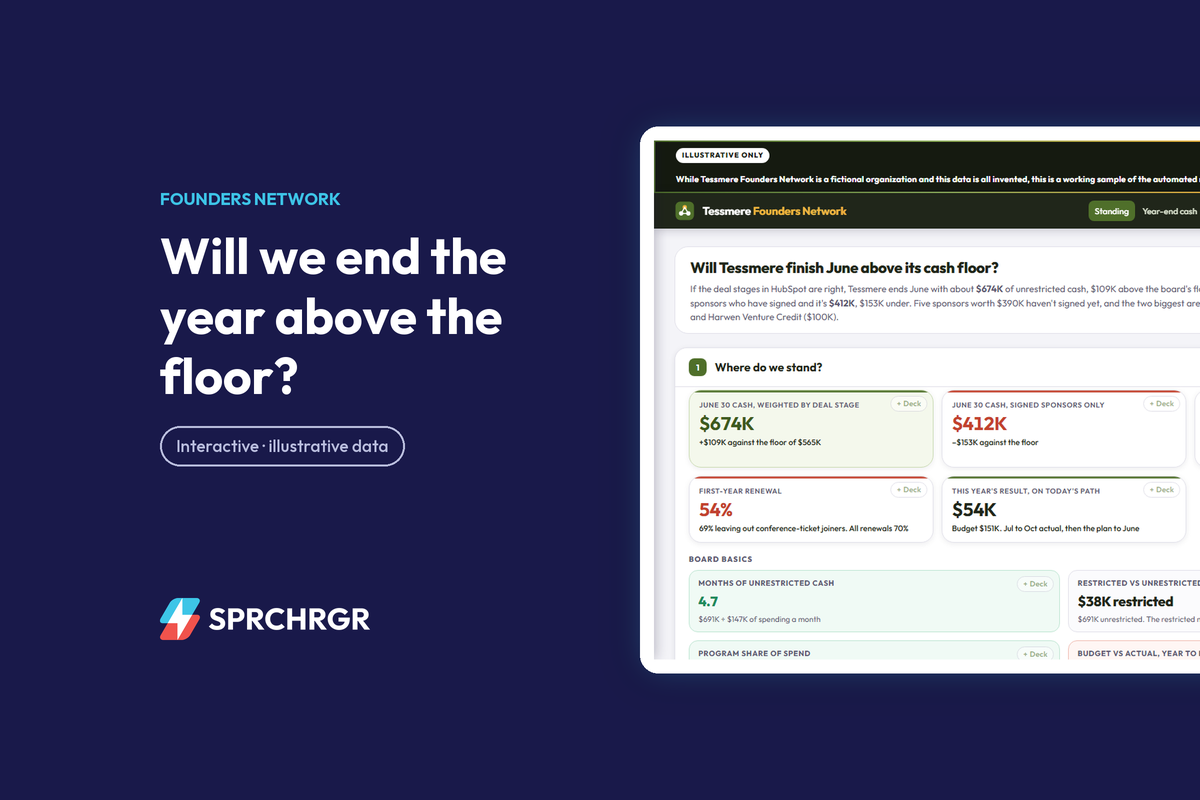
Tessmere is a national network for startup founders with a budget around $1.6M. About 1,630 members pay dues in three tiers. Eight corporate sponsors bring in about two fifths of the money. Twice a year it runs a 12-week accelerator, and it holds a big fall conference and a smaller spring one. The fiscal year ends June 30, and the board's policy is to hold four months of spending in unrestricted cash. That's the floor: $565K.
The answer depends on what you count
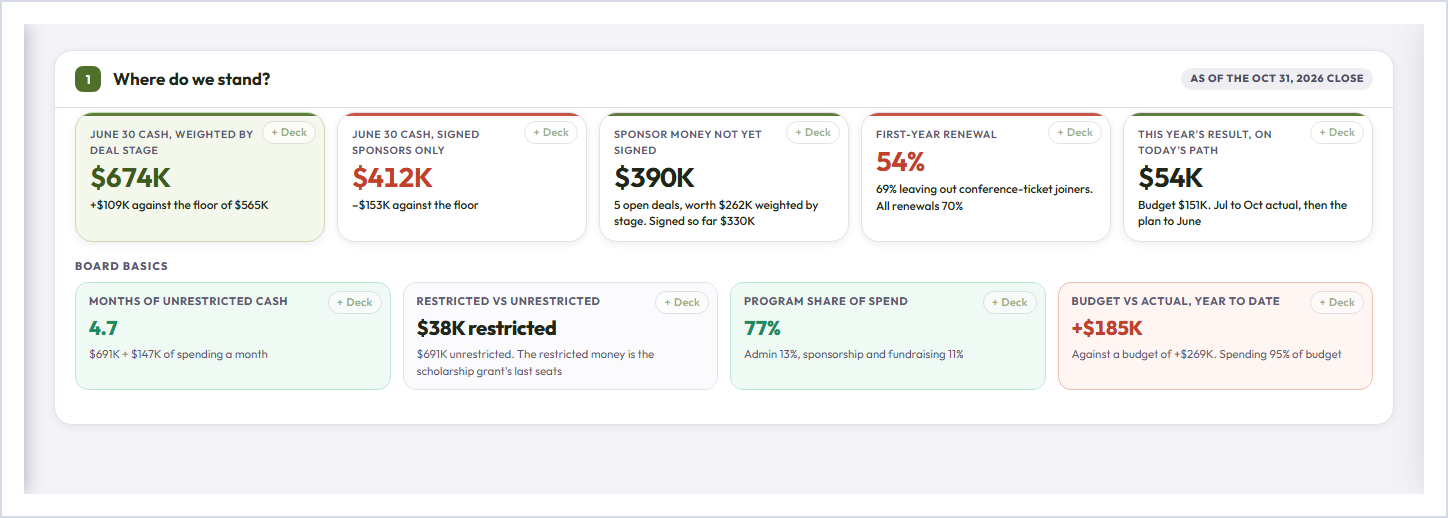
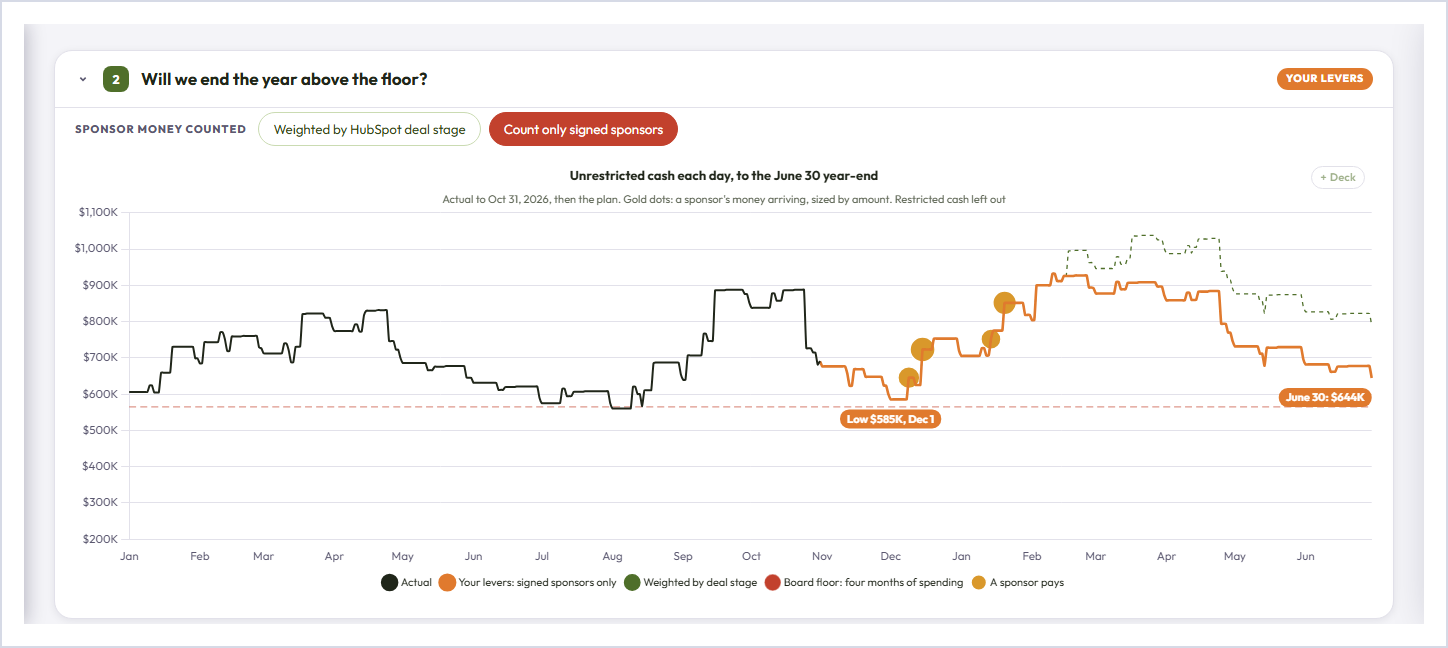
Start with the two cards at the top left. If the deal stages in HubSpot are right, Tessmere ends June with about $674K of unrestricted cash, $109K above the floor. Count only the sponsors who have signed and it ends at $412K, $153K under.
Nothing else changes between those two numbers. The whole gap is sponsor deals that aren't signed yet. That's the number the board actually needs, and it's the one a QuickBooks report can't show, because unsigned deals don't exist in QuickBooks. They live in HubSpot.
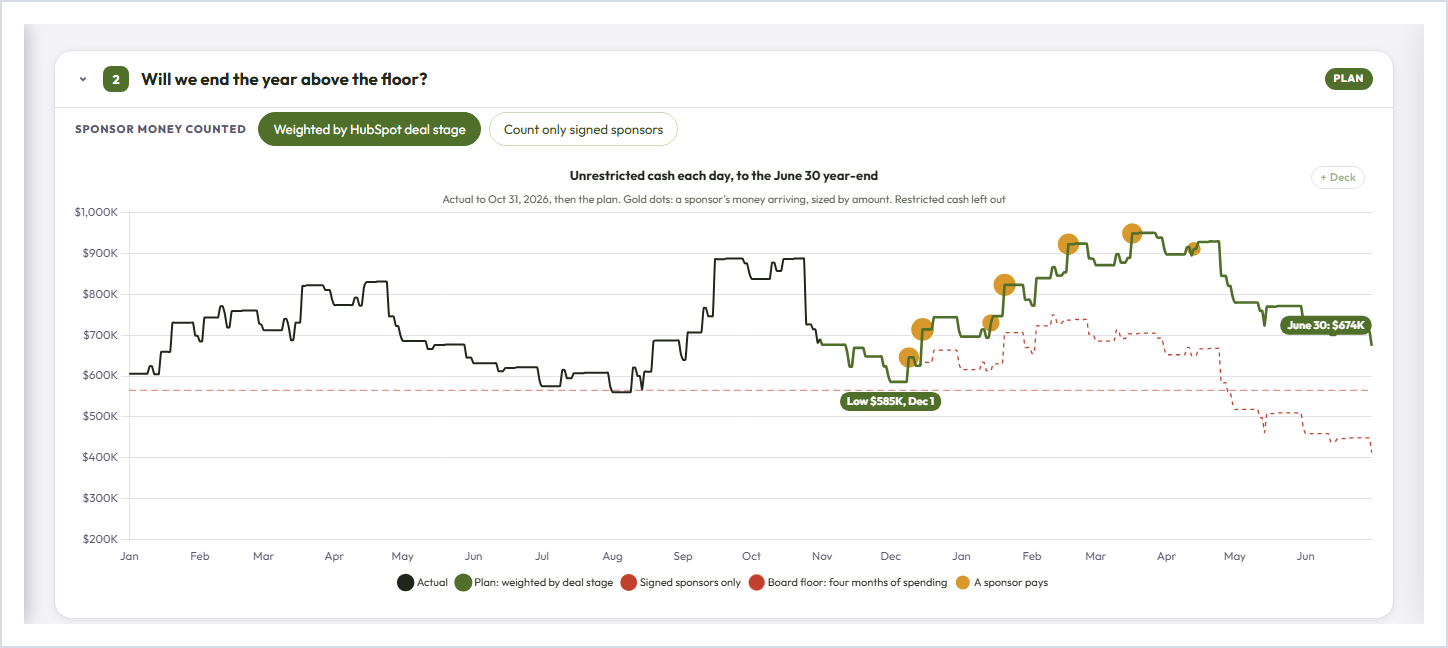
The signature view is the cash path. Every payroll, every dues batch, every conference ticket and every sponsor payment lands on the day it's expected, from the October close to June 30. The gold dots are sponsors. Each open deal is counted at its HubSpot stage weight on its expected date: a contract that's been sent counts at 90%, a verbal yes at 80%, a proposal at 60%, a renewal conversation at 40%.
Then flip the switch above the chart to count only signed sponsors.
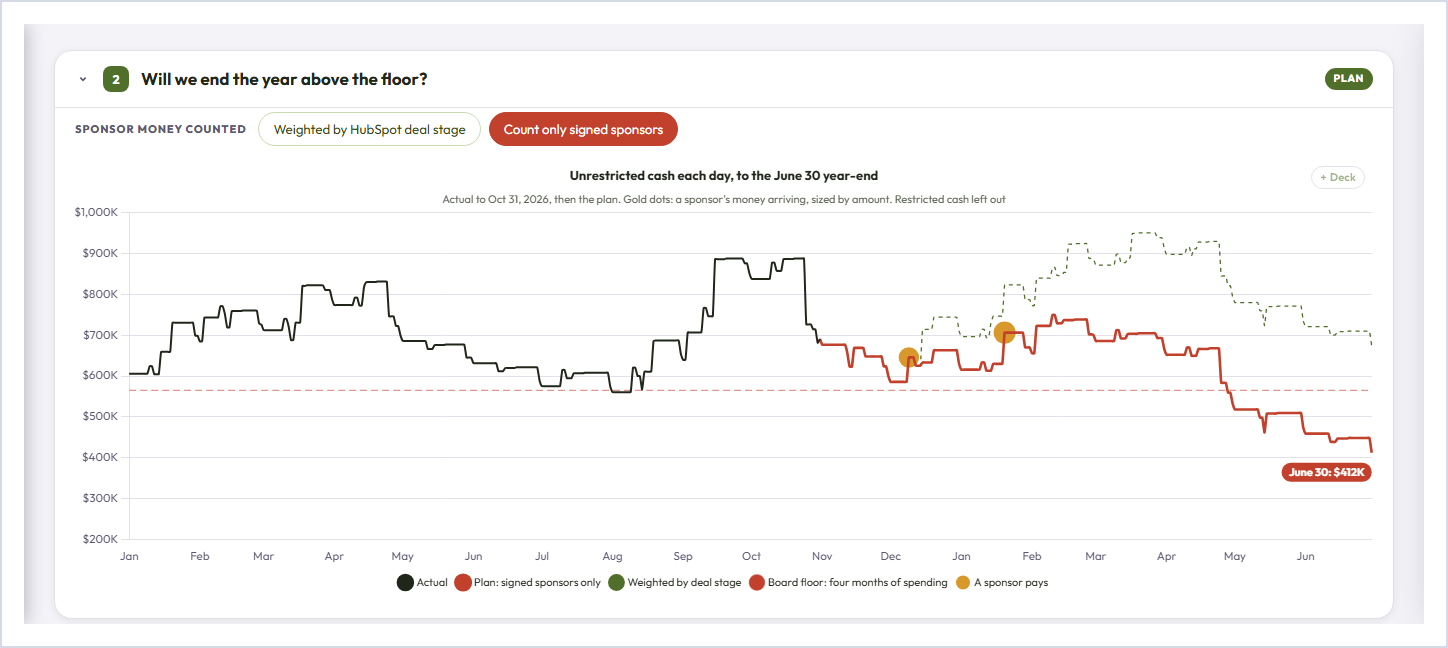
Two dots stay: the law firm's December check and the bank's second installment in January. Everything else disappears, and June sinks under the floor. I'd show a board both lines side by side every month until the deals close.
Who we're counting on
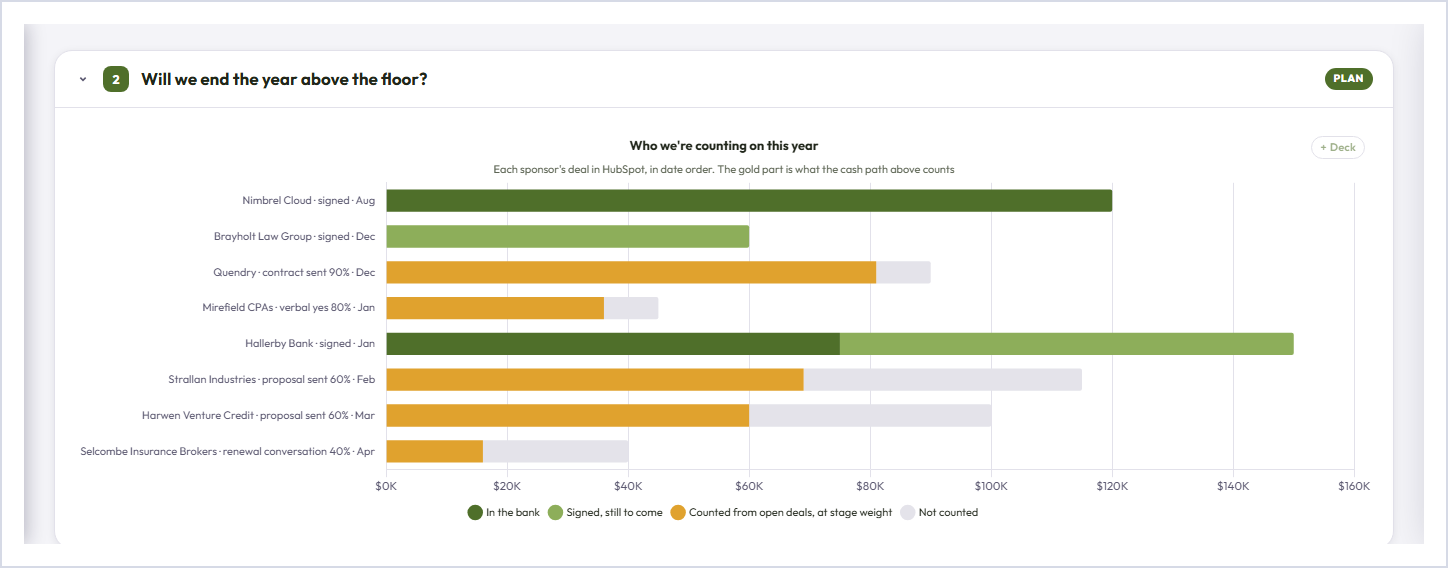
This chart answers the second half of the treasurer's question. Of $720K in sponsorships this year, $330K is signed and $195K is already in the bank. The other $390K sits in five open deals, worth $262K once you weight them by stage.
Two of those deals carry most of the risk. A manufacturer, new this year, is at proposal stage for $115K. The venture lender is at proposal stage for $100K. Together they're $215K of the year, both at 60%.
There's a budget story in here too. The year to date shows a $185K surplus, but the budget expected $269K by now. Most of the difference is one sponsor: the payroll software company signed last September, the budget assumed it would sign in September again, and its $90K contract is still out for signature. The bigger point is that the budget counted every sponsor at full value. On HubSpot's stages the year ends nearer $54K than the $151K surplus the board approved.
Are members renewing?
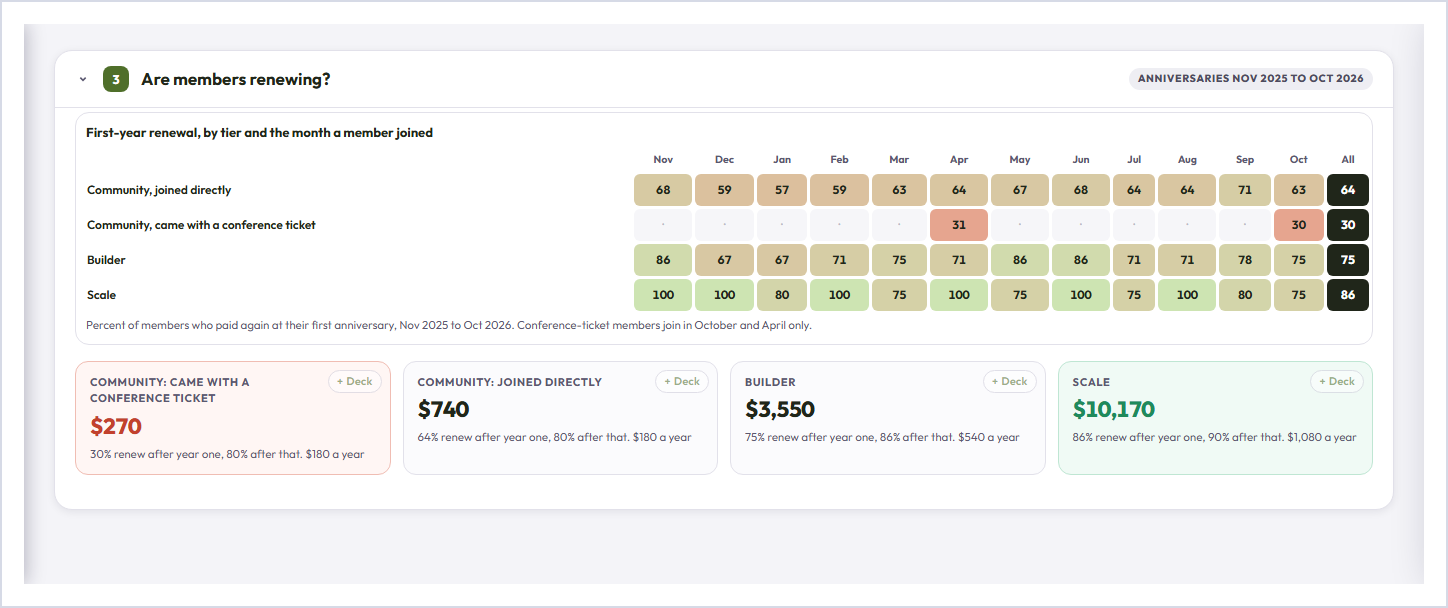
About 54% of members renew after their first year. That sounds bad, and it hides two very different groups. Founders who joined on their own renew at 64%. Founders who came in through a conference ticket, which includes a free first year of the entry tier, renew at 30%. Most of them never chose to join.
That shows up in lifetime value. Over a membership's life a conference-bundle member brings about $270 in dues, against $740 for a founder who joined directly and $3,550 for the middle tier. The fix is cheap: ask conference buyers to pick a tier at checkout instead of handing them one.
Do the programs pay for themselves?
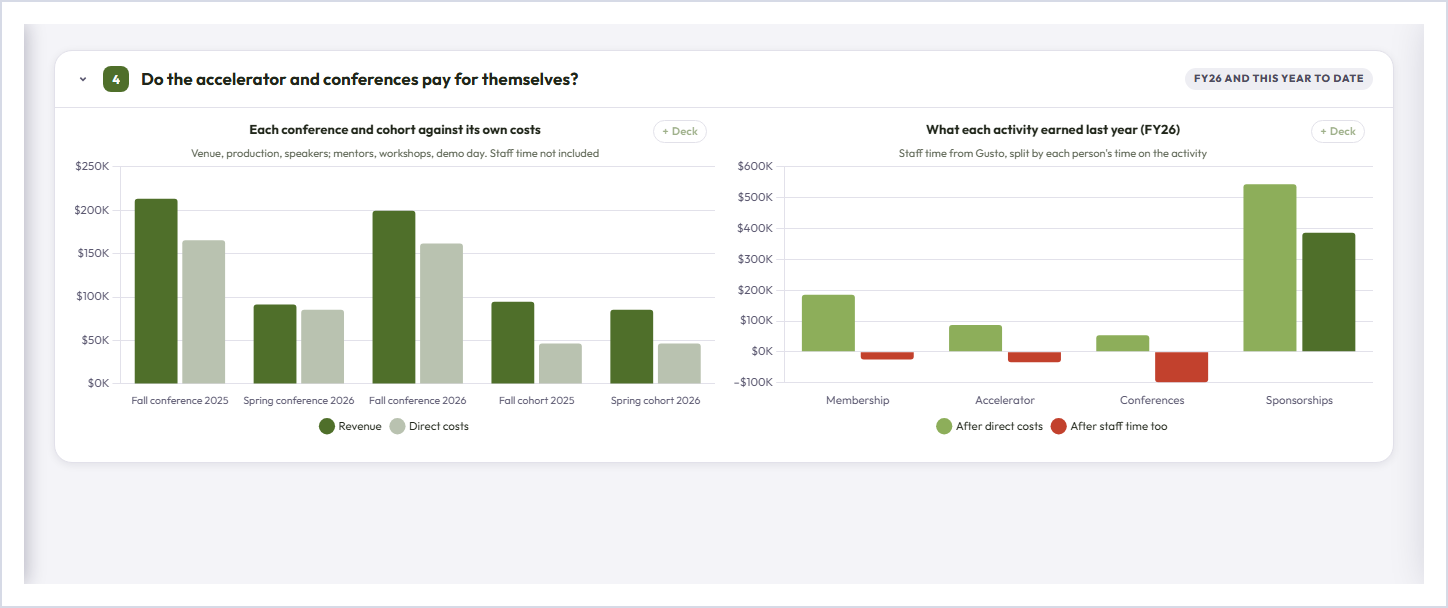
Every conference and accelerator cohort covers its own direct costs. This fall's conference cleared about $38K over venue, production and speakers. None of them covers the staff time it takes. Once Gusto's time records put staff on them, last year's conferences came up $98K short and the accelerator $33K short. Sponsorships carried the network, $386K after the partnerships team and sponsor events.
That's a fine model if the board sees it plainly. The conferences are what sponsors buy, and the accelerator is the mission. A founder's seat costs about $2,450 in mentors, workshops and demo day against a $4,800 fee, and a scholarship grant pays for six seats a cohort.
What I'd do first
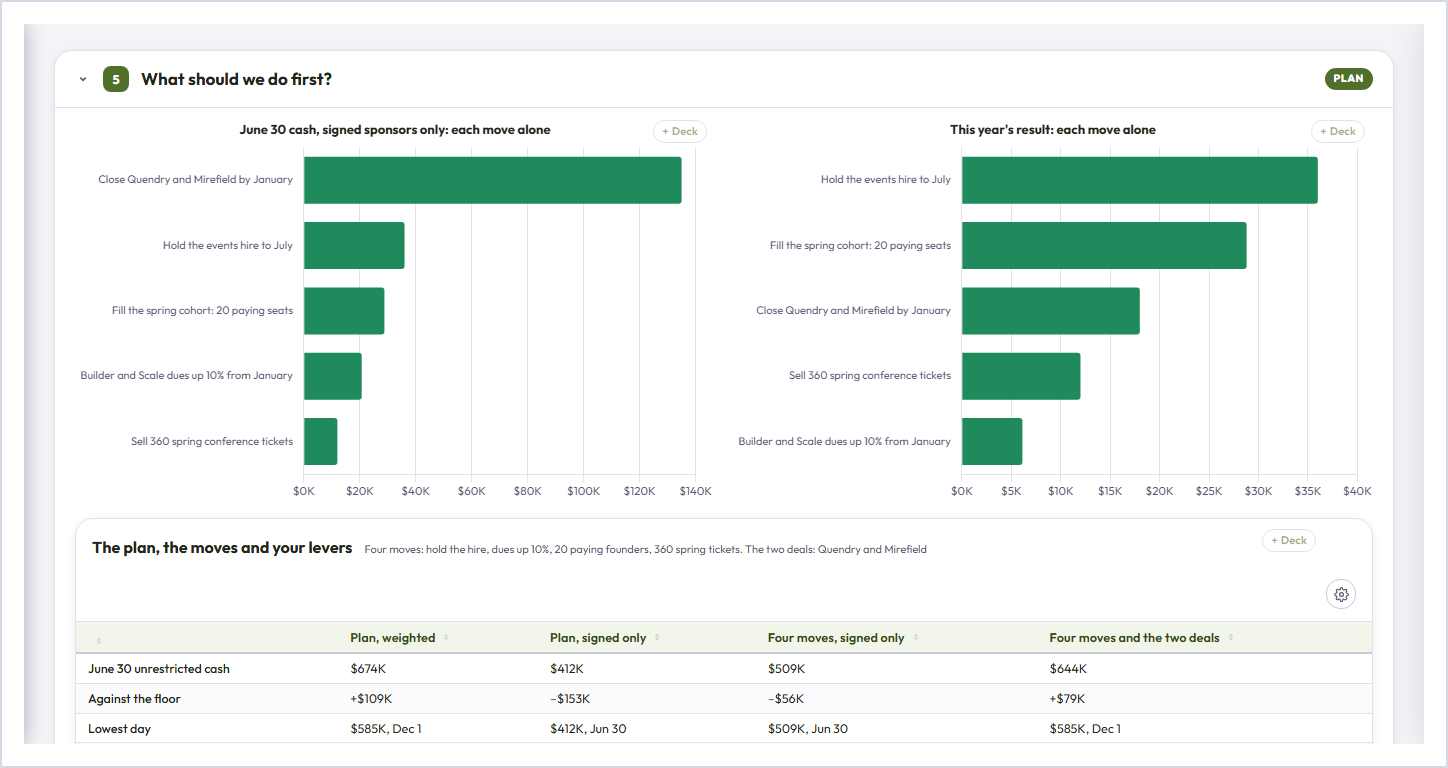
Plan the year on signed money, then work the list. Closing the payroll software company and the accounting firm by January, the 90% and 80% deals, is worth $135K. It's the biggest bar on the page, and it belongs to whoever owns those two relationships.
The operating moves are smaller but they're in the network's own hands. Holding the planned events hire to July saves $36K. A full spring cohort of 20 paying founders brings $29K. Raising the two upper tiers' dues 10% from January brings $21K of cash by June, though only about $6K shows up in this year's result because dues are earned over the year they cover. Selling 360 spring conference tickets adds $12K.
Those four moves take signed-only June to $509K, still under the floor. Add the two near deals and it's $644K, above the floor without the manufacturer or the lender. If those two sign as well, June ends near $771K, and the board can treat them as upside.
Why not do this in a spreadsheet?
You could, once. The hard part is keeping it true. The cash path needs QuickBooks classes set up by program, Gusto's time records to put staff on each activity, HubSpot's deal stages and dates kept honest, and every member's join month to see who renews. It needs someone who knows that the bank pays in two halves and that a conference ticket comes with a membership. And when a board member asks where $153K comes from, someone has to stand behind it.
That's what CFOptimize for Nonprofits does. We connect those systems, keep the data in a secure warehouse that refreshes itself, build the board view around the questions your board asks, and sit with your finance committee as a part-time CFO. Meet with our team.
Mark
Tessmere Founders Network is a made-up organization. Every sponsor, member, event and figure in the dashboard and this post is invented, and any likeness to a real company is accidental. Benchmarks on the page are illustrative and carry their source and year. The sample dashboard doesn't connect to QuickBooks, Gusto or HubSpot. Nothing here is investment, legal or tax advice.
Share