Share


Built for: Executive directors, treasurers and finance committees of food banks and food recovery nonprofits from $1.5M to $15M, with books in QuickBooks Online.
What it answers: What a meal costs you by how the food arrives, which partners and routes cost most to reach, what happens when a big grant ends, and which moves keep the pace.
See it live: Food recovery board dashboard · a made-up organization with invented numbers
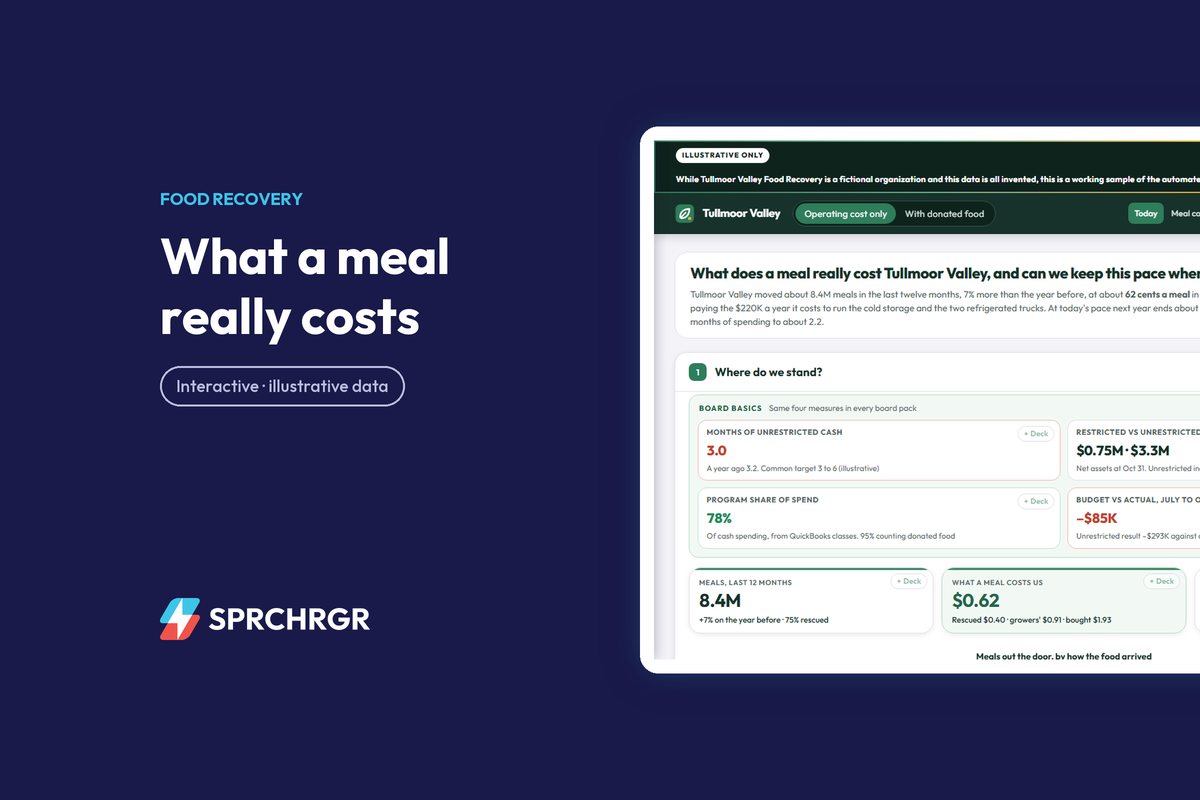
"What does a meal cost us?" It's the first question a new board member asks at a food recovery nonprofit, and it's the one the finance report never quite answers. The audited statements say you're a $20M-plus organization. The bank says you're a lot smaller. And the grant that bought your trucks is about to stop paying to run them.
Here's how I'd walk an executive director and treasurer through it, using a sample dashboard we built for a made-up nonprofit called Tullmoor Valley Food Recovery. It rescues food from grocery stores and farms, pays growers to glean what they'd otherwise plough in, buys food to fill the gaps, and delivers to 90 partner pantries, shelters, schools and senior centers. About 10 million pounds a year, 8.4 million meals, a cash budget of about $5.6M. The books are in QuickBooks Online, donors in HubSpot, payroll and driver hours in Gusto.
Start with the board basics
Every board pack I build for a nonprofit opens with the same four numbers, defined the same way every month.
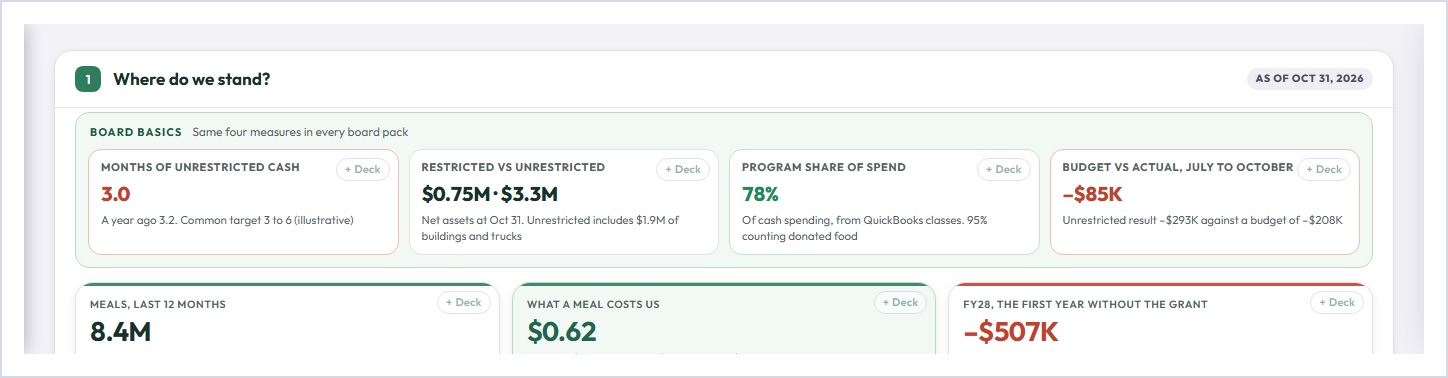
Tullmoor has about 3.0 months of unrestricted cash, down from 3.2 a year ago. That's cash you can actually spend, after taking out money donors restricted, divided by an average month of spending. Restricted money is $749K, and $149K of it is the last of the capital grant. Program spending is 78% of cash spending, straight from QuickBooks classes. And the year is $85K behind budget through October.
The budget gap is where a CFO earns their keep. $60K of it is one grocer chain's gift moving from September to December. That's timing, and it comes back. Food prices ($16K), individual gifts ($14K) and fuel ($7K) are the rest, and they won't. The harvest dinner beat its budget by $12K.
Your statements and your bank tell two different stories
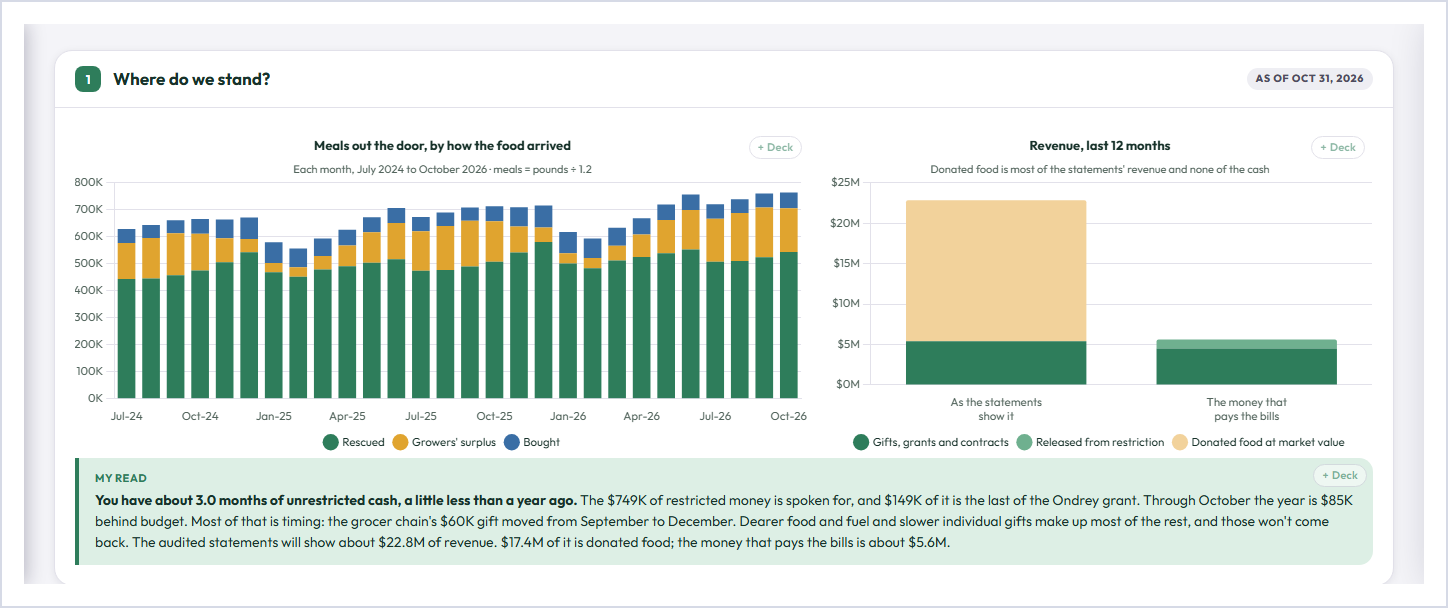
The audited statements will show about $22.8M of revenue this year. $17.4M of that is donated food, booked at market value. It comes in as revenue and goes out as program expense in the same month, so it never touches the surplus, but it makes the organization look four times its real size. The money that pays the bills is about $5.6M. Board members who read the 990 need to hear that early.
What a meal costs, by how the food arrives
This is the view I'd spend the most time on.
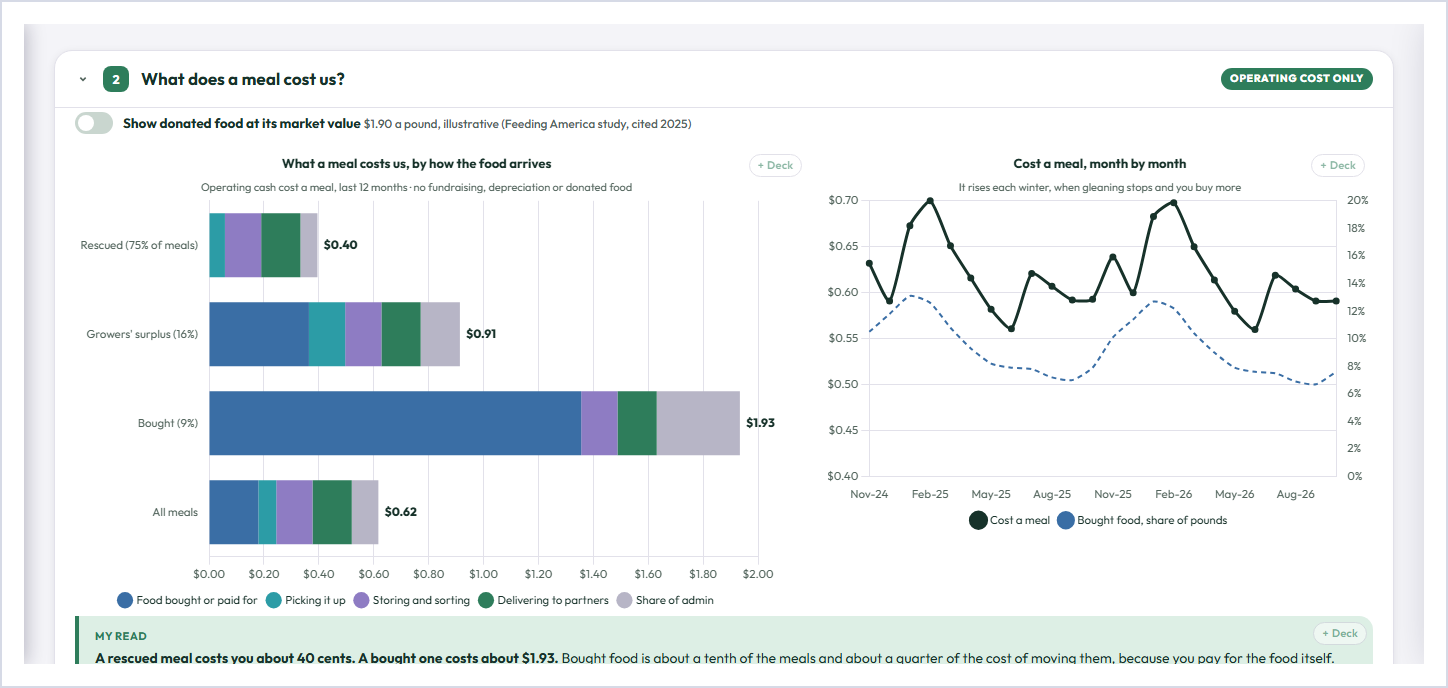
Across everything, a meal costs Tullmoor about 62 cents to move. That's picking it up, storing and sorting it, delivering it, and a share of admin, divided by meals (pounds divided by 1.2, the Feeding America convention). No fundraising, no depreciation, no donated food.
Split it by channel and the story changes. A rescued meal costs about 40 cents. A growers' surplus meal about 91 cents, mostly the 22 cents a pound Tullmoor pays growers to pick and pack. A bought meal costs about $1.93, because you're paying for the food itself. Bought food is about a tenth of the meals and about a quarter of the cost. And it bites in winter, when gleaning stops and the cost of a meal climbs to about 70 cents.
Now flip the switch to "show donated food at its market value."
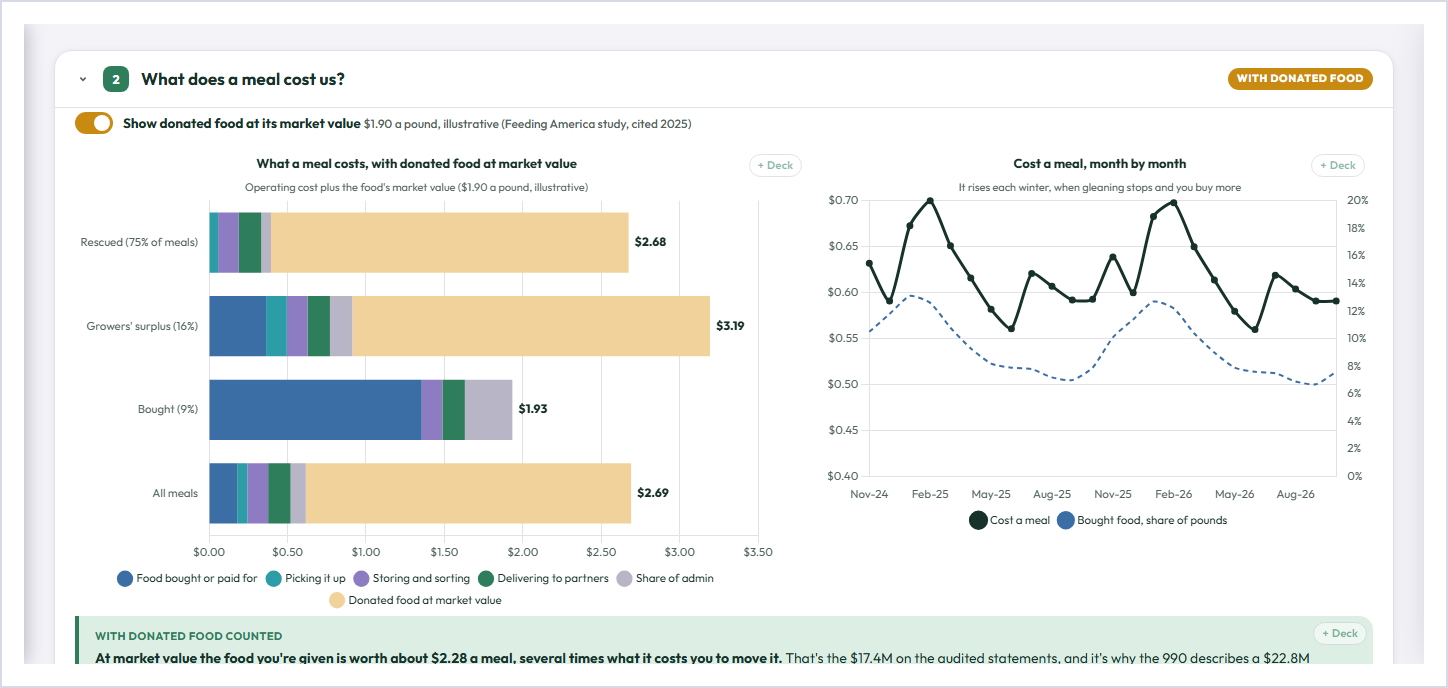
At $1.90 a pound (illustrative), the food Tullmoor is given is worth about $2.28 a meal, several times what it costs to move. That's real value to the community, and it's worth saying to funders. It can't pay a driver. I'd leave the switch off whenever the board is talking about the budget.
Which partners and routes cost most
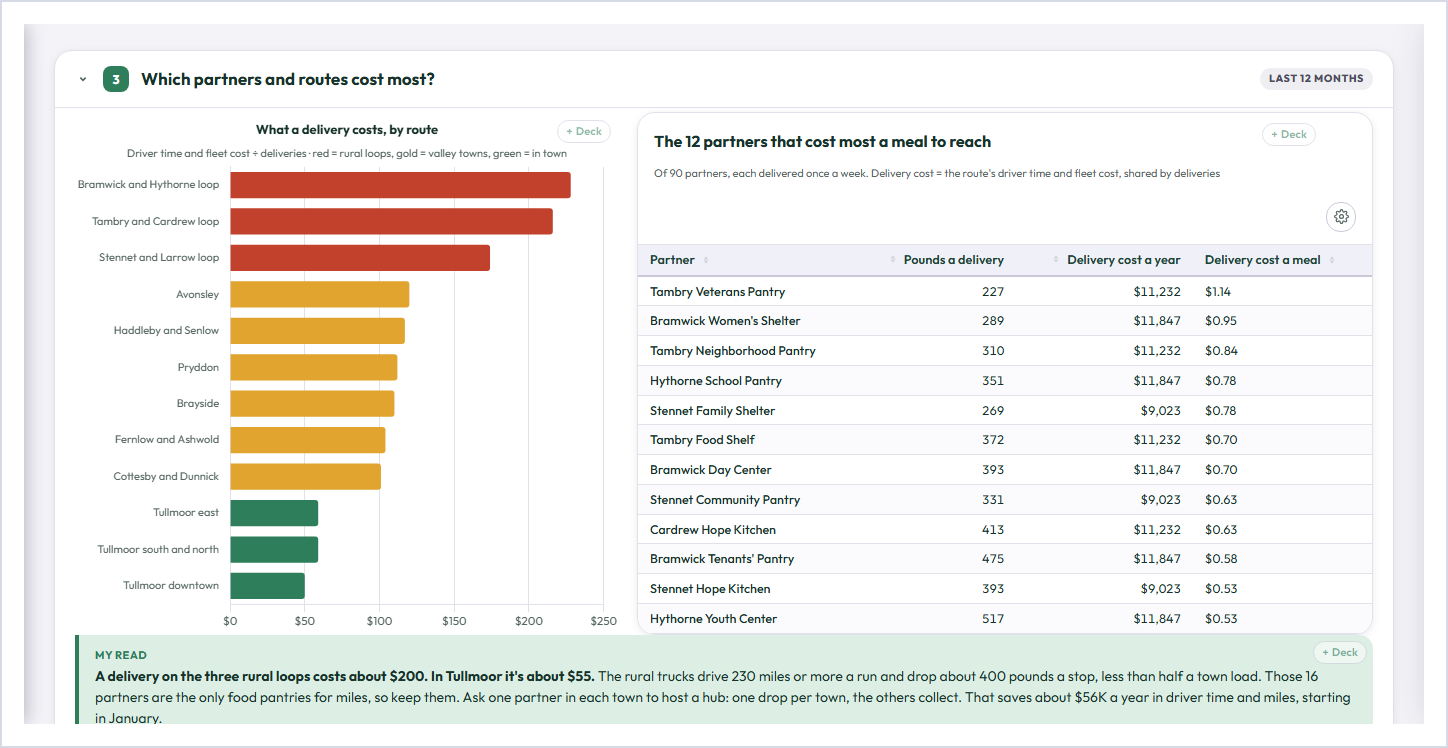
Route costs come from driver hours in Gusto and fleet costs in QuickBooks, spread over deliveries. In town a delivery costs about $55. The three rural loops cost about $200 a stop. Those trucks drive 230 miles or more a run and drop about 400 pounds at each partner, less than half a town load.
Nobody should cut those 16 partners. They're often the only food pantry for miles. But the board can change how they're served. Ask one partner in each town to host a hub, make one drop per town, and let the others collect. That saves about $56K a year in driver time and miles, and it can start in January.
What happens when the capital grant ends
Three years ago the (made-up) Ondrey Foundation gave Tullmoor $2.4M. It built the cold storage ($1.35M), bought two refrigerated trucks ($378K), and has paid $18,600 a month to run them. That stops June 30, 2027.
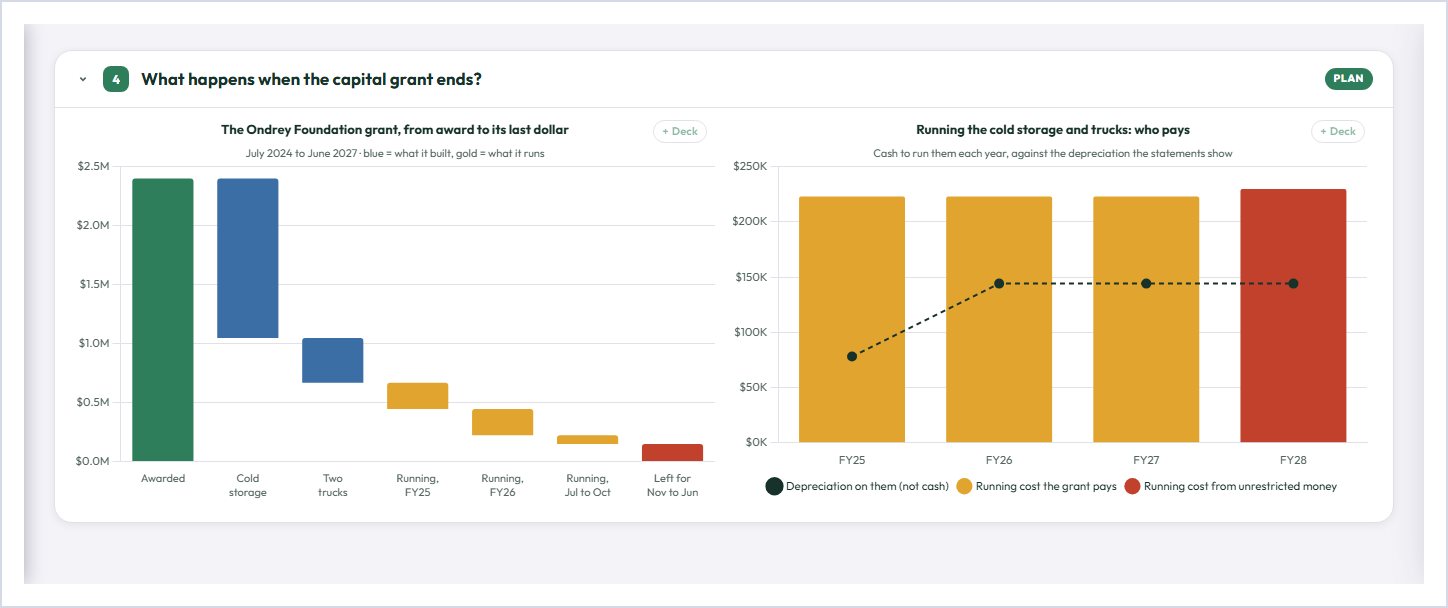
Two things happen in July, and boards mix them up. The statements keep showing about $144K a year of depreciation on the warehouse and trucks. That's not cash. It's their cost spread over their lives. The cash problem is the running cost, about $230K a year, which moves onto unrestricted money, on top of food and fuel rising faster than gifts.
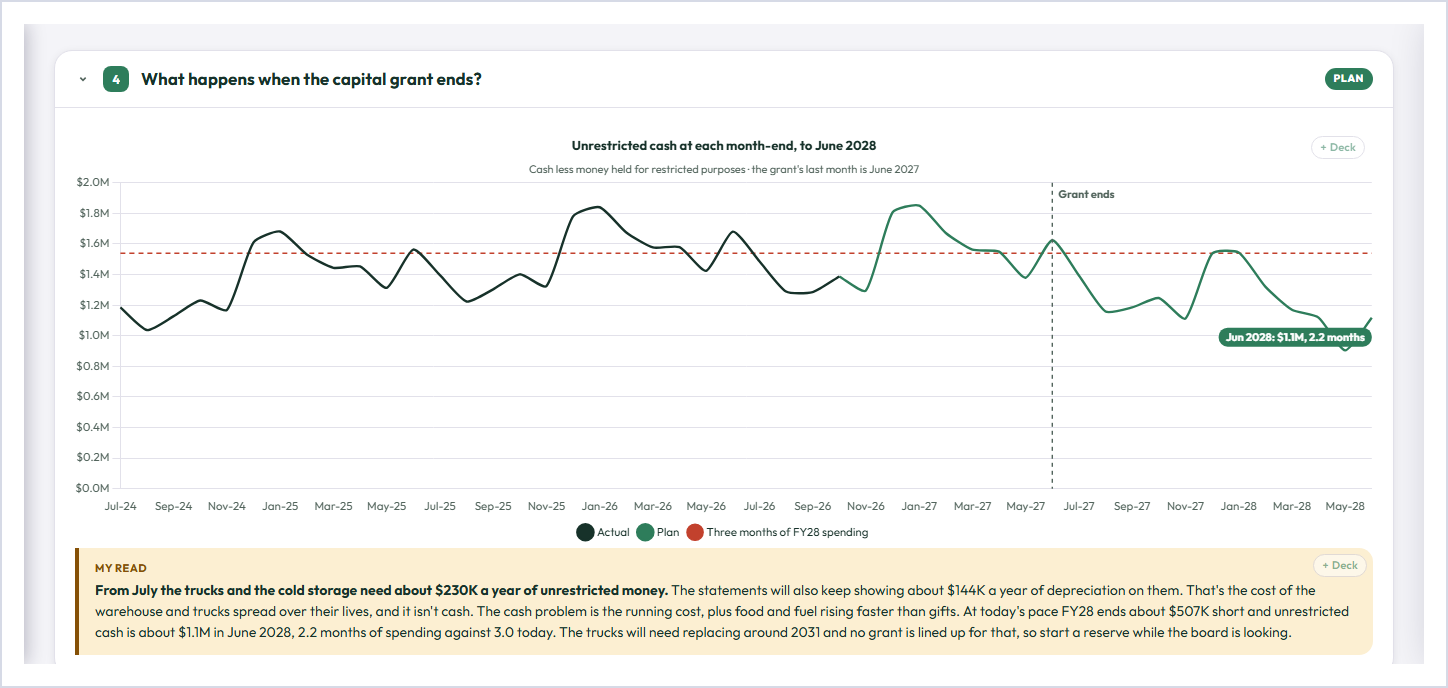
At today's pace, FY28 ends about $507K short and unrestricted cash falls to about $1.1M by June 2028. That's about 2.2 months of spending. For context, 52% of nonprofits held three months or less in the Nonprofit Finance Fund's 2025 survey (illustrative). Tullmoor would be firmly in that group.
The moves
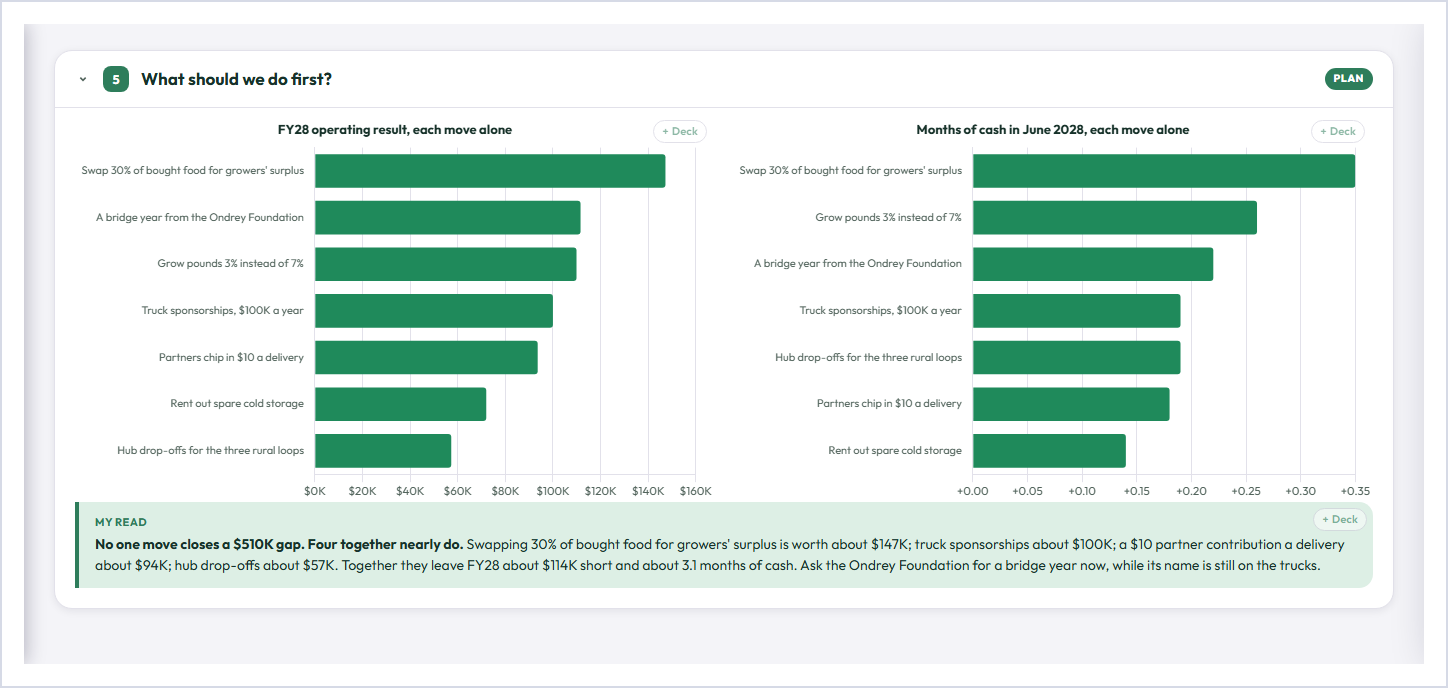
No single move closes a $500K gap. Swapping 30% of bought food for growers' surplus is the biggest, worth about $147K. Truck sponsorships at $100K a year are worth exactly that. Asking partners to chip in $10 a delivery brings about $94K. Hub drop-offs, about $57K. Renting spare cold storage, $72K. Slowing pound growth from 7% to 3% saves about $110K, and that's a decision the board should make on purpose, not by accident.
Pull the first four together on the rail and FY28 lands about $114K short with about 3.1 months of cash in June 2028.
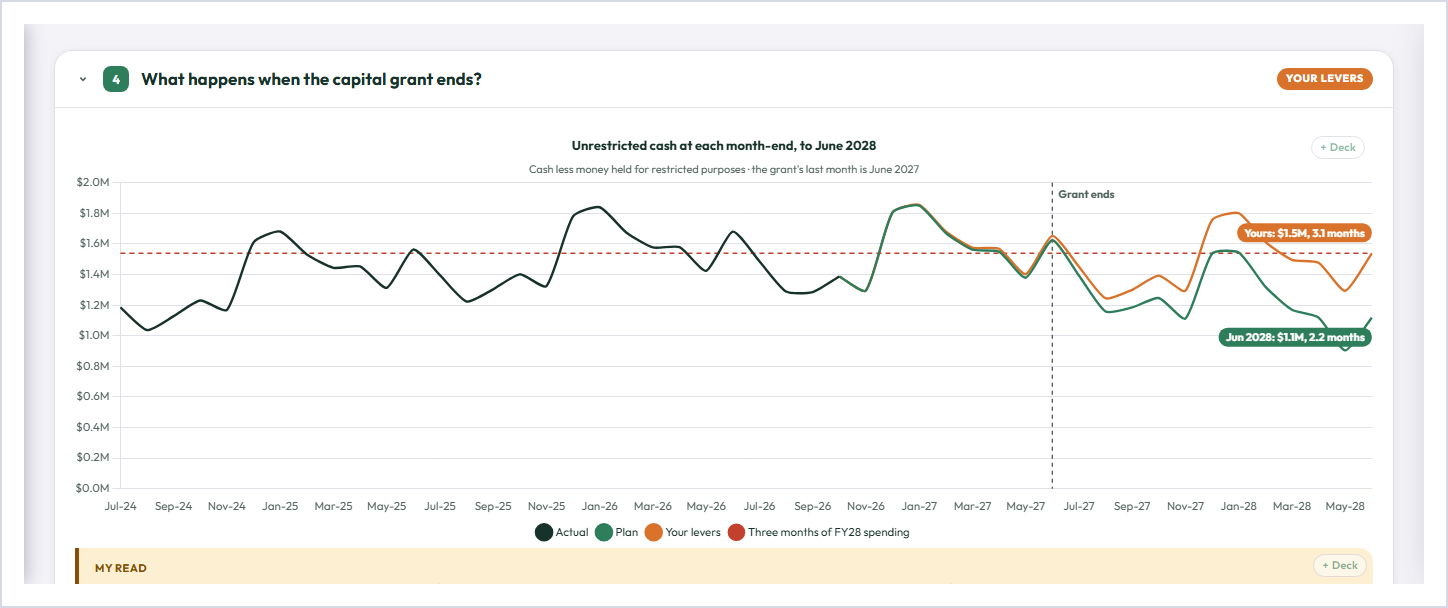
Then ask the Ondrey Foundation for a bridge year, now, while its name is still on the trucks. Half the running cost for one more year is worth $112K, and with the cold storage rent it puts FY28 in surplus.
Why not do this yourself?
You could rebuild this in a spreadsheet once. The hard part is keeping it true every month: classes coded right in QuickBooks, restricted grants tracked as projects, driver hours from Gusto, donor gifts from HubSpot, pounds from the warehouse, and somebody who can tell a timing gap from a real one before the finance committee meets. AI tools can summarize a P&L. They can't tell you that a $60K gift moved to December, or that your rural loops cost nearly four times a town stop.
That's CFOptimize for Nonprofits. We connect your systems read-only, keep the data in a secure warehouse, put programs, grants and restricted money on one page your board can read, and give you a part-time CFO to walk the treasurer and committee through it. Meet with our team.
Mark
Tullmoor Valley Food Recovery is a made-up organization, and the Ondrey Foundation, its partners, towns, routes and every figure in the dashboard and this post are invented. Benchmarks are illustrative and carry their source and year. The sample dashboard doesn't connect to QuickBooks, HubSpot or Gusto. Nothing here is investment, legal or tax advice.
Share