Path-to-profit demo · built on a fictional company with invented numbers
After a Series B the board's question gets simpler and harder at the same time. Nobody asks about runway in months any more. They ask whether the round you raised really gets you to cash-flow positive, which month that happens, and what could push it out.
So here's how I'd walk a CEO through it, using a working sample dashboard for a fictional company called Vesperline. It makes a reusable recorder for home sleep-apnea testing. Practices (sleep physicians, dental sleep groups and cardiology groups) buy the recorders up front for a little over $4,000 each, then pay about $300 a month per recorder for the cloud scoring and reports. Fourteen months past a $45M Series B, 167 people, $31M of revenue over the last twelve months, up 59%. Every number is invented.
Start with the month, the low point and why the date moved
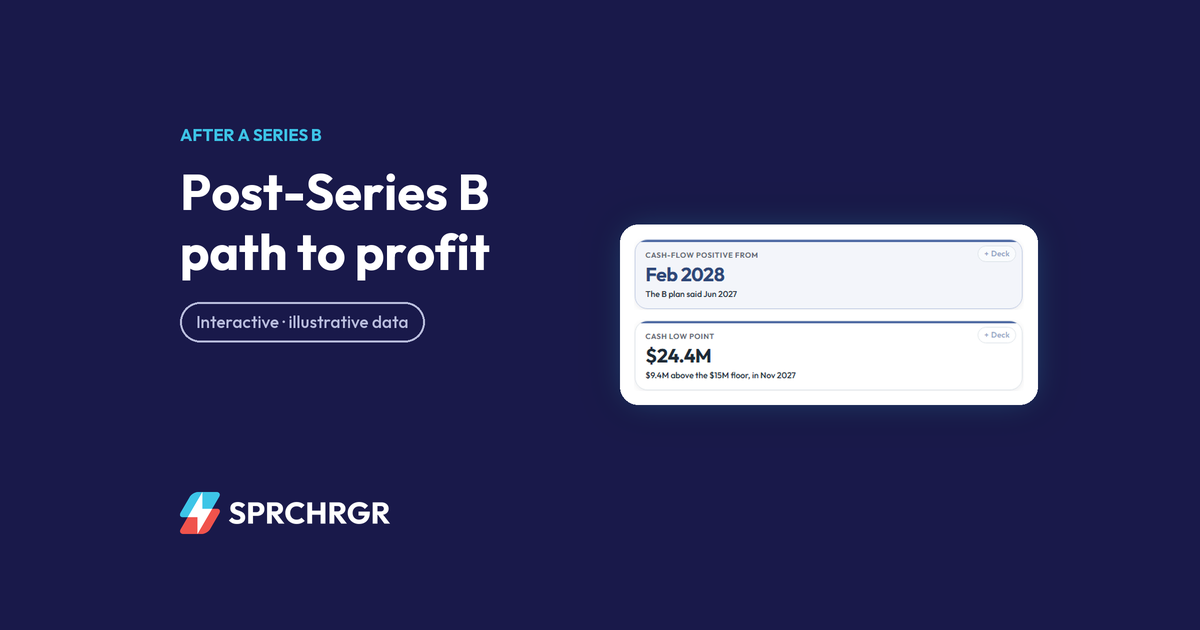
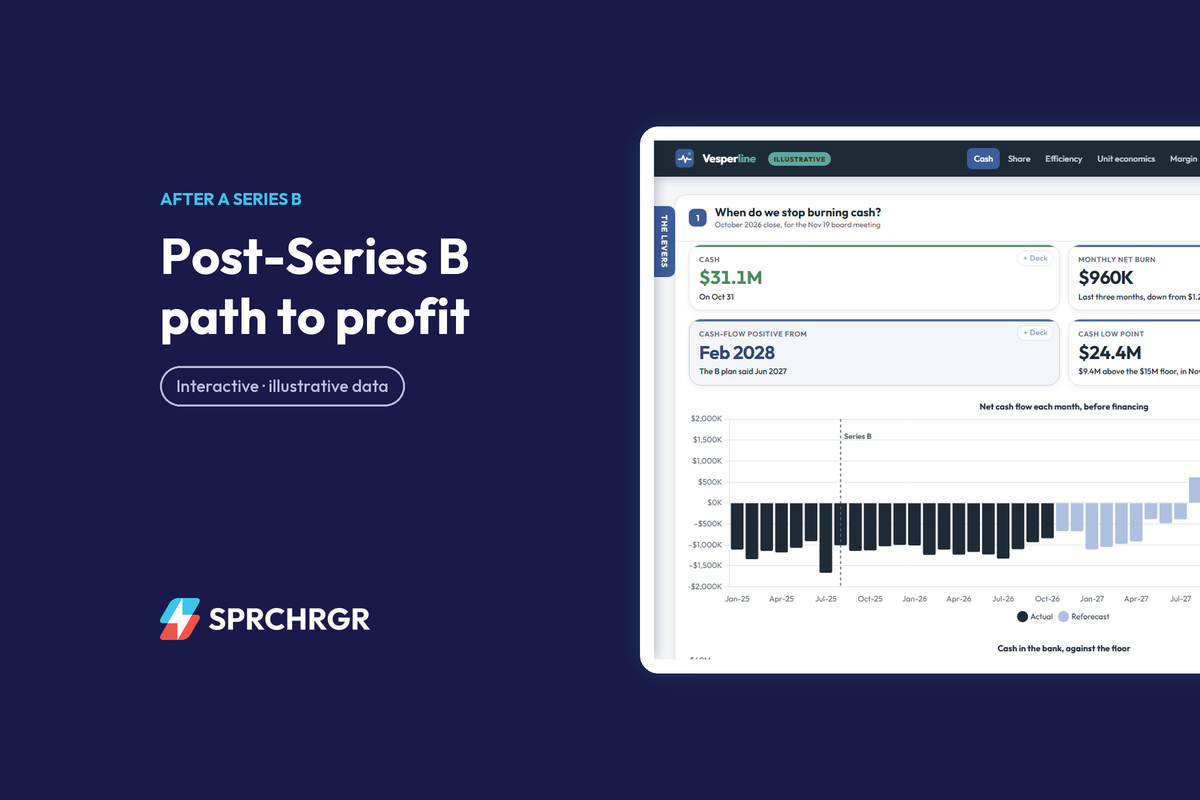
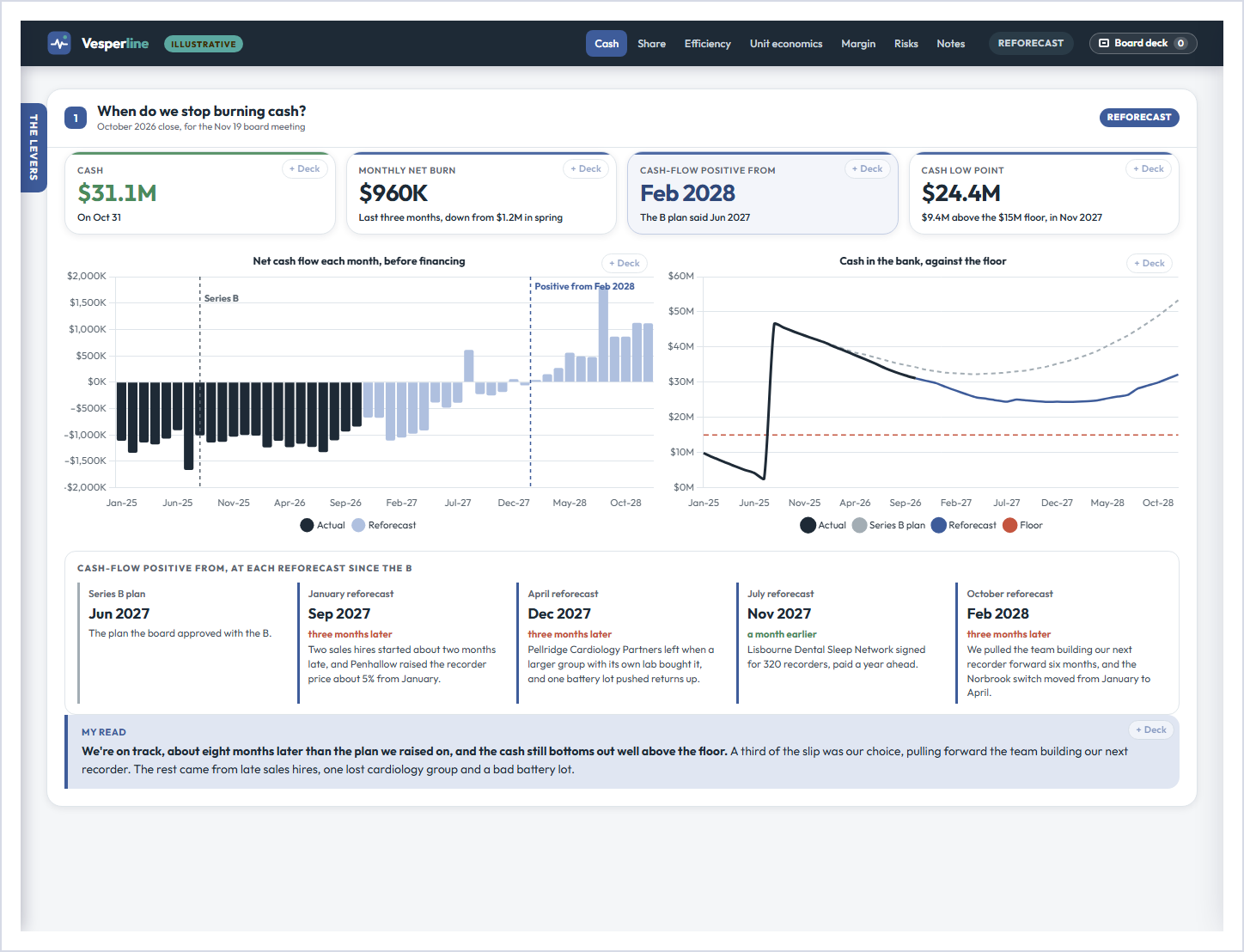
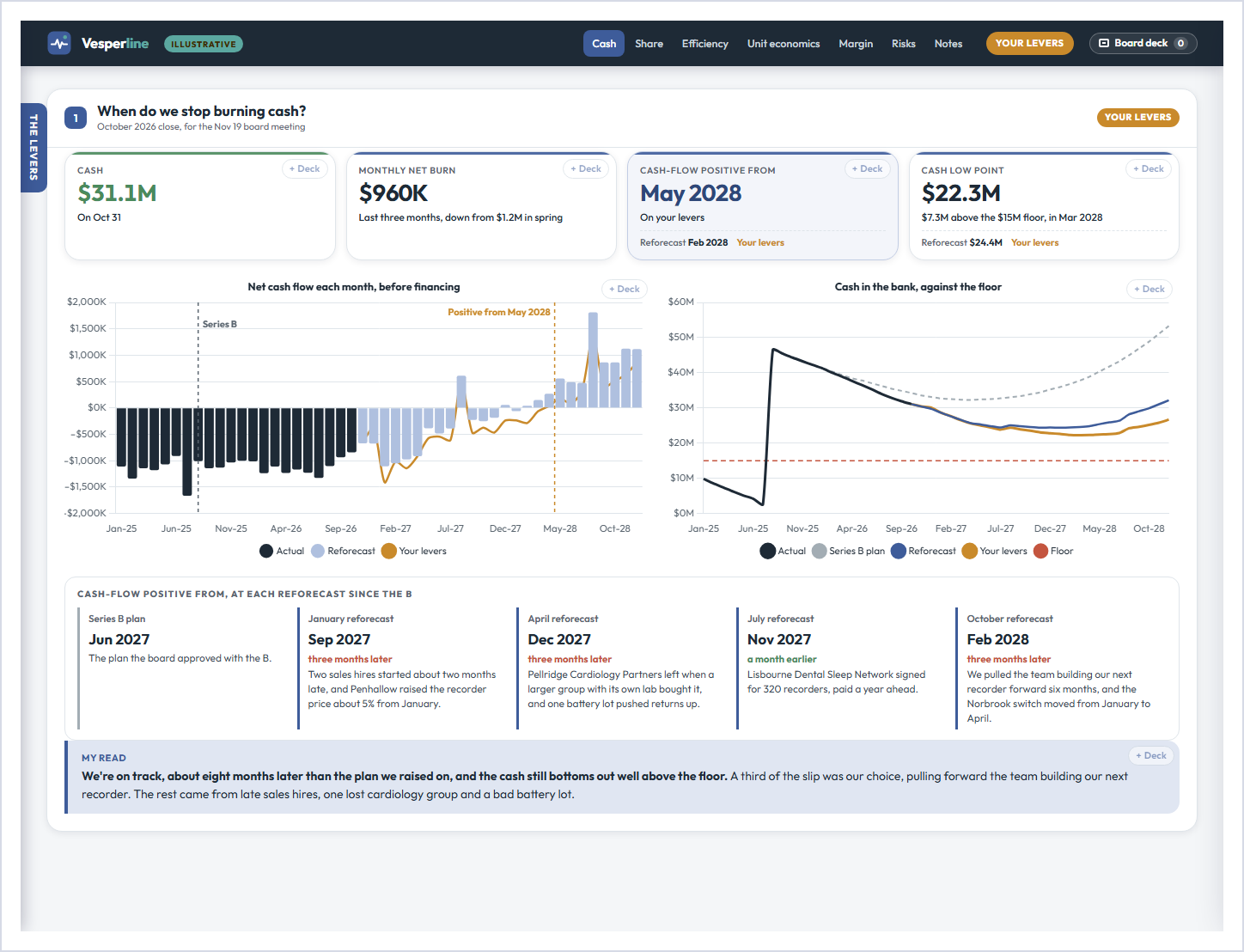
The first screen answers the question in four numbers. $31M in the bank, about $960K a month of net burn (down from about $1.2M in the spring), cash flow positive from February 2028, and a cash low point of about $24M in November 2027, roughly $9M above the $15M floor the board set for itself.
The strip under the charts shows the crossover month at every reforecast since the B: June 2027 in the plan they raised on, then September, December, November and now February 2028. Each step has its reason in one line – two sales hires that started late, a cardiology group bought by a larger group with its own lab, a bad battery lot, the team building the next recorder pulled forward six months, and one big dental network win that pulled it back a month. Eight months of slip sounds bad until the board can see that a third of it was a decision they'd make again.
Show that the growth is share, and getting cheaper
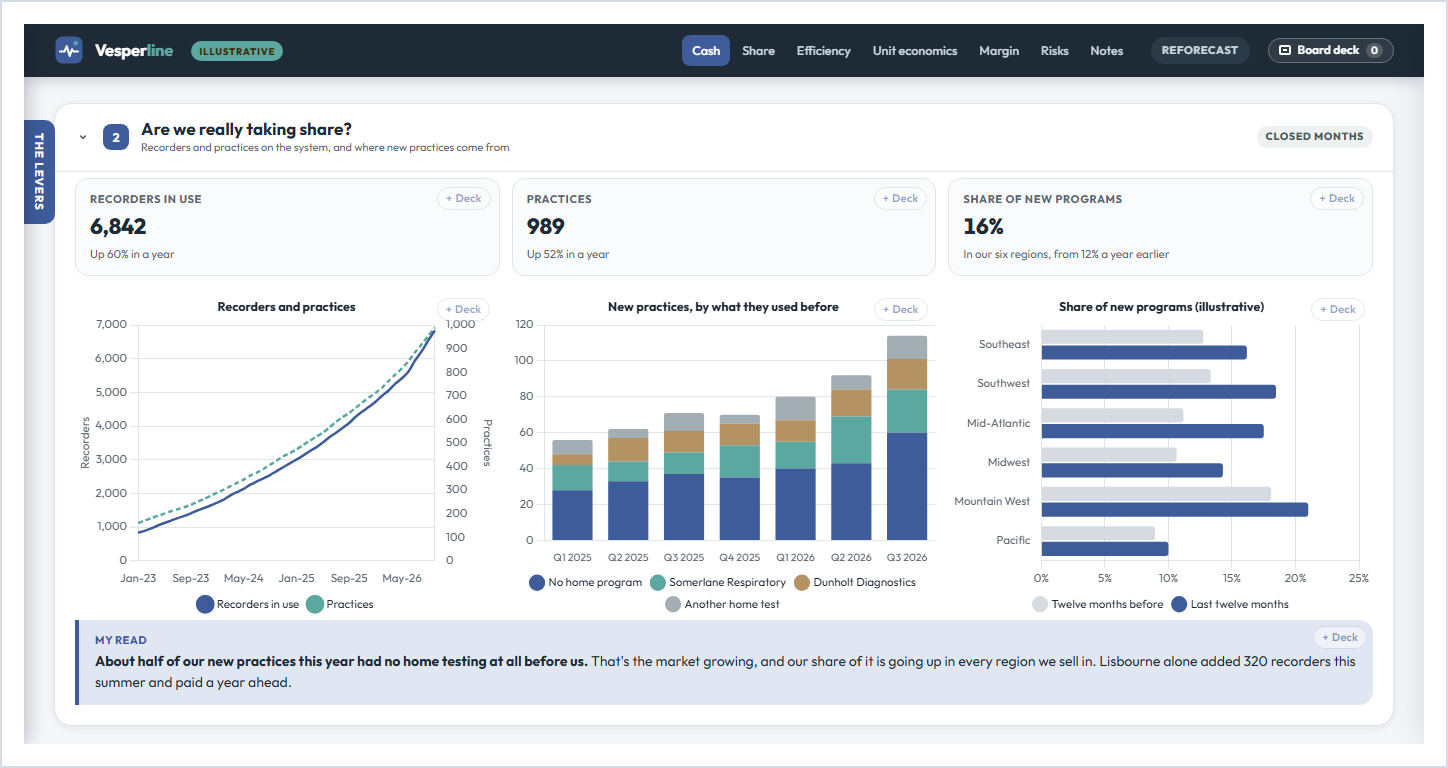
Recorders in use are up about 60% in a year and practices about 52%. The interesting chart is where new practices came from. About half had no home testing at all before Vesperline, so most of the growth is the market opening up rather than a fight over the same customers. Against our own rough estimate of new home-testing programs in each region (illustrative, not a market study), share went from about 12% to 16%, and it rose in all six regions.
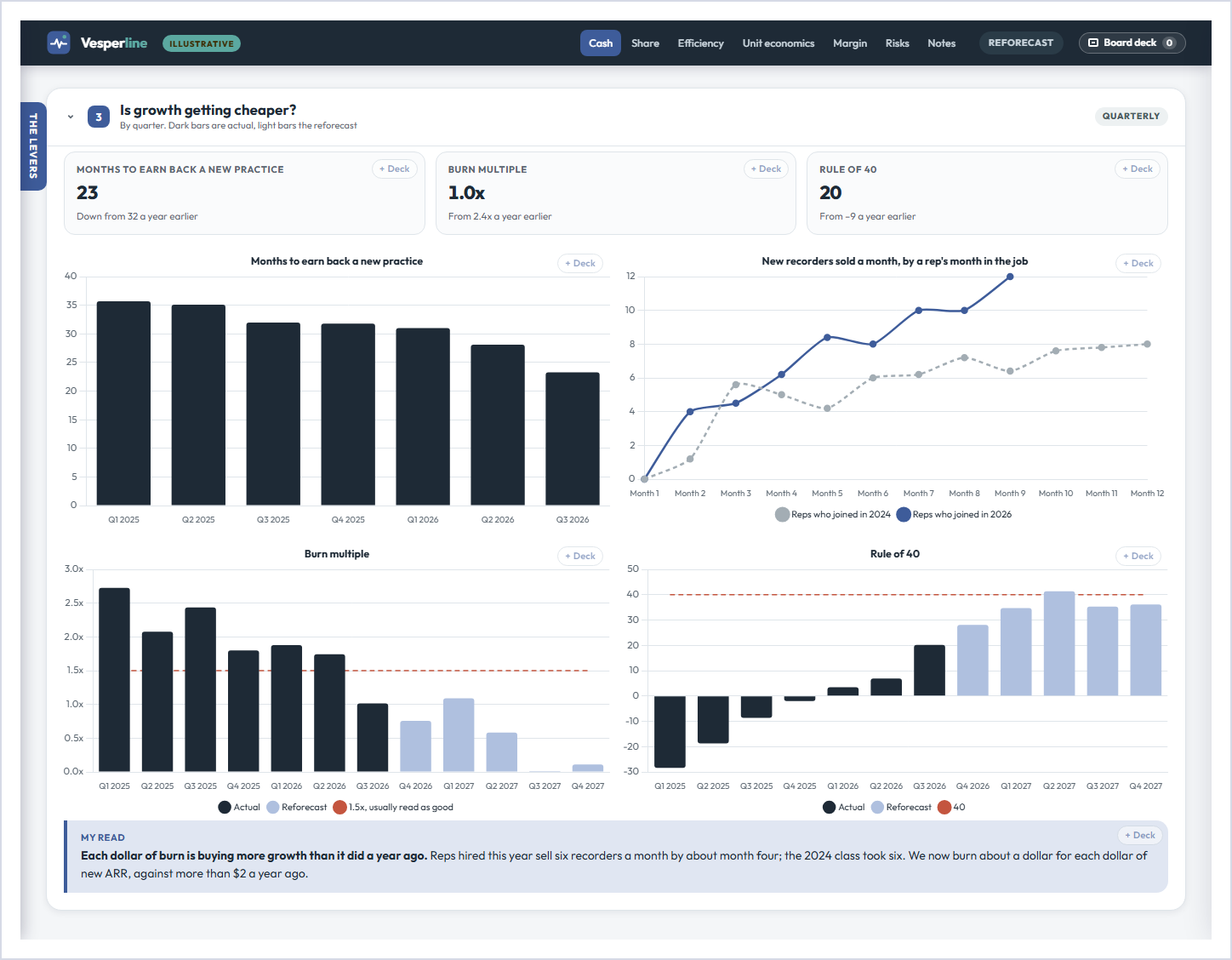
By quarter, months to earn back what it cost to win a new practice fell from about 32 to 23 (the last quarter is flattered by one large network, and the page says so). The burn multiple, net burn divided by new ARR, went from about 2.4x to 1.0x. Rule of 40, revenue growth plus EBITDA margin, went from –9 to 20. Reps hired this year reach six recorders a month by about their fourth month; the 2024 class took six.
Prove each unit pays for itself
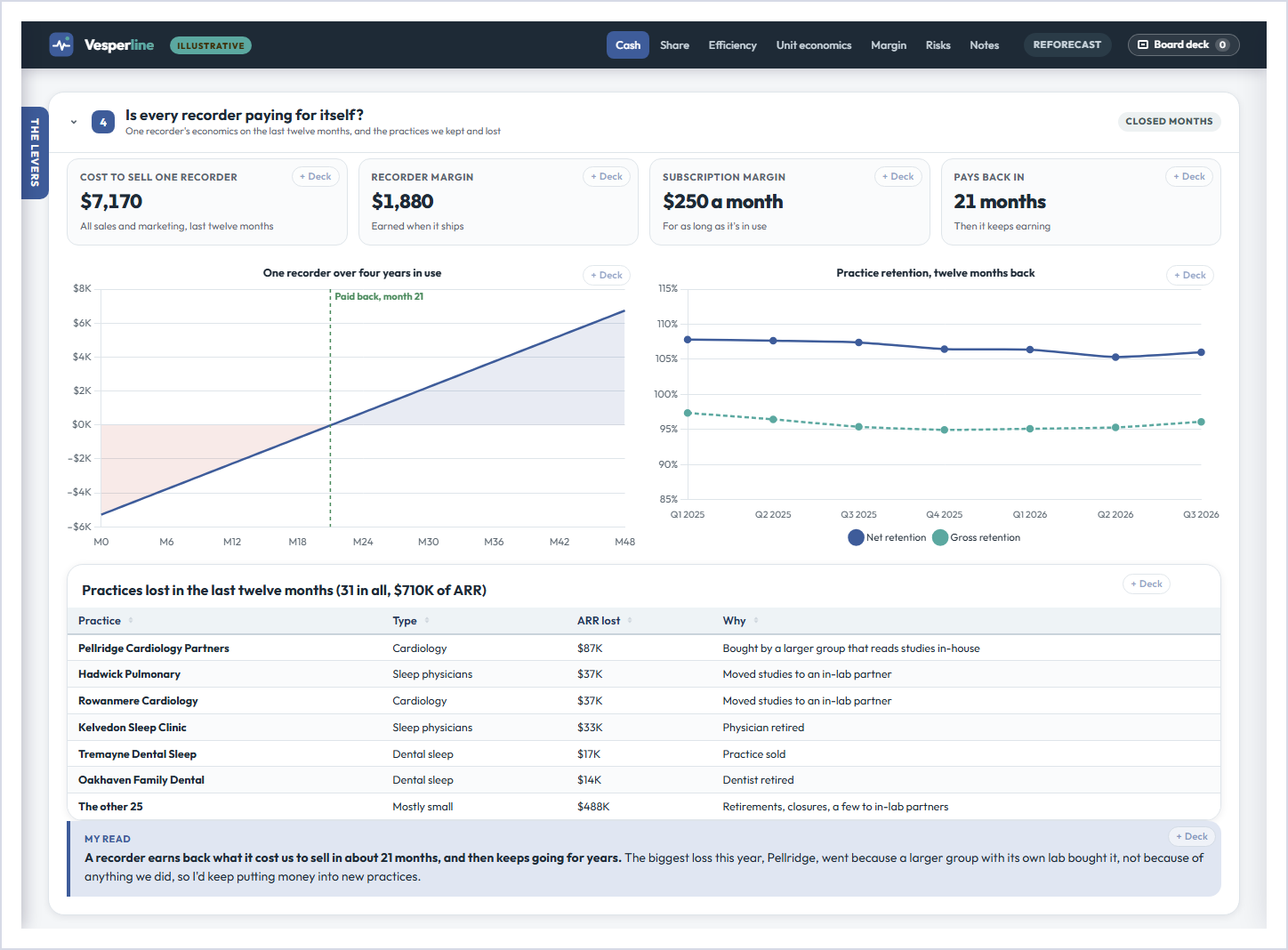
This is where device companies get pushed hardest. On the last twelve months it costs about $7,200 of sales and marketing to place a recorder with a new practice. The recorder itself earns about $1,900 of margin when it ships, and the subscription earns about $250 a month after cloud, support and scoring. So a recorder pays back in about 21 months and then keeps earning for years.
Retention sits beside it: about 105% net and 96% gross for practices, and a short table of the practices lost in the last year with the reason for each. The largest, Pellridge Cardiology Partners, went when a larger group with its own lab bought it. That's a different conversation from losing one to a competitor.
Show how the margin gets from here to there
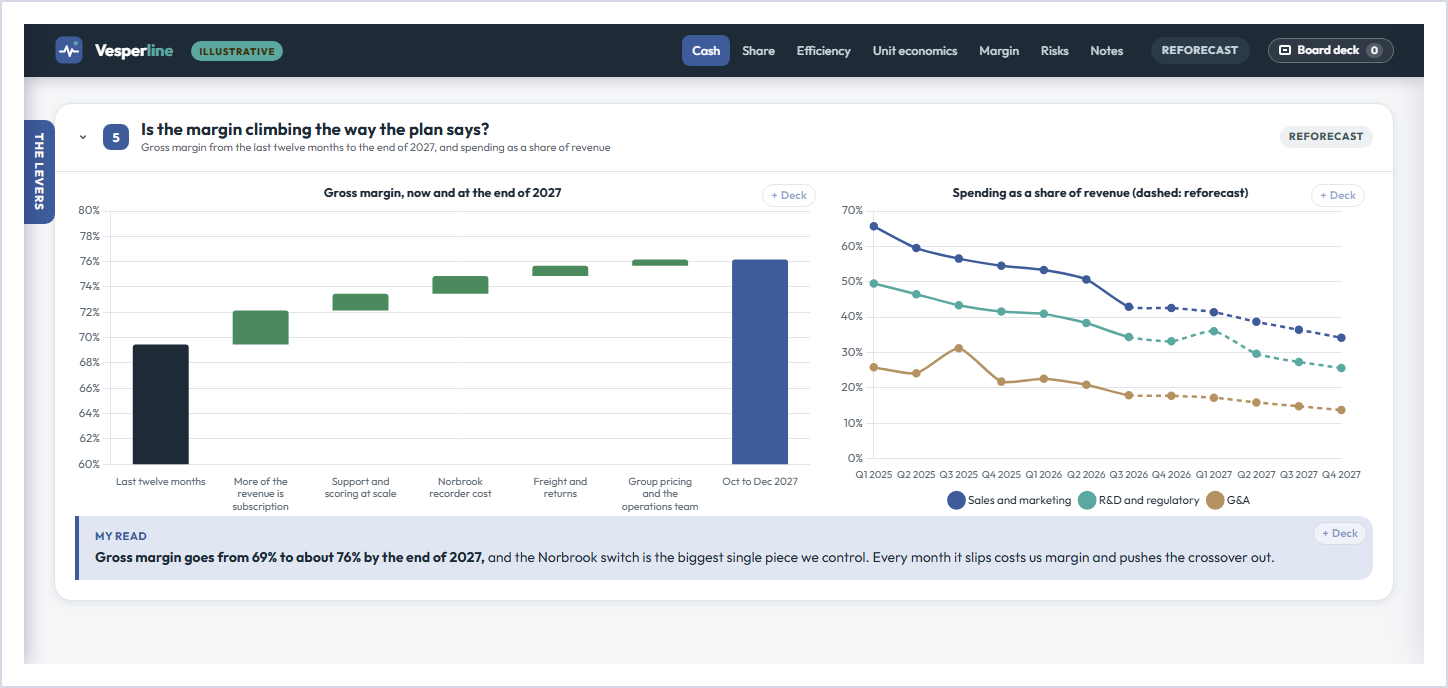
Gross margin is 69% on the last twelve months, with recorders at about 44% and the subscription at about 85%. The bridge takes it to about 76% by the end of 2027 in five steps: more of the revenue is subscription, the support and scoring teams cover more recorders each, a new contract manufacturer's quote takes about $305 off each recorder from April, freight and returns come down, and group pricing gives a little back. For context, device makers often run 55–75% gross margin and software well above 80% (illustrative, consensus figures from secondary sources, 2025).
End on what could knock you off
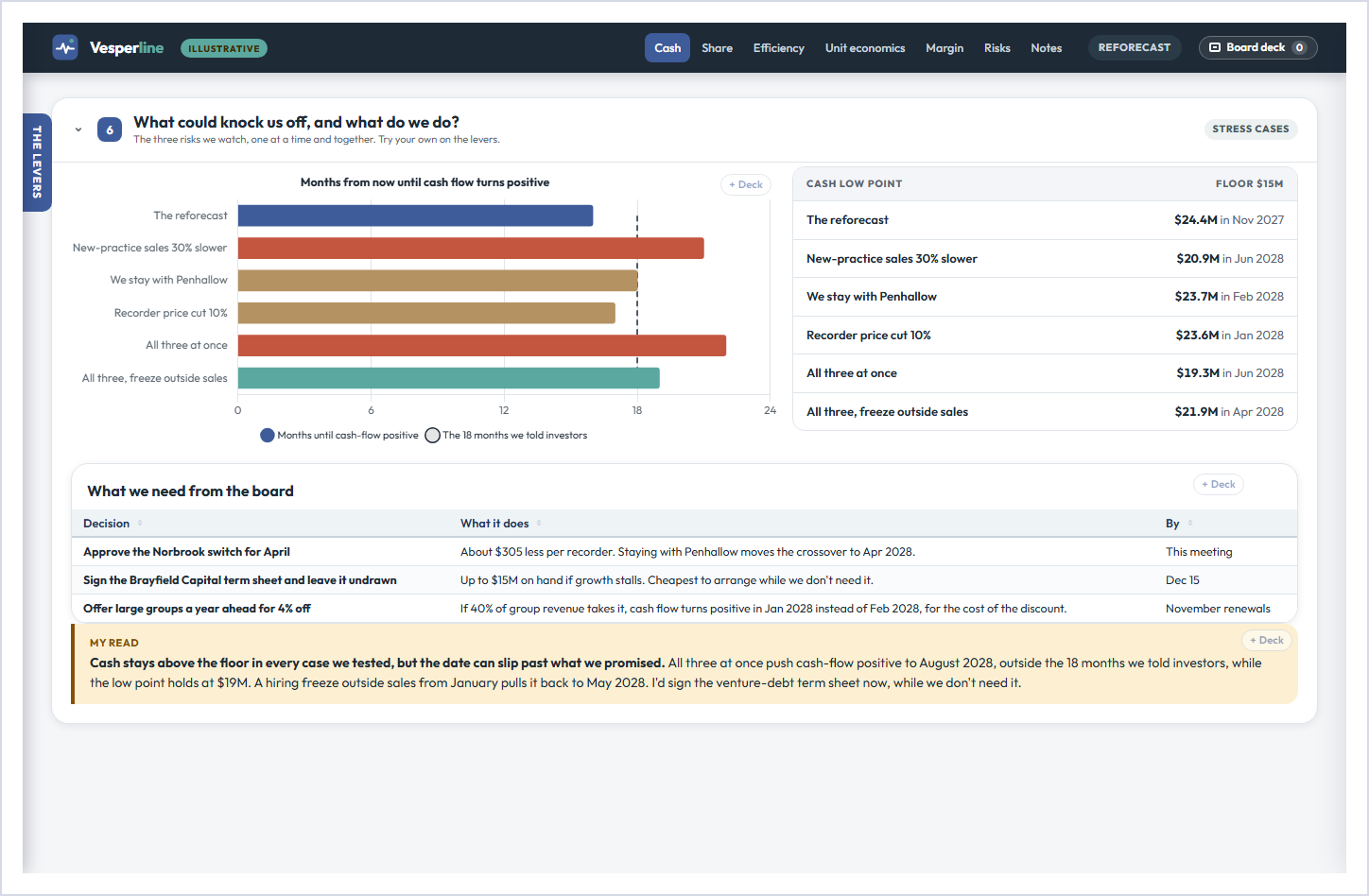
The last section takes the three risks the CEO actually worries about – new-practice sales coming in 30% slower, staying with the current manufacturer, and a 10% recorder price cut to match a competitor – and runs them one at a time and together. Cash stays above the floor in every case; even all three at once leave about $19M at the low point. All three together do push cash-flow positive to August 2028, outside the 18 months the CEO told investors. A hiring freeze outside sales from January pulls it back to May.
The rail lets anyone in the room try their own version. Then three decisions for the board, each with a date: approve the manufacturer switch, sign a venture-debt term sheet and leave it undrawn while the company doesn't need it, and offer large groups a discount to pay a year ahead.
What it takes to get this on your own numbers
We connect read-only to your bank, accounting system, payroll, billing, CRM and supplier records, close the books every month, and run one model forward from that close, so the crossover month, the low point and the reasons the date moved come out of the same numbers your auditors will see.
That's CFOptimize for Startups, a fractional CFO sized for seed through Series B. It starts with a free path-to-profit review on your own numbers, plus a look at R&D tax credits. If you want to know the month you stop needing investors, book your free path-to-profit review. Backed by one of our VC partners? Ask about partner perks.
Mark
Vesperline is a fictional company, and every practice, supplier, lender, person and figure in the dashboard and in this post is invented for illustration. The safety floor, regional share, venture-debt terms, price response and benchmark ranges are illustrative, not market quotes, and nothing here is investment, legal, tax or medical advice.
Share