
Share


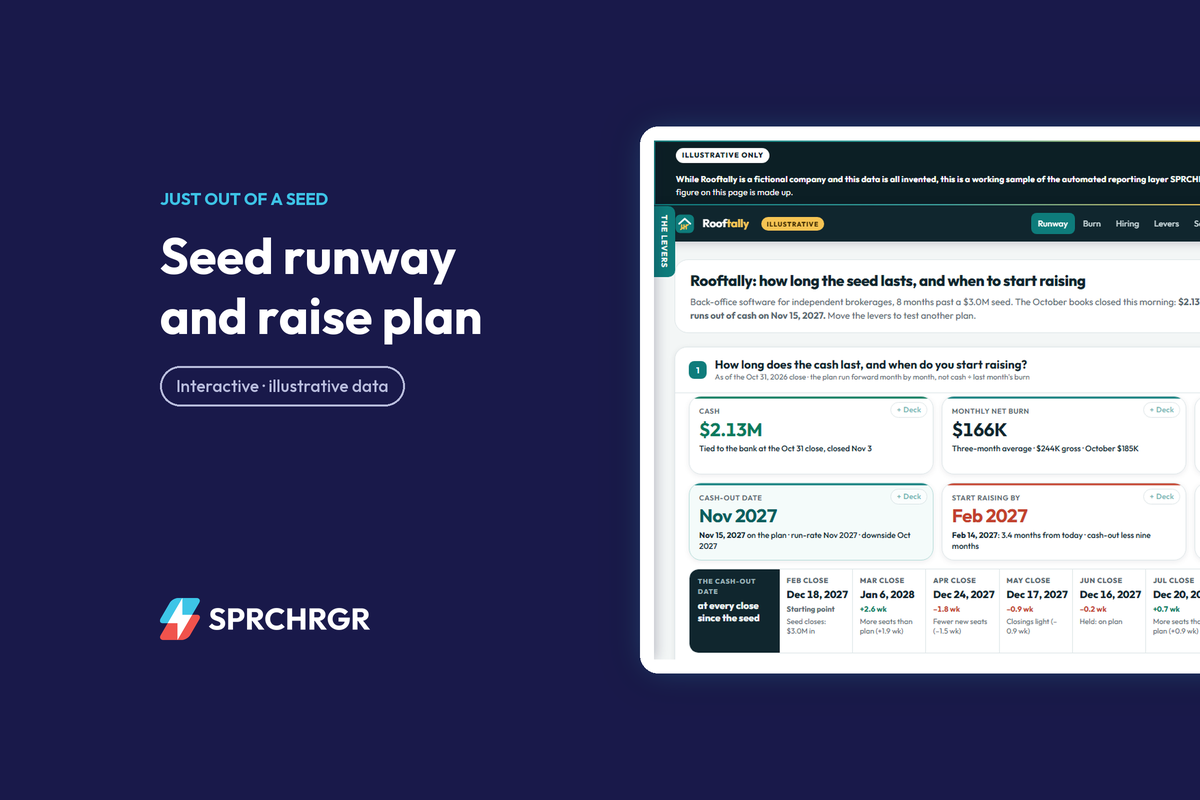
"What's your runway?" is the first finance question an investor asks a seed founder, and in my experience it's the one most founders answer least cleanly. They divide cash by last month's burn, round to a number of months that sounds safe, and move on – and the number they give depends a lot on which month they happened to pick.
So here's how I'd walk a founder through it, using a working sample dashboard we built for a fictional company called Rooftally. Every figure is invented, but the shape is one I see often: back-office software for independent real-estate brokerages, priced at $36 per agent seat a month plus a $35 fee on every closing that runs through it, fifteen people, 37 brokerages and 1,469 agent seats, eight months past a $3.0M seed. Every section on the page is labelled with the question an investor or board member will actually ask, and the first screen answers the runway question without scrolling.
Start with cash you can prove
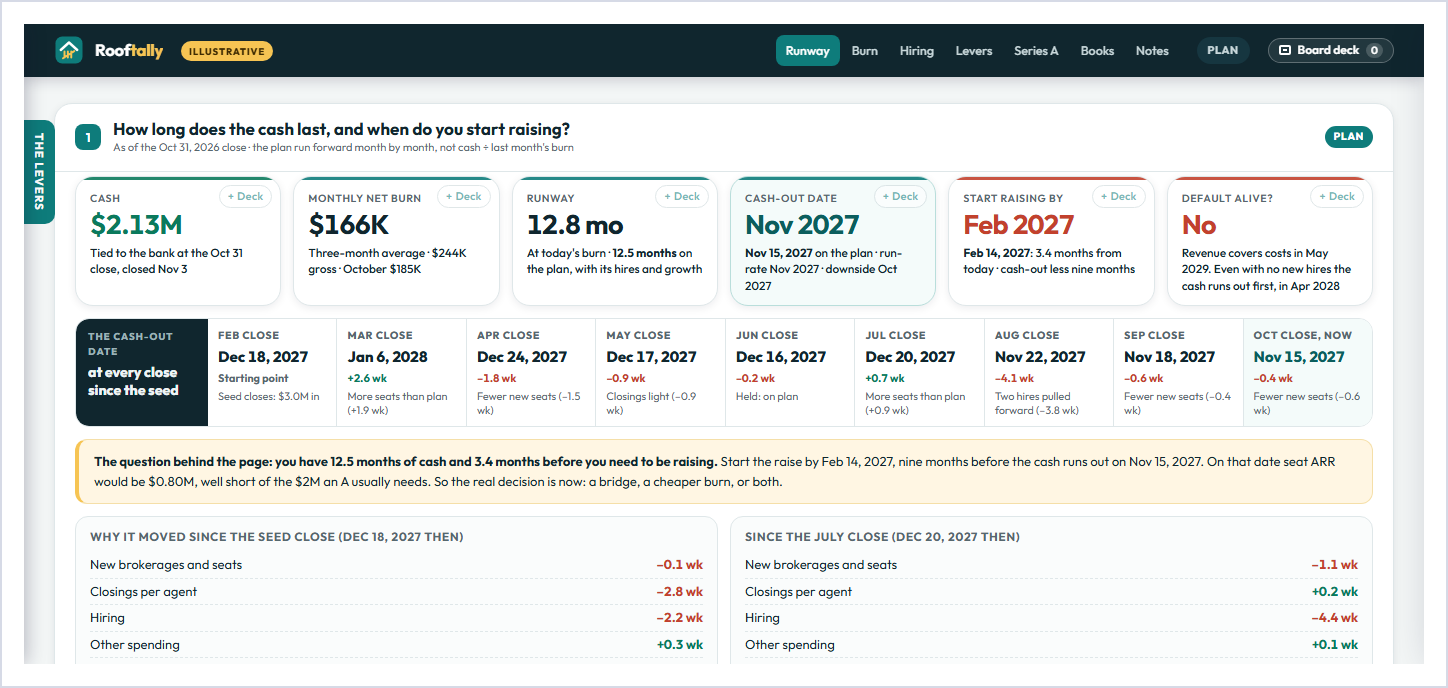
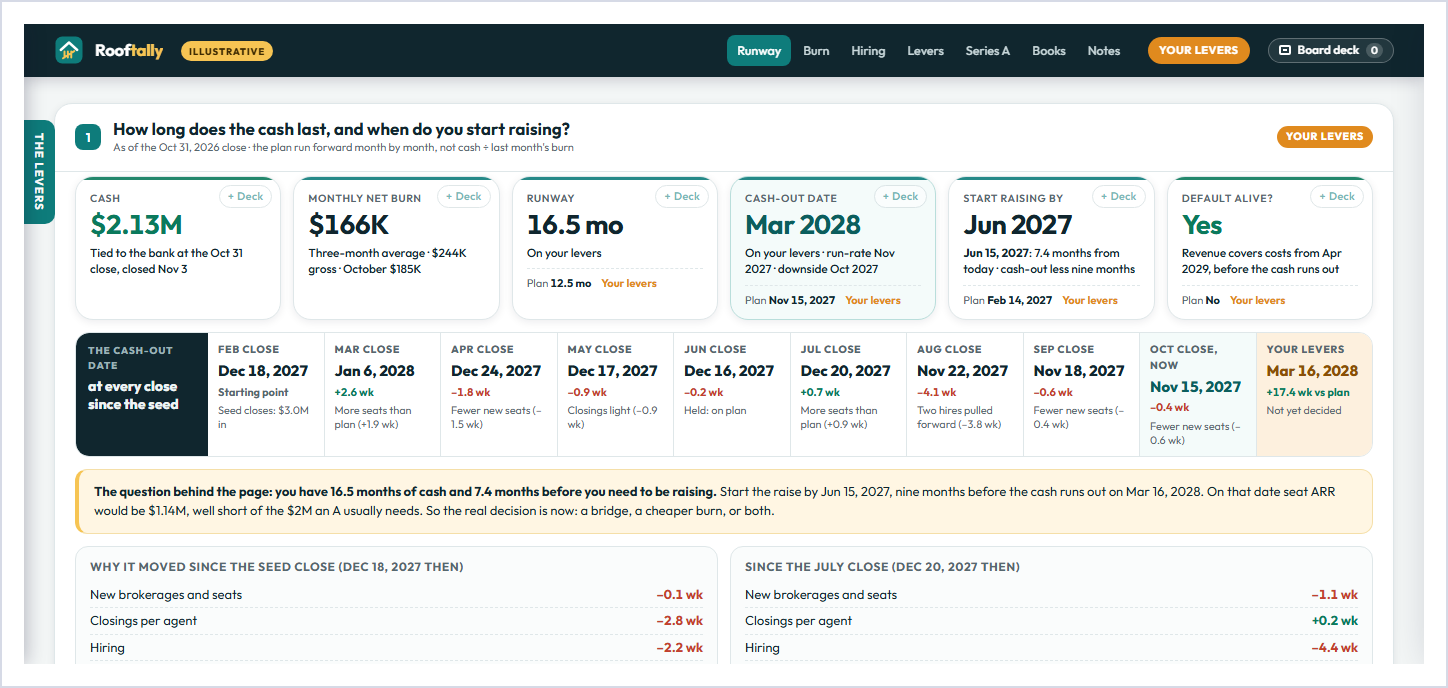
The first card is cash: $2.13M at the October close, tied to the two bank statements to the cent. A runway date built on unreconciled cash is a guess, and it's the first thing a Series A investor checks. Rooftally's October books closed on November 3, the second business day of the month.
Net burn is $166K a month on a three-month average ($244K gross before revenue comes in). That's 12.8 months at today's burn.
Run the plan forward instead of dividing
The number I'd actually hand an investor comes from the plan run forward month by month: new brokerages at the pace the sales team is hitting, closings on the seasonal curve, closing fees collected a month after they're billed, payroll with January raises, the annual insurance bill every March, and the five hires still in the plan. On that model Rooftally runs out of cash on November 15, 2027. Today's run-rate lands in the same month, and a downside with lighter closings and fewer new brokerages pulls it to October 7.
Next to the cash-out date sits the one founders tend to skip: start raising by February 14, 2027. An A takes about six months to close, and you never want to walk into one with less than nine months of cash, so the raise-by date is the cash-out date less nine months. For Rooftally that's three and a half months away, which changes the conversation quite a bit more than "about a year of runway" does.
The last card is Paul Graham's default-alive test. On today's team and spending, does revenue catch costs before the cash runs out? Rooftally's answer is no – revenue covers costs in May 2029, and even with no new hires the cash runs out first.
Ask why the date moved
This is the part of the page I'd spend the most time on. The strip under the cards shows the cash-out date at every close since the seed, and each month says why it moved.
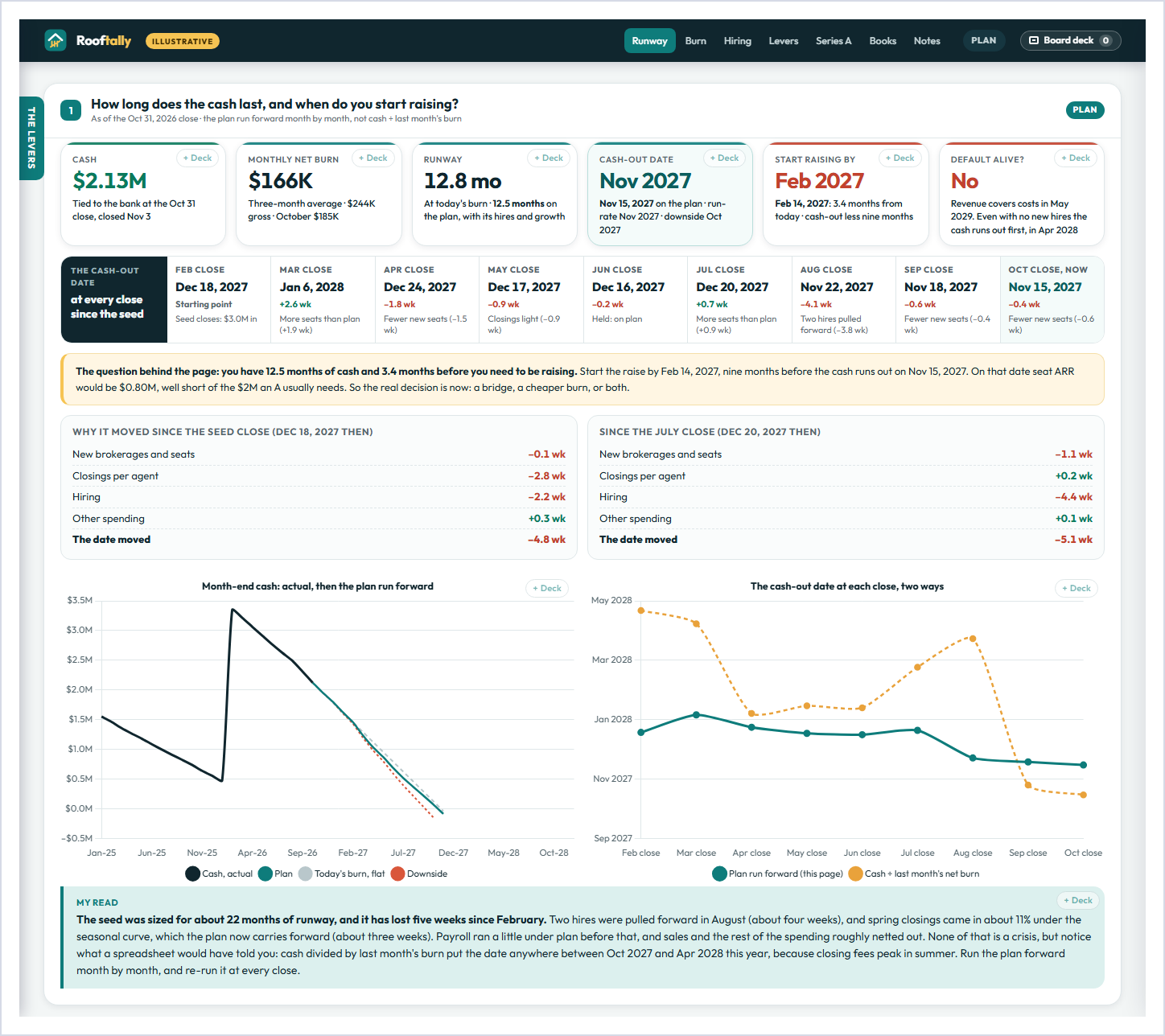
At the February close, with the seed in the bank, the plan ran to December 18, 2027 – about 22 months. Today it's November 15, so the company has lost about five weeks of runway since February. Two things did it. In August, two hires that the seed plan had starting in early 2027 (a senior payments engineer and a head of customer success) were pulled forward to September and October, which took almost four weeks off on its own. And spring closings came in light: from April on, agents closed about 11% fewer deals than the seasonal curve, and because the model re-bases on the last six months, that carries forward into every month after it, worth about three more weeks. New brokerages and the rest of the spending roughly netted out.
None of that is a crisis, and both hires may well have been right for the product – but nobody re-priced them against the raise, and cash ÷ last month's burn would never have shown it. The chart on the right shows why: that shortcut put the date anywhere between October 2027 and April 2028 over the year, because per-closing fees peak in summer. Annualise June and you'd think you had 14.2 months, against 12.8.
See where the money goes
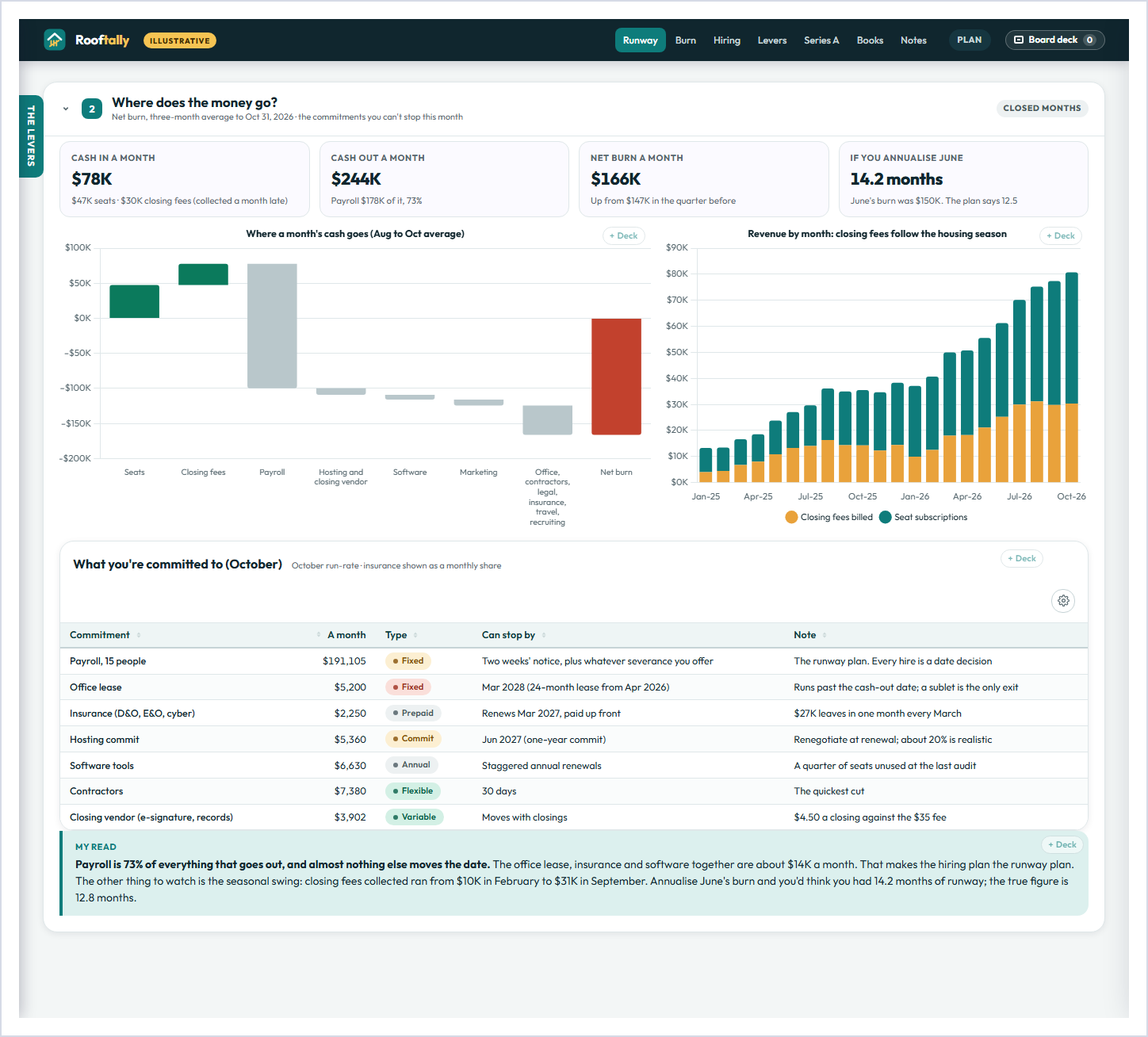
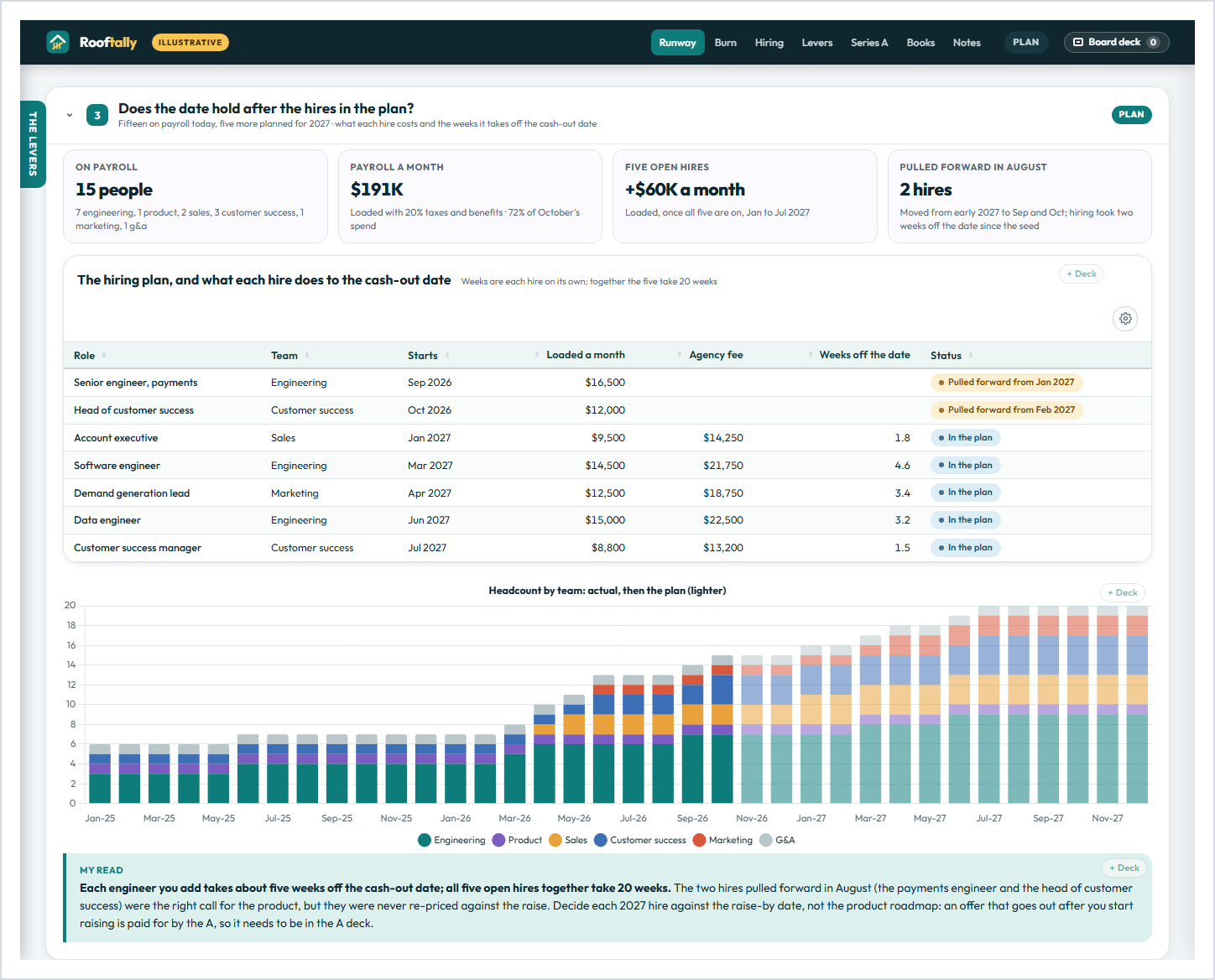
Payroll is 73% of everything that leaves the account. The office lease, insurance and software together come to about $14K a month, so almost nothing except headcount moves the date. The commitments table shows what can be stopped and how fast, down to an office lease that runs past the cash-out date.
That makes the hiring plan the runway plan. Each of the five open hires shows the weeks it takes off the date: the 2027 software engineer alone costs about four and a half weeks, and all five together cost about twenty.
Know which levers still work, and until when
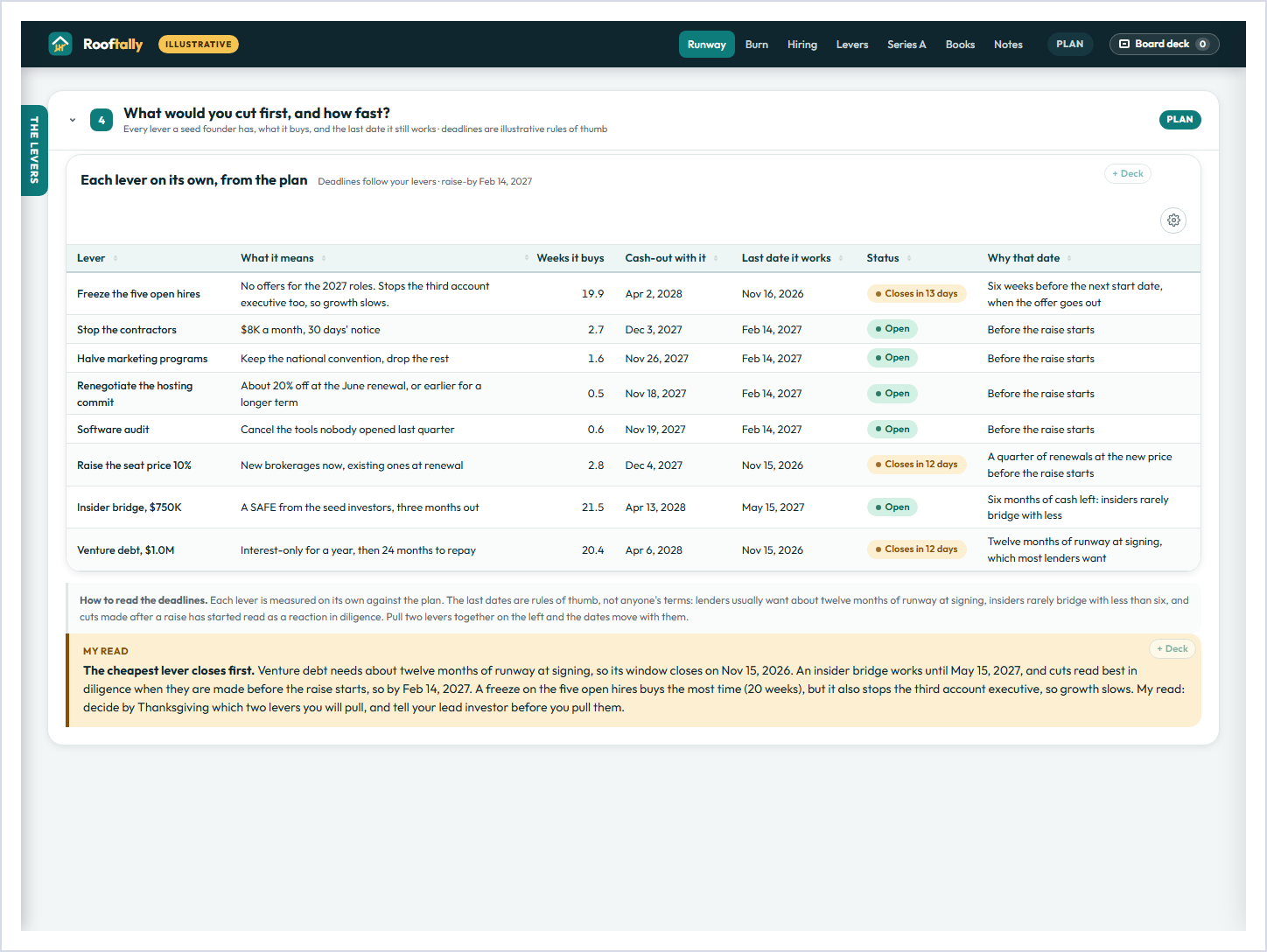
Section four lists every lever a seed founder has – a hiring freeze, named cuts, a price rise at renewal, an insider bridge, venture debt – with the weeks each one buys and the last date it still works. The deadlines are rules of thumb, and the page says so, but they're the ones I'd hold a founder to. Lenders usually want about twelve months of runway at signing, so Rooftally's venture debt window closes on November 15, 2026, twelve days from today. The freeze has to happen before the January offer goes out. An insider bridge works until about six months of cash are left, and cuts read better in diligence when they're made before the raise starts rather than during it.
The levers on the left rail let a founder test combinations. Drop the demand-generation lead and the data engineer from the plan, stop the contractors and raise the seat price 10% at renewal, and the cash-out date moves to March 16, 2028, the raise-by date to June 2027, and Rooftally passes the default-alive test.
Measure the distance to a Series A
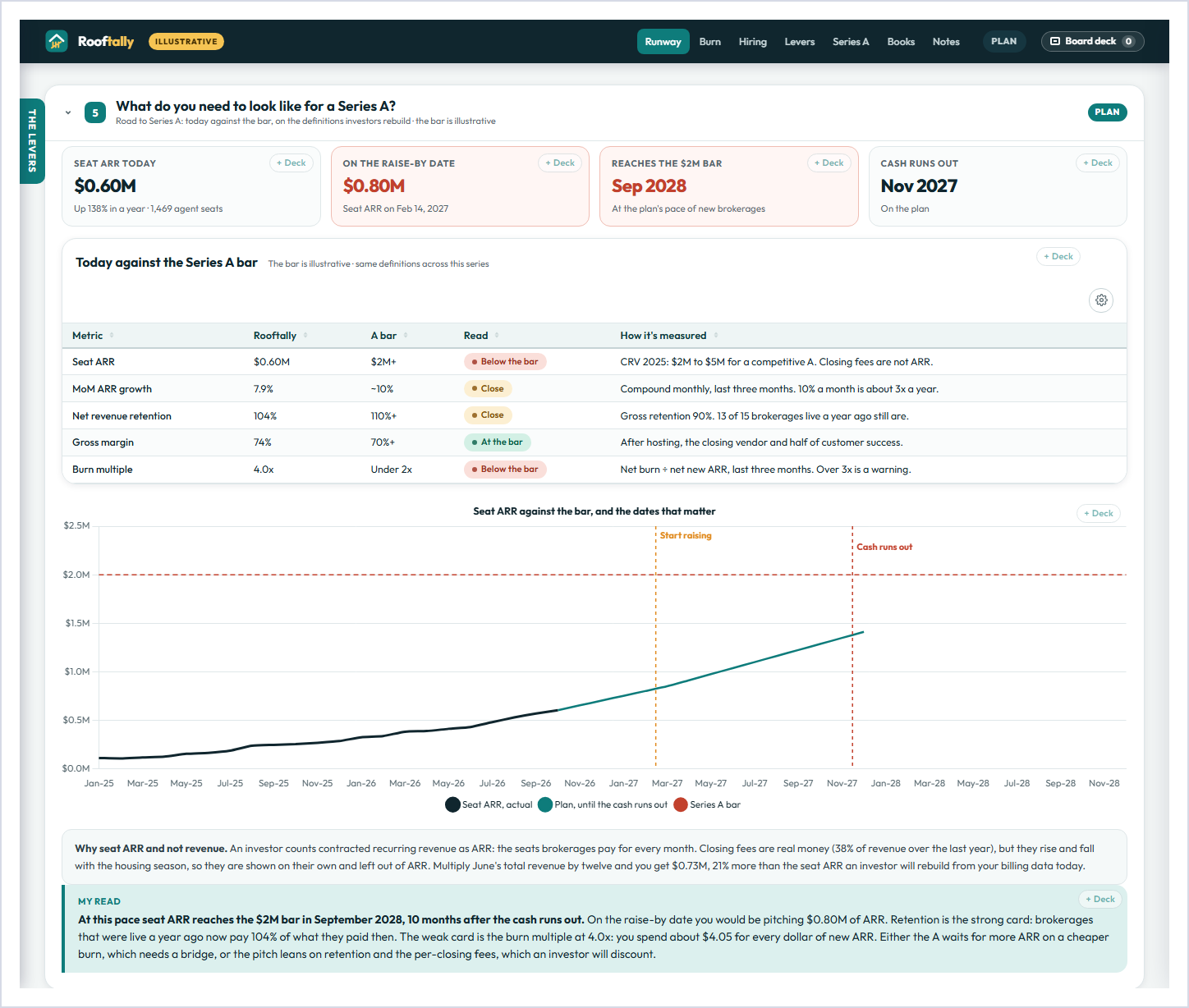
The last section puts Rooftally's numbers next to the bar for an A, on the definitions an investor will rebuild from your billing data. Seat ARR is $0.60M, growing 7.9% a month. Brokerages that were live a year ago now pay 104% of what they paid then, gross margin is 74%, and the burn multiple is 4.0x, meaning about $4 of burn for every dollar of new ARR. Closing fees are left out of ARR on purpose, since they move with the housing season; multiplying June's revenue by twelve would overstate ARR by about a fifth.
The chart ends on the sentence I'd want every seed founder to be able to say out loud: at this pace, seat ARR reaches $2M in September 2028, ten months after the cash runs out, and on the raise-by date it would be about $0.80M. So the decision in front of Rooftally is whether to buy time with a bridge, slow the burn, or both, and the time to decide is now, while the cheaper levers are still open.
Build the board deck
Every card, chart and table has a + Deck button, and "Use the runway pack" loads the set I'd bring to a board meeting as an editable PowerPoint, with the levers you had set recorded in the speaker notes.
What it takes to get this on your own numbers
We connect read-only to your bank, your accounting system, payroll and billing, close your books every month and tie cash to the bank, then run your plan forward from them so the cash-out date, the raise-by date and the Series A scorecard update themselves after every close. You get the answer to "what's your runway" before your investors ask for it, along with the reason it moved.
That's CFOptimize for Startups, on a fractional model sized for seed through Series B, and it starts with a free runway check on your own numbers: cash tied to the bank, burn, runway and the cash-out date, the gap to your next round, and a review for R&D tax credits. If you want to know your cash-out date before your investors ask, book your free runway check and we'll walk through it together. Backed by one of our VC partners? Ask about partner perks.
Mark
Rooftally is a fictional company, and every brokerage, person and figure in the dashboard and in this post is invented for illustration. Nothing here is drawn from any client's books. The Series A bar, the raise timeline, the lever deadlines and the financing terms are illustrative rules of thumb, not market quotes or anyone's terms, and nothing here is investment, legal or tax advice.
Share