Diligence-Proof Books: What a Quality of Earnings Team Checks First

Key Points
The letter of intent is signed, the number feels right, and then the diligence team asks for 24 months of bank statements, your general ledger and every reconciliation you've done. What happens over the next several weeks decides whether the price holds or gets renegotiated, and most of the answer was already written in your monthly closes long before the buyer showed up.
Founders tend to underestimate how much of diligence is a test of the finance function itself. Writing in the Association for Corporate Growth Middle Market Growth magazine, Craig Arends of CLA notes that buyers typically don't rely solely on audited or reviewed financial statements, and that a sell-side quality of earnings report can include findings on "the company's internal control structure, management and accounting team, and accounting information systems." If a report the seller pays for covers those areas, assume the buyer's team is looking at them too. They're grading how your numbers get made, along with the numbers.
The three things they check first
A CFA Institute Enterprising Investor piece on quality of earnings names three factors any quality of earnings analysis should address: financial performance, proof of cash and net working capital. Each one leans on a different part of your close.
Proof of cash
A proof of cash ties the revenue and expenses in your books back to what actually moved through the bank, month by month. Kroll's transaction advisory team describes it as a check on whether "incoming cash has been appropriately recorded as revenue" and whether "outgoing cash has been properly recorded as expenses," and lists the issues it tends to uncover:
- Sales tax recorded as revenue instead of a liability, which inflates earnings
- Deposits received but never recorded
- Bank and merchant fees netted out of deposits instead of recorded as expenses
- Duplicate vendor payments
- Transfers between your own accounts booked as revenue or expense
Kroll also says the inability to complete a proof of cash, "whether due to missing records, inconsistent bank data or poor internal controls," should be "viewed as a significant red flag." That's a line worth reading twice if your bank and credit card reconciliations are a few months behind. It's one of the first things a buyer's team will notice.
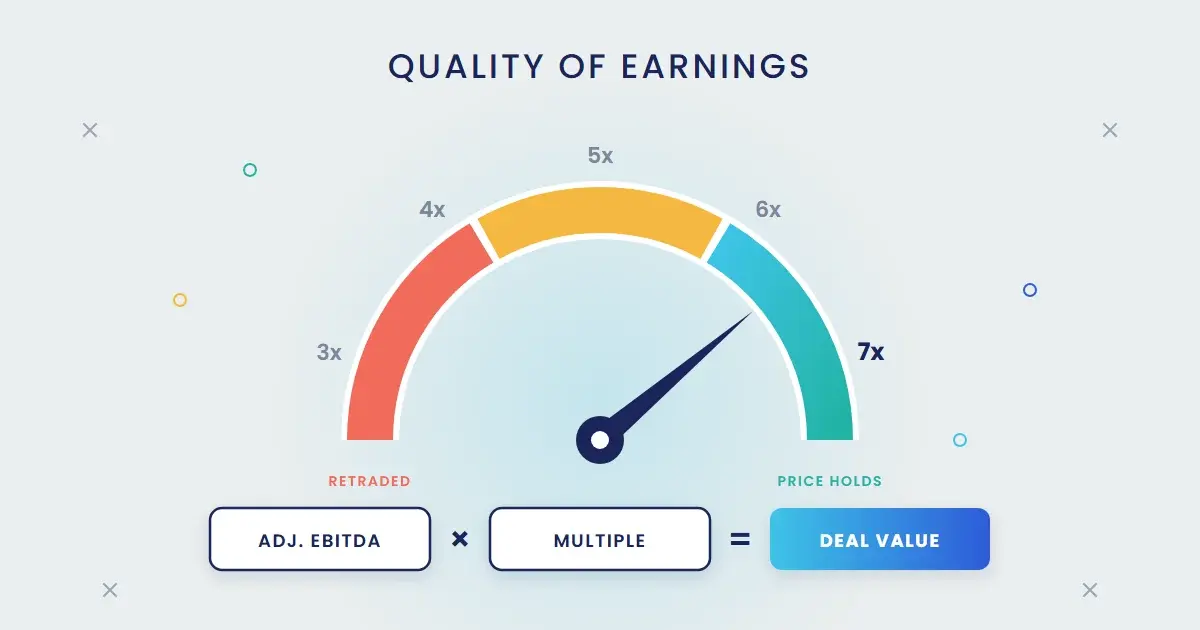
The first proof of cash I ran for a $7M services company preparing for a sale showed about $140,000 more revenue over the trailing 12 months than customers had actually paid. The cause was a coding habit. In slow months, the owner moved money from a savings account to cover payroll, and the bookkeeper coded each transfer as sales. Because there was no cost attached to those entries, the full $140,000 also flowed through to EBITDA. At the 5x EBITDA multiple the owner was hoping for, that was $700,000 of purchase price resting on a miscoded transfer. We found it nine months before going to market, corrected those months, and the owner went into buyer meetings with an EBITDA number that held up.
Net working capital
Most deals set a working capital target, often called the peg, based on what a "normal" month looks like over the trailing year. If the business delivers less working capital than the peg at closing, the price usually comes down to make up the difference, and if it delivers more, the price usually goes up. The CFA Institute piece notes that deviations from that normal level "may lead to adjustments in the purchase price."
Here's why that matters for your close. The peg is built from your month-end balance sheets. If unpaid bills weren't recorded, if customer deposits were sitting in revenue instead of deferred revenue, or if receivables included invoices for work that wasn't done yet, every one of those months is wrong, and so is the average the price is negotiated against. The buyer's team will rebuild those months correctly, and the gap between your version and theirs turns into a negotiation you're starting from behind.
Through my consulting practice, I once came into a company about two months after its LOI was signed. It had been recording vendor bills when it paid them rather than when they arrived, so every month-end balance sheet was missing 30 to 45 days of payables. Because the peg was built from the trailing 12-month average, working capital was overstated by roughly $250,000. We caught it before the peg was final. The conversation with the buyer was not a comfortable one, but it was short. If those payables had shown up for the first time on the closing balance sheet, the seller would have given up about $250,000 at closing for a gap that had been there all along.
Financial performance and add-backs
Financial performance covers revenue trends and customer concentration, but the piece that depends most on your close is the add-back schedule. Adjusted EBITDA starts with EBITDA, which is net income with interest, taxes, depreciation and amortization added back. From there come the add-backs you can defend: one-time legal fees, the part of a founder's salary above market rate, a project that won't repeat. Adjustments cut both ways, though. If a founder draws a below-market salary or the business rents space from an owner at a discount, the buyer's team will lower EBITDA to what those costs would be at market. Either way, adjustments only hold up when the underlying costs were coded consistently, month after month, in accounts a buyer can trace. A cost that bounced between three accounts over two years is hard to call non-recurring with a straight face.
What a controller does in the 12 to 24 months before a deal
The good news is that diligence-ready books come from the same monthly discipline that makes your numbers useful for running the business. On the clients we've taken through a raise or a sale, it looks like this:
- Reconcile every bank, credit card and merchant account monthly, so a proof of cash is a formality.
- Close on an accrual basis, with unpaid bills, prepaid expenses and deferred revenue recorded every month.
- Hold revenue to a written recognition policy, and check cutoff at every month-end.
- Record sales tax and other pass-through amounts as liabilities.
- Keep coding consistent, and document why when it changes.
- Keep a close binder each month with reconciliations, support and the controller's sign-off.
- Track the one-time items as they happen, with support, so the add-back schedule is a list you already have.
If you're 18 months out, that's plenty of time. If you're six months out, it's still worth doing, and a sell-side quality of earnings review of your own before you go to market can surface problems while you still control the timeline.
What our clients saw on the other side
Anthony Jenkins, CEO of NTERSOL, said the at-a-glance financial summary we built for them "proved vital to help us communicate the value to investors and buyers during due diligence." NTERSOL closed its sale to CI&T within six months of its own prior acquisition. At MedCompli, President and CEO Chris Gingras put it this way: "We could scale the business and were ready when the right investment partner approached us." And Mindset built the investor-ready finance function that carried it through a $13M Series A.
A quick test
If a buyer asked tomorrow, could you hand over 24 months of reconciled bank statements, a month-end balance sheet you'd stand behind for each of those months, and a list of one-time costs with support? If the honest answer is "most of it," you're closer than most companies we meet. If it's "we'd need a few weeks," it's worth starting now, while the timeline is still yours. We've written more about this in 9 things to know before due diligence and our transaction readiness guide, and if you want a second set of eyes on your books before the buyer's team gets there, let's talk.
This is Part 3 of our four-part series, Controllership and the people counting on it:
- Everything's Coded in the Bank Feed. Why Does Anyone Need to Review the Books?
- What a Grant Officer or DCAA Auditor Expects to Find in Your Books
- Diligence-Proof Books: What a Quality of Earnings Team Checks First (this post)
- Your Cash Forecast Is Only as Good as Last Month's Close
This post is general information, not accounting, tax, legal or investment advice. Talk to your advisors about your specific transaction.
Share