Holding company CEOs and CFOs a year after a platform acquisition, reporting to a board and a lender.
What each firm contributes after intercompany eliminations, how much covenant headroom is left, and what the next deal does to both.
Twelve months after a platform deal closes, the lender's first question on the quarterly call is always some version of this: are you deleveraging the way the model said you would? It's an easy question to answer badly. The consolidated numbers say yes, and then the second question comes: which firm is behind, and why?
A consolidated P&L can answer the first question. Paste it into any AI tool and you'll get a fluent, correct summary in thirty seconds. It can't answer the second, because the answer isn't in the P&L. It's in the timesheets, the project budgets, the receivables ledger and the change-order log of each firm, on three different systems, plus a few things nobody wrote down.
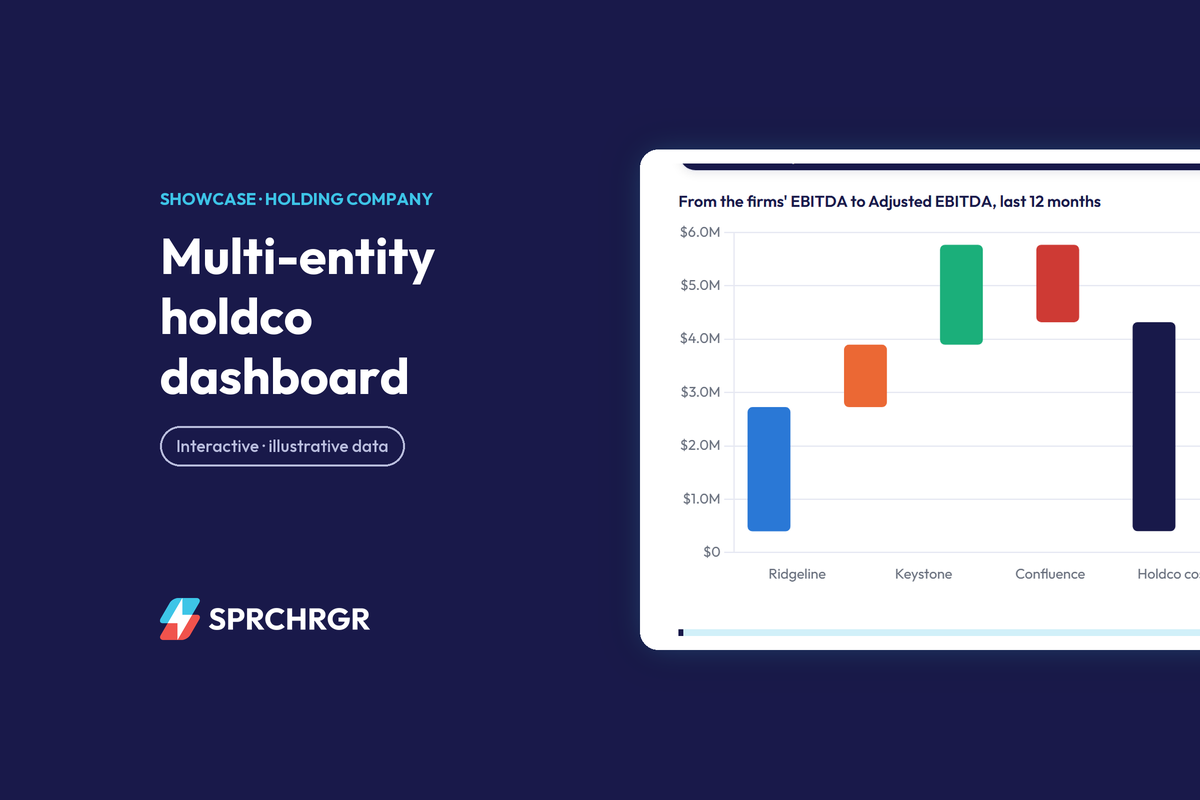
So here's how I'd walk a holdco CEO through that call using a working sample dashboard for a fictional platform called Gateway Design Holdings. It owns three design and engineering firms, Ridgeline, Keystone and Confluence, each on its own books, and the page covers the first year under ownership. The company, the clients and the numbers are invented. The patterns aren't. Open it in another tab and follow along.
The year in one paragraph
This is the paragraph at the top of the page, written so the CEO can say it to a lender without looking down:
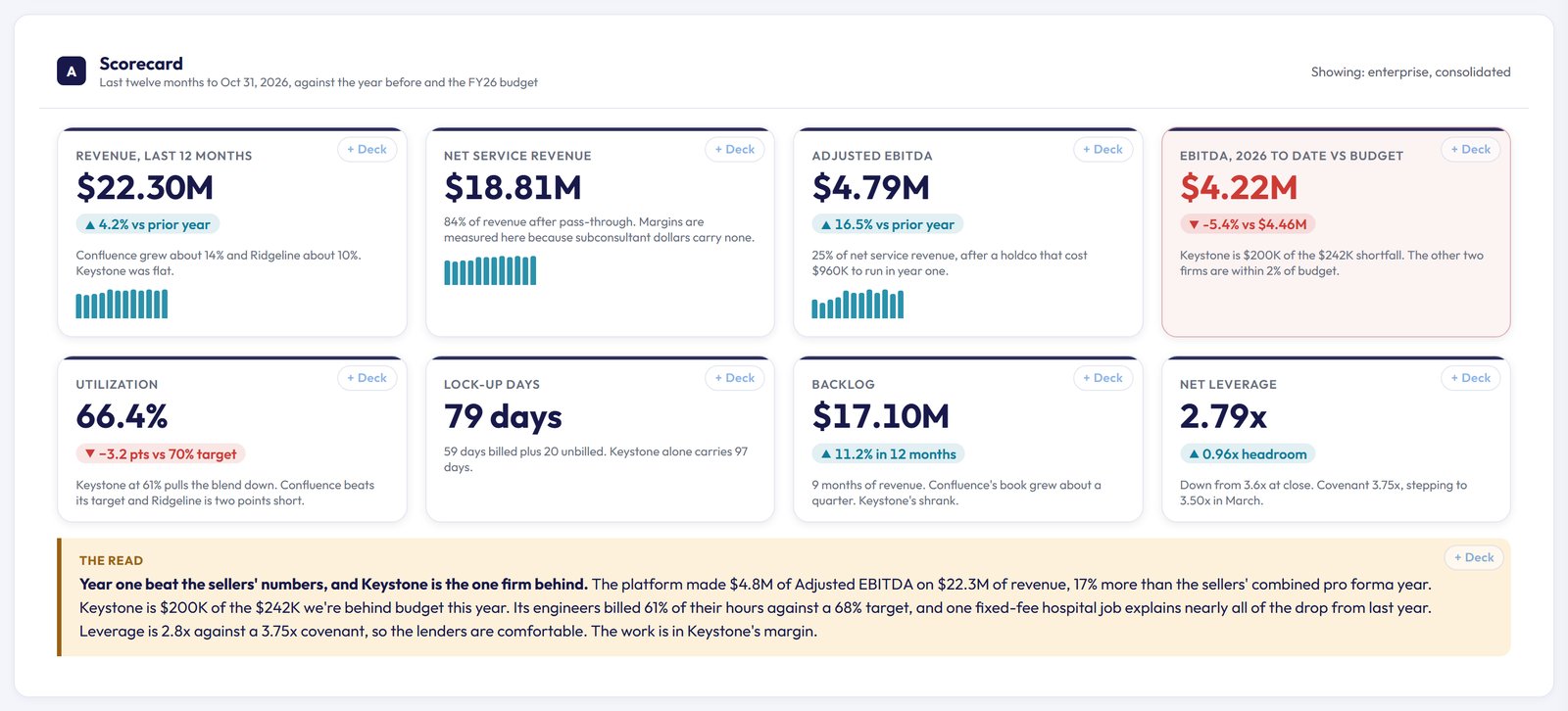
Our first year under ownership made $4.8M of Adjusted EBITDA, 17% more than the sellers' combined pro forma year, and net leverage came down from 3.6x at close to 2.8x. August through October was the best quarter yet at $1.3M, 12% ahead of the same months last year. Ridgeline and Confluence carried that growth. Keystone made 7% less in the quarter than a year ago, mostly because one fixed-fee hospital job ran 2,400 hours past its fee.
The first two sentences are what a summary tool would give you. The last one is the one the lender actually wanted, and it only exists because someone matched Keystone's timesheets to its project budgets.
The budget miss has one owner
Year to date the platform is $242K behind its EBITDA budget. Keystone is $200K of that. Ridgeline and Confluence are both within 2% of plan. I'd say that in the first five minutes, because a miss you name is a management update and a miss the lender finds is a credibility problem.
Flip the view switcher to Keystone and the story gets specific. Its engineers billed 61% of their hours against a 68% target, and its margin on net service revenue is 20%, against 31% at Ridgeline and 46% at Confluence.
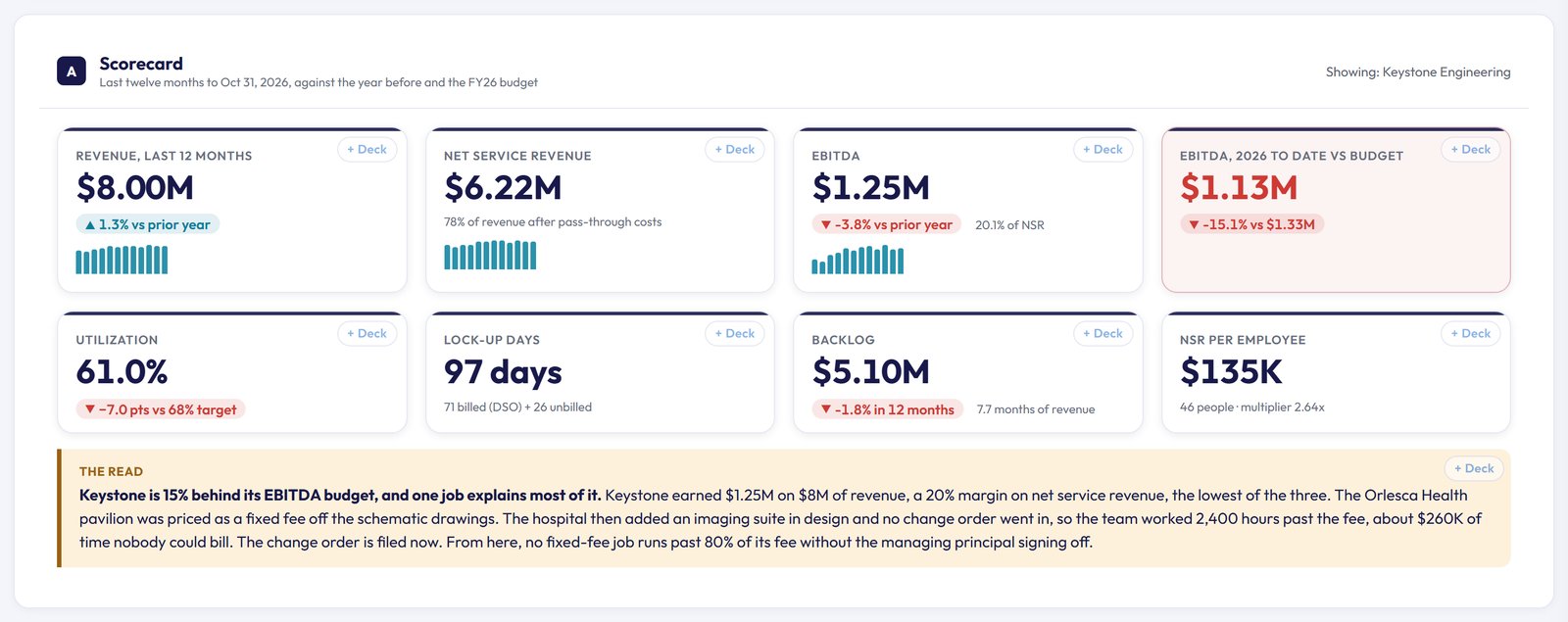
Here's the part that came from below the ledger. Keystone priced the Orlesca Health pavilion as a fixed fee off the schematic drawings. In design, the hospital added an imaging suite, and no change order went in. The team worked 2,400 hours past the fee, about $256K of time nobody could bill. Keystone's utilization fell by about 2,700 hours year over year, so that one job is nearly all of the drop. The change order is filed now, and the new rule is simple: no fixed-fee job runs past 80% of its fee without the managing principal signing off.
Who moved the year
Every lender and board member asks "who?" after the first number, so the page has a small table under the EBITDA bridge with the clients and projects that moved the year. Every figure in it sits inside a firm total on the page.

- Quenmoor Logistics gave Ridgeline its largest award of the year, a $1.6M distribution campus, which keeps nearly nine months of work signed.
- Pellwater Basin Water District awarded Confluence a $1.4M five-year stormwater program. Confluence's backlog grew about a quarter, and the firm wins 44% of what it bids.
- Dunmarrow Unified School District is the other side of Keystone's year: a $1.1M schools program Keystone pursued for months and lost. Keystone wins 29% of its bids. It should bid less often and price what it wins properly.
- Ridgeline's modelers spent 3,559 hours on Keystone jobs, $420K billed at cost, while Keystone's own engineers sat at 61%. Only two of Keystone's 46 people model in Revit at production speed. Train two more and much of that work stays on Keystone's payroll.
That last one is my favorite example of why the timesheets matter. On the consolidated P&L the intercompany billing disappears in elimination, as it should. In the timesheets it's a skills gap with a price on it.
Where the cash is
Leverage came down from 3.6x at close to 2.8x, and the covenant steps down to 3.50x in March with 0.7x of room left after it does. So the lender question has a good answer. The faster path is sitting in Keystone's receivables: 97 days of revenue in billed and unbilled work, against 70 at Ridgeline.

The ledger shows two causes. Keystone's books take 15 days to close, so invoices go out in the third week of the month. And $142K of its $249K over 60 days is one general contractor, Wexcombe Builders, paying only when the owner pays them, on terms Keystone accepted before the deal. Bill from timesheets on the third business day, stop accepting pay-when-paid, and getting Keystone to Ridgeline's pace frees about $590K. That's more than half the drawn revolver.
The next deal, and the board deck
The question after "are we on plan" is "can we do the next one." The acquisition section takes a target's revenue, margin, multiple, debt share and synergies and shows what the deal does to the platform. At the default inputs, a $6M firm at a 20% margin bought at 6x with 60% debt, pro forma leverage is 2.88x and the deal fits. Push the multiple to 8x and leverage goes to 3.12x, with less than half a turn to spare under the stepped-down covenant.
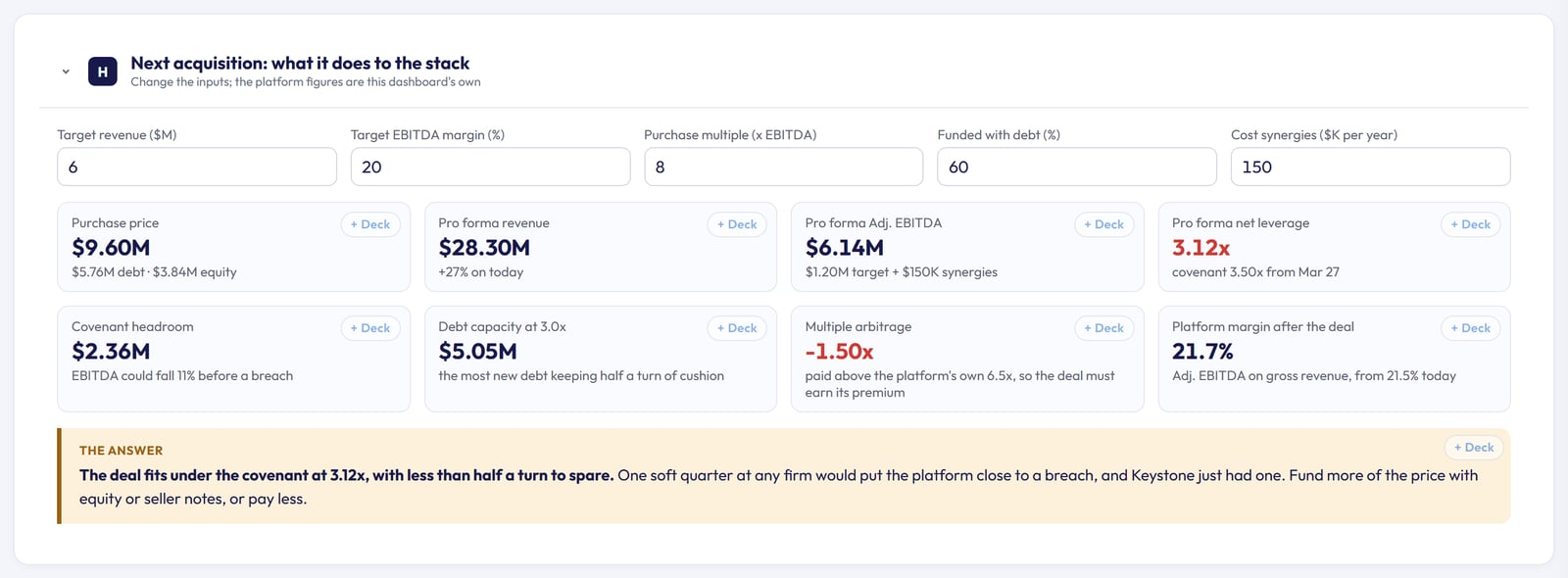
The answer under the inputs changes with them, and at the default terms it says the thing I'd say in the room: diligence the target's timesheets and fixed-fee jobs as well as its P&L, because Keystone just showed us what an unpriced fixed-fee book costs.
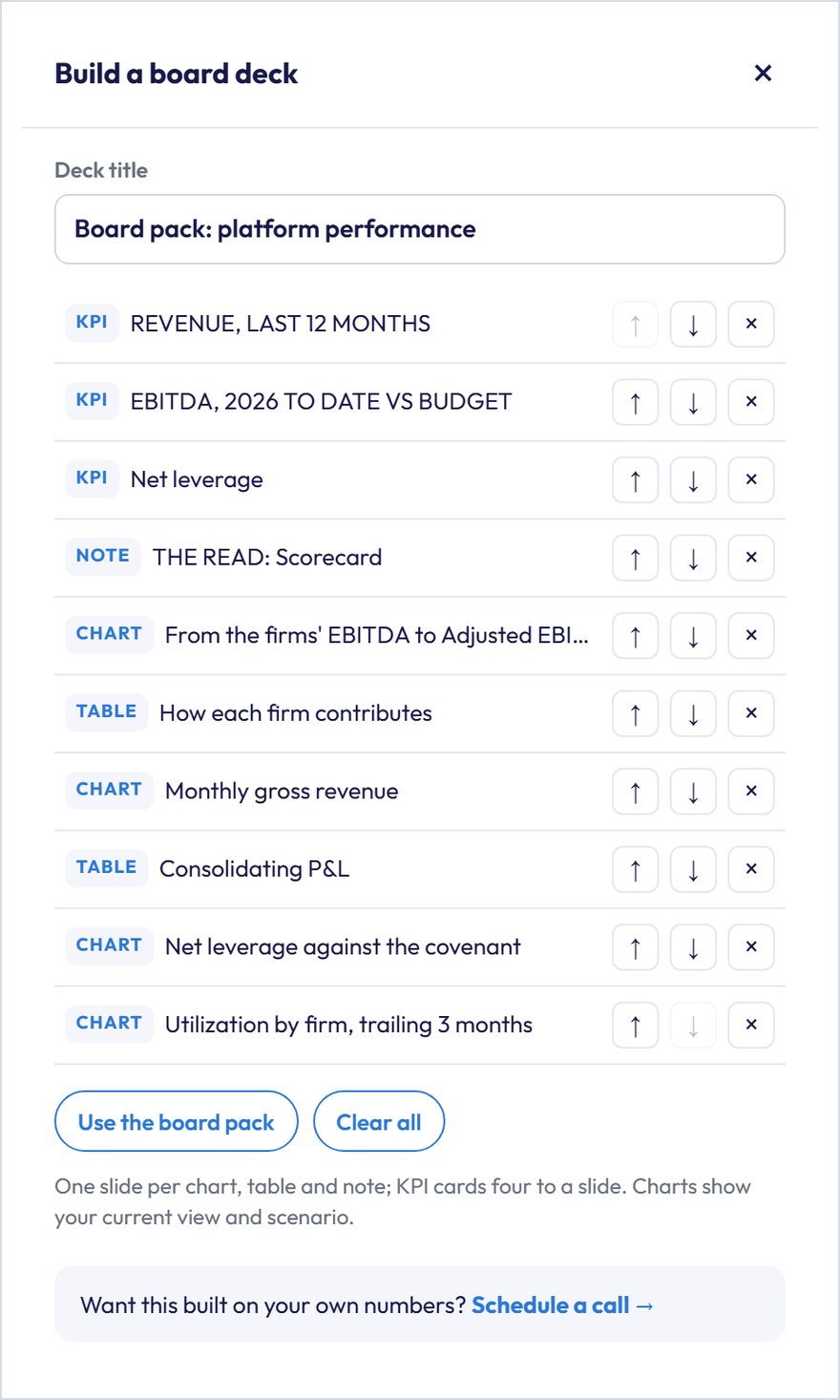
Every card, chart, table and callout also has a + Deck button. Use the board pack preloads what a holdco board usually wants, and you download an editable PowerPoint with speaker notes, built from whichever view is on screen.
Why not just do this yourself with AI?
You should use AI. We use it every day. But the analysis was never the hard part. Every finding above came from four things a chatbot doesn't have:
- Transaction-level data, kept current. Timesheets, project budgets, invoices and aging from every firm, pulled after each close and mapped to one chart of accounts, so three ledgers read as one platform.
- Context nobody wrote down. That the hospital added an imaging suite, that a contractor pays only when the owner does, that only two engineers can model in Revit. We add that next to the numbers it explains.
- Somewhere safe to keep it. Read-only connections and a secured warehouse with access controls, instead of three firms' payroll and client files pasted into a chat window.
- Someone accountable for it. A CFO who knows the credit agreement and the deal model, reads the month with you, and then changes the fixed-fee sign-off rule.
What it takes to get this on your own platform
We connect read-only to each firm's accounting and project systems and to the holdco ledger, map them to one chart of accounts in a warehouse you control, and eliminate intercompany labor on the way in. The roll-up and covenant tests then refresh the day each firm closes, instead of 18 business days later, and the next acquisition plugs in as one more feed instead of one more spreadsheet tab.
If you're running a platform, or about to add the next firm to one, schedule a call with our team and we'll walk through what this would look like on your books. The rest of our interactive demos are in the showcase.
Gateway Design Holdings, its three firms and every client, project and person named in this post are fictional, and every figure is invented for illustration. Nothing here is drawn from any client's books.
Share