Founders and finance leads of AI companies doing $5 to 50M of revenue who bill on usage, or are moving to tiers with included usage, and the investors, CPAs and bankers who read their numbers.
What the move to subscription pricing actually did to revenue, margin and forecast accuracy, which customers it helped and hurt, and what the model bill does to every price you set.
Most AI founders I talk to about pricing want to start with the new tiers, because the tiers are the decision they just made, and I usually steer us to the model bill first – every price you set is a promise about an average conversation, and the cost of serving one is never average.
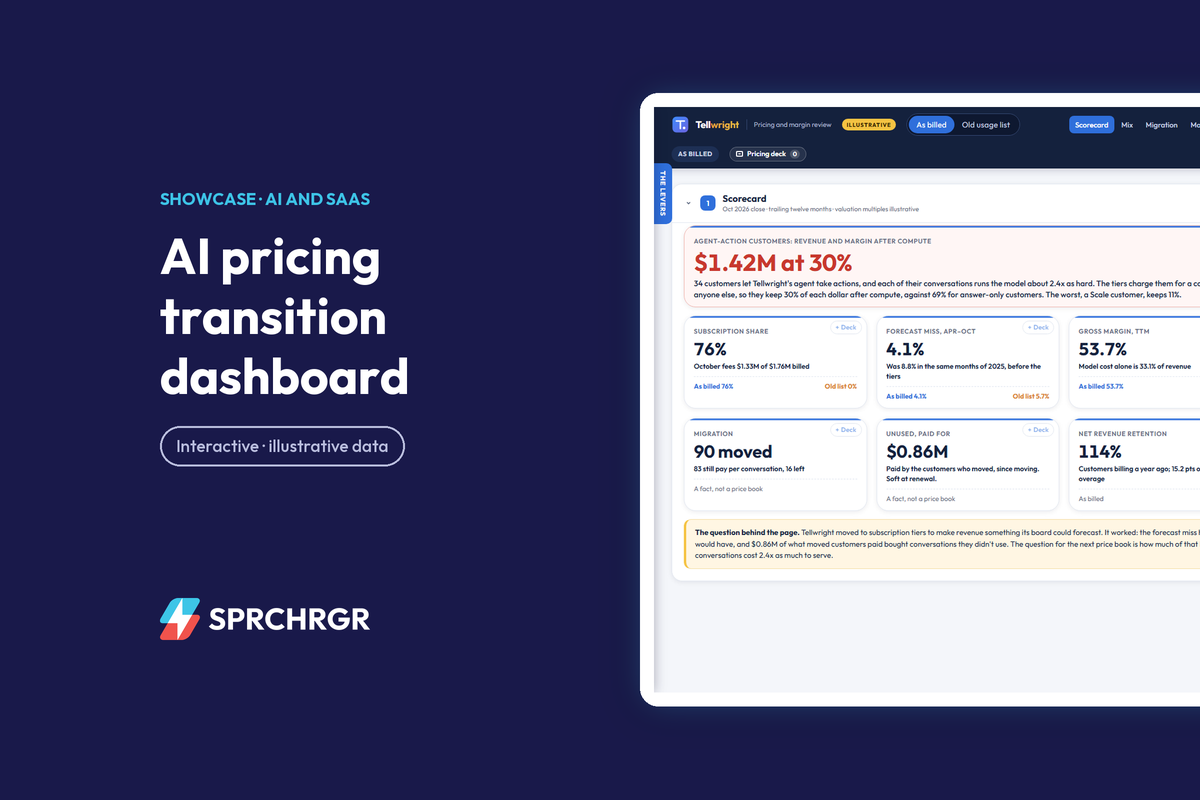
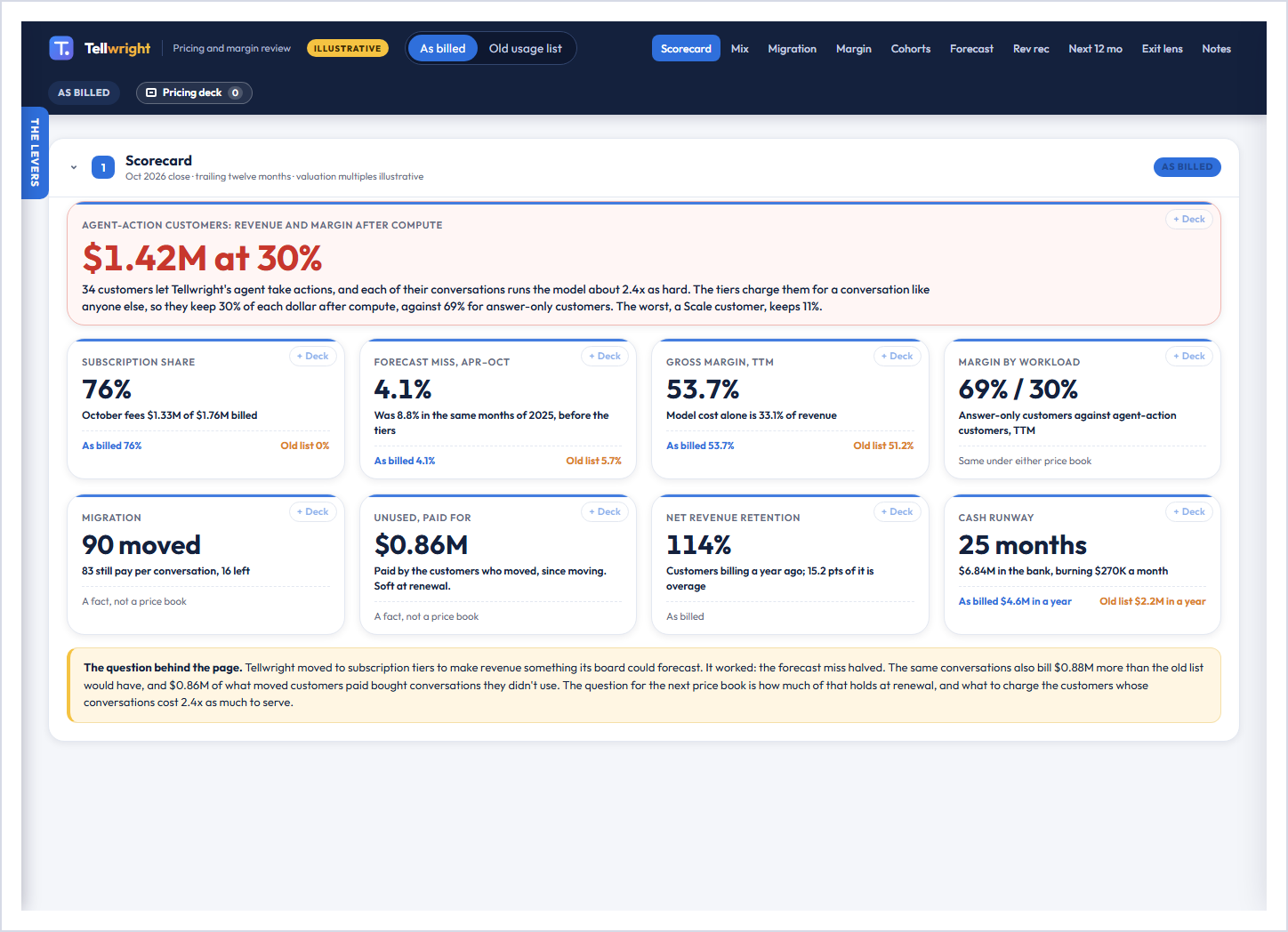
So here's how I'd walk a founder through it, using a working sample dashboard we built for a fictional company called Tellwright. Every figure in it is invented, but the shape is common: an AI support agent founded in early 2023, 309 mid-market customers, $15.5M of revenue in the last twelve months, and a move in January 2026 from billing per conversation to three subscription tiers with included conversations and overage. A switch at the top flips the history between what Tellwright billed and what the same conversations would have billed on the old price list, and that switch is most of the conversation.
Start with what the switch actually did to revenue
Revenue went from $3.1M to $7.1M to $15.5M over three years, and the pricing change didn't slow it. What changed is the shape. In October, 76% of monthly revenue was subscription fees, 10% overage and 14% usage from the customers who haven't moved yet, which puts committed ARR at $16.0M before anyone renews.
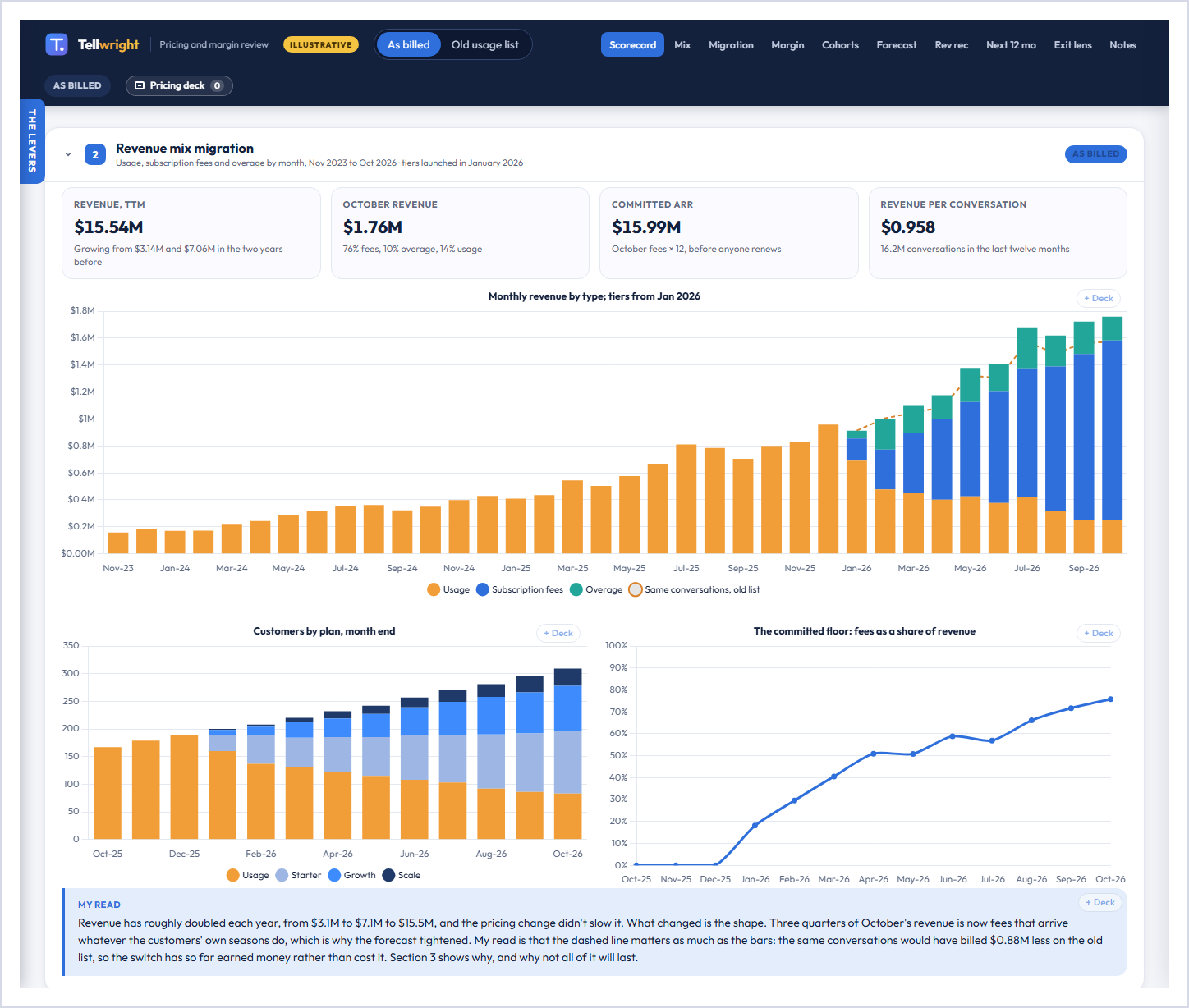
Then flip to the old price list. The same conversations would have billed $14.7M over the last twelve months, $0.88M less than Tellwright actually billed. Most founders expect the opposite, since tiers usually come with a volume discount for the biggest customers, yet the customers who moved bill 5.5% more per conversation than the old list would charge.
My read: that's a good outcome, and I'd want to know exactly where it came from before I put it in a board deck.
Show who moved, who didn't, and why
Of the 189 customers paying per conversation in December 2025, 90 have moved to a tier, 83 are still on usage and 16 have left. The tracker shows every one of them, with what they were billed since launch against what the old list would have charged.
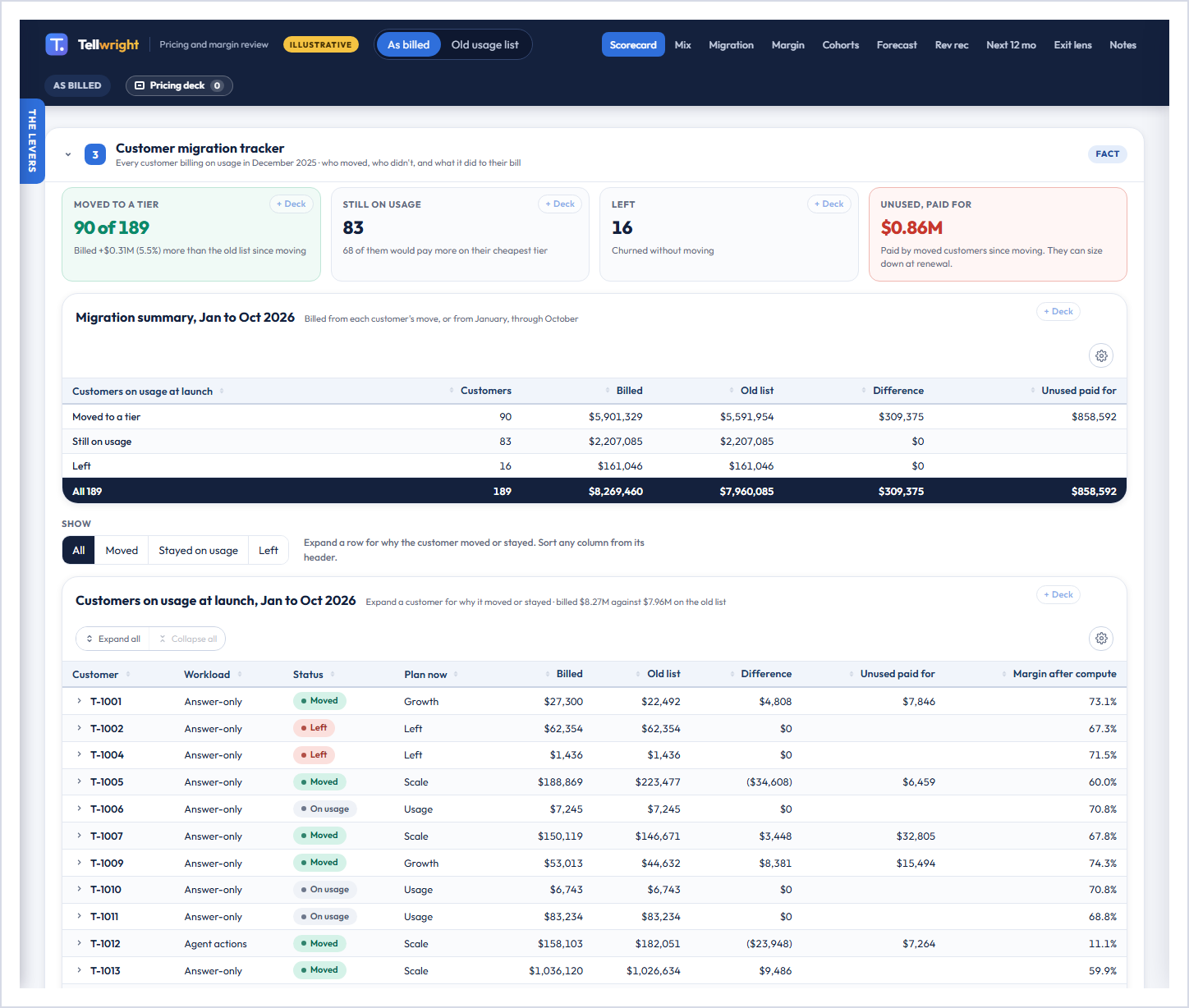
Two patterns stand out. First, 68 of the 83 who stayed would pay more on their cheapest tier – a $2,400 Starter fee is a bad deal at 1,500 conversations a month. Second, the customers who moved picked their tier from their last six months of volume, and for an online retailer those six months include the holidays. So they bought allowances sized for December and paid for them in March. Since moving, $0.86M of their fees bought included conversations they didn't use.
My read: that $0.86M is real revenue today and it's soft, because the first renewal is when a customer sees a year of unused allowance. I'd plan for some downgrades rather than book the uplift as permanent, and I'd offer seasonal customers an annual allowance before they ask for a smaller tier.
Put compute inside cost of sales where you can see it
This is the section that separates an AI company from the SaaS dashboards founders are used to. Every conversation calls a language model, and the model bill is Tellwright's biggest cost of sales: $5.1M in the last twelve months, 33% of revenue, about $0.32 per conversation.
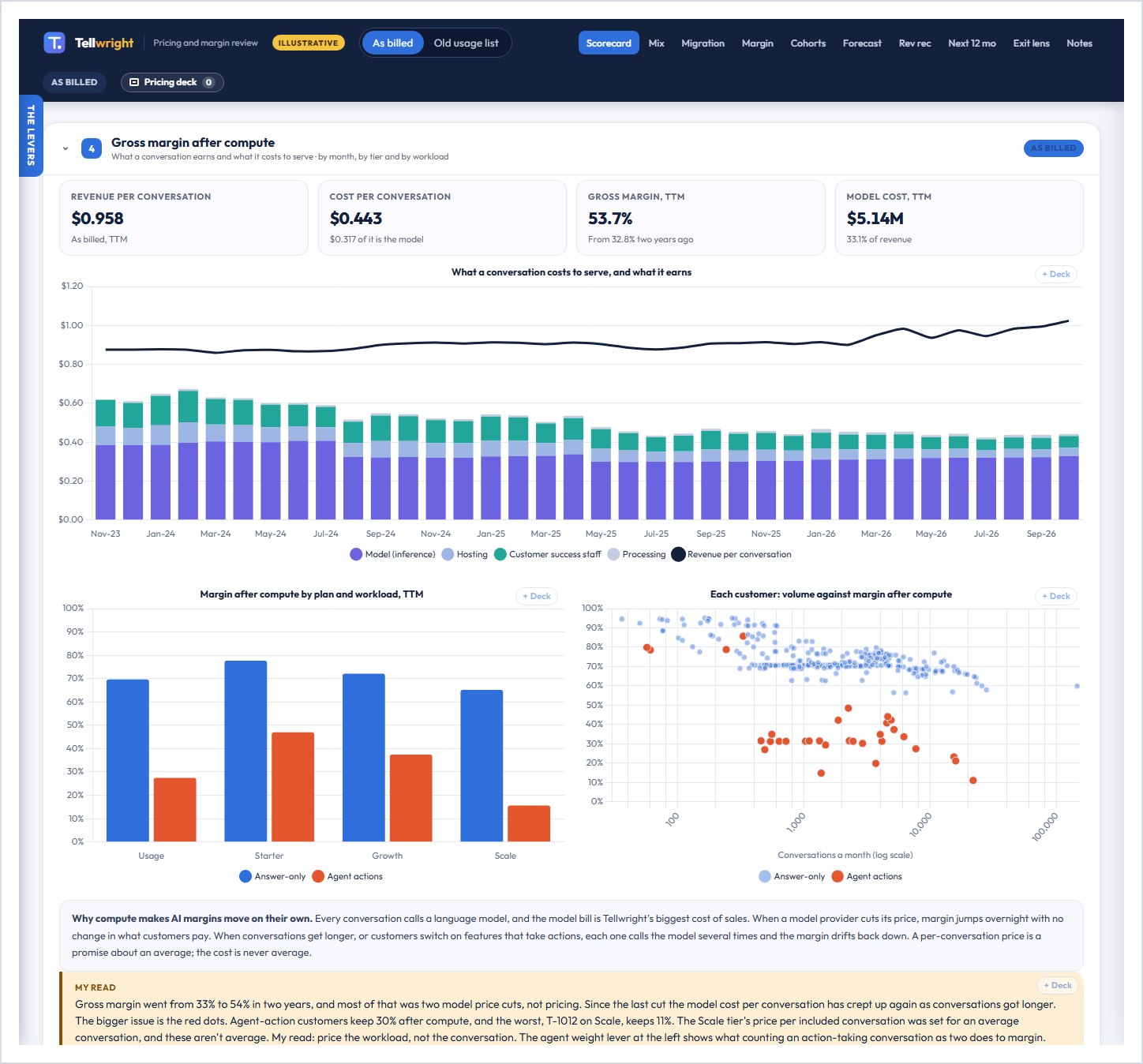
Gross margin went from 33% to 47% to 54% across the three years, mostly from two model price cuts rather than anything customers paid, and since the last cut cost per conversation has been creeping back up as conversations got longer.
The bigger issue sits in the scatter chart. Thirty-four customers let Tellwright's agent take actions – refunds, order changes, bookings – and each of those conversations runs the model about 2.4 times as hard. The tiers charge them for a conversation like anyone else, so they keep 30% of each dollar after compute against 69% for customers who only want answers. The worst one, on the Scale tier, keeps 11%.
My read: price the workload, not the conversation. The fix in the demo is an agent weight, where one action-taking conversation uses up two of the included allowance, and in the next-twelve-months view that alone adds about $1.6M of revenue and 2.4 points of gross margin without touching a single answer-only customer.
Read retention with the overage separated out
Net revenue retention is 113.5%, 84% of last October's customers are still here, and recent cohorts pay back their acquisition cost in about nine months. Fifteen points of that retention is overage, though, which is usage again under another name and will swing with customers' seasons.
My read: those are strong numbers for investors, as long as the deck says which part is a fee floor and which part is growth.
Have the forecast conversation honestly
The board wanted predictability, and it got some. Comparing the same months a year apart, the average monthly forecast miss from April to October fell from 8.8% to 4.1%.
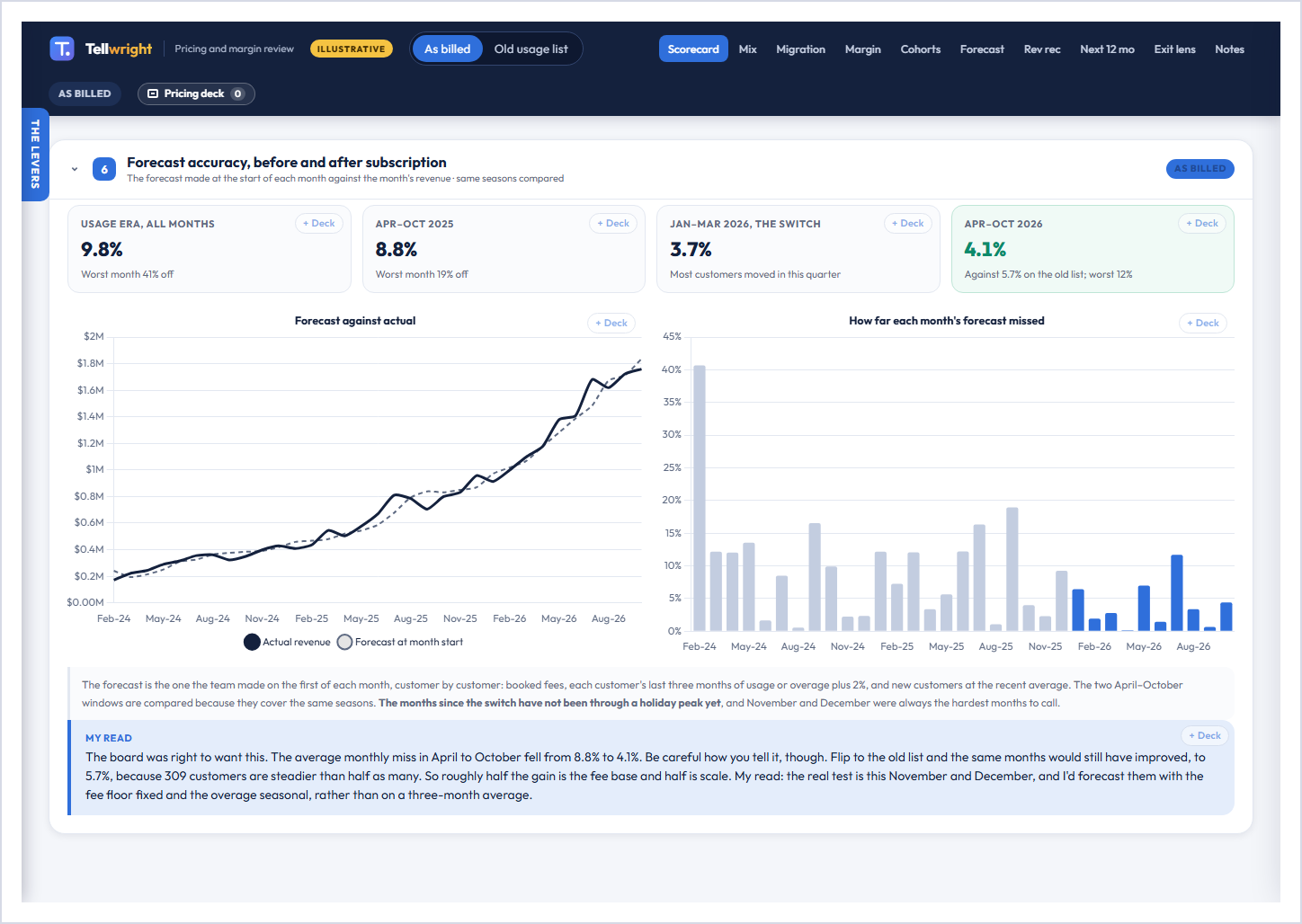
Flip to the old list and the same months would still have improved, to 5.7%, because 309 customers are steadier than half as many. So roughly half the gain is the fee base and half is scale. The months since the switch also haven't been through a holiday peak yet, and November and December were always the hardest months to call.
My read: the real test is this November and December, and I'd forecast them with the fee floor fixed and the overage seasonal, rather than on a three-month average.
Explain revenue recognition in plain English
Fees count as revenue evenly over the month or year they cover, and usage and overage count in the month the conversations happen. Unused conversations don't roll forward, so nothing extra gets deferred – the exception is the 78 annual payers, whose prepaid fees leave $1.19M of service still owed.
My read: write the no-rollover rule into the order form. The day unused conversations carry forward, part of every fee becomes deferred revenue, and your auditors will want a model of how much will be used.
Have the scenario conversation before the next price book
The levers act on the next twelve months only, with a new price book from January 2027, and a strip follows each change from price per conversation through gross margin and cash to an illustrative value.
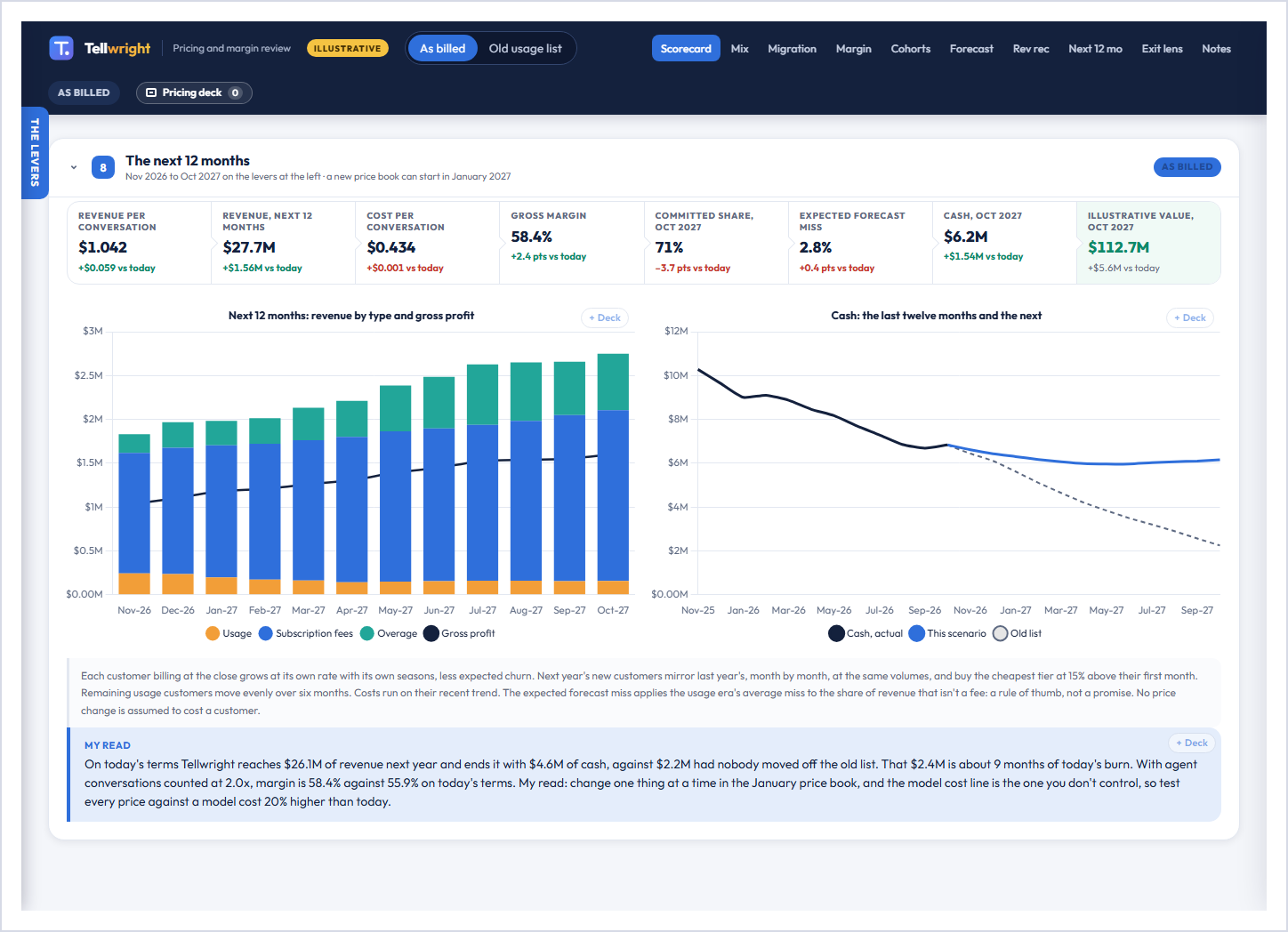
On today's terms Tellwright reaches about $26.1M of revenue next year and ends it with $4.6M of cash, against $2.2M had nobody moved off the old list.
My read: change one thing at a time in the January price book, and test every price against a model cost 20% higher than today, because that's the line you don't control.
Look at it the way a buyer or investor would
The exit lens tab asks what this is worth. A buyer or growth investor pays more for a committed dollar than a usage dollar. At illustrative multiples of 4.0x committed ARR and 2.0x variable revenue, Tellwright is worth about $74.2M as billed against $37.7M on the old list, and the split card is clear that $32.0M of that gap is the higher multiple and only $4.5M is revenue. Diligence will test the unused allowances and the agent customers' margin. If a sale or raise is on the horizon, the exit readiness demo walks through the rest of that conversation.
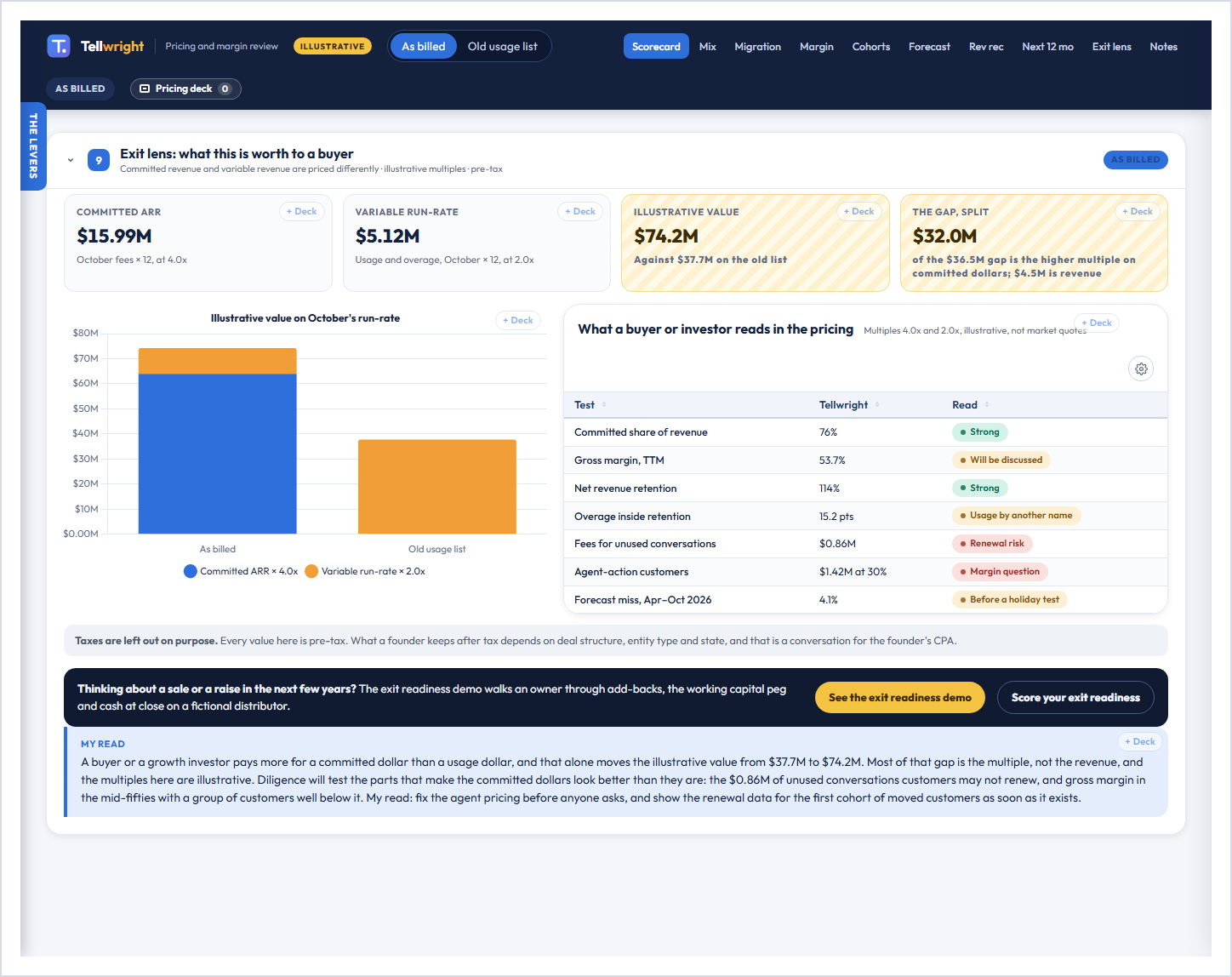
My read: fix the agent pricing before anyone asks, and show renewal data for the first cohort of moved customers as soon as it exists.
Build the pricing review deck
Every card, chart and table has a + Deck button, and Use the pricing review pack loads the set I'd bring to a board meeting, from the scorecard through the exit lens. It downloads as an editable PowerPoint, with speaker notes recording every lever setting that was active.
What it takes to get this on your own numbers
We connect read-only to your billing system, your accounting system and your model-provider invoices, rebuild every customer's usage, bill and compute cost by month, and reprice your history on any price book you're considering. Then we put pricing, margin by customer and the forecast in the form your board and investors read, and refresh it after every month-end close, so a customer running at thin margin shows up before renewal instead of after it.
That's CFOptimize – accelerate your growth, built for AI companies working out what to charge. If you'd like to see it on your own customers, grab time with me and we'll walk through your pricing together.
Mark
Tellwright is a fictional company and every figure in the dashboard and in this post is invented for illustration. Nothing here is drawn from any client's books, prices or customers. Valuation multiples are illustrative assumptions, not market quotes, and nothing here is tax, legal, accounting or investment advice.
Share