Founders and finance leads of AI companies doing $5 to 50M of revenue who bill on usage, or are moving to tiers with included usage, and the investors, CPAs and bankers who read their numbers.
What the move to subscription pricing actually did to revenue, margin and forecast accuracy, which customers it helped and hurt, and what the model bill does to every price you set.
When an AI company changes how it charges, the first diligence request from a growth investor is usually one line long: show us what the same customers would have paid on the old prices. It sounds simple. Most founders I meet can't answer it without a week in spreadsheets, and the ones who can usually stop at the total.
The total is the easy part. Any AI tool will read a P&L and tell you revenue grew and margin improved. What it can't tell you is which customers bought more allowance than they use, which ones cost twice as much to serve as they pay for, and which one just left to build its own. That lives in the usage meter, the billing history and the model-provider invoices, matched customer by customer, month by month.
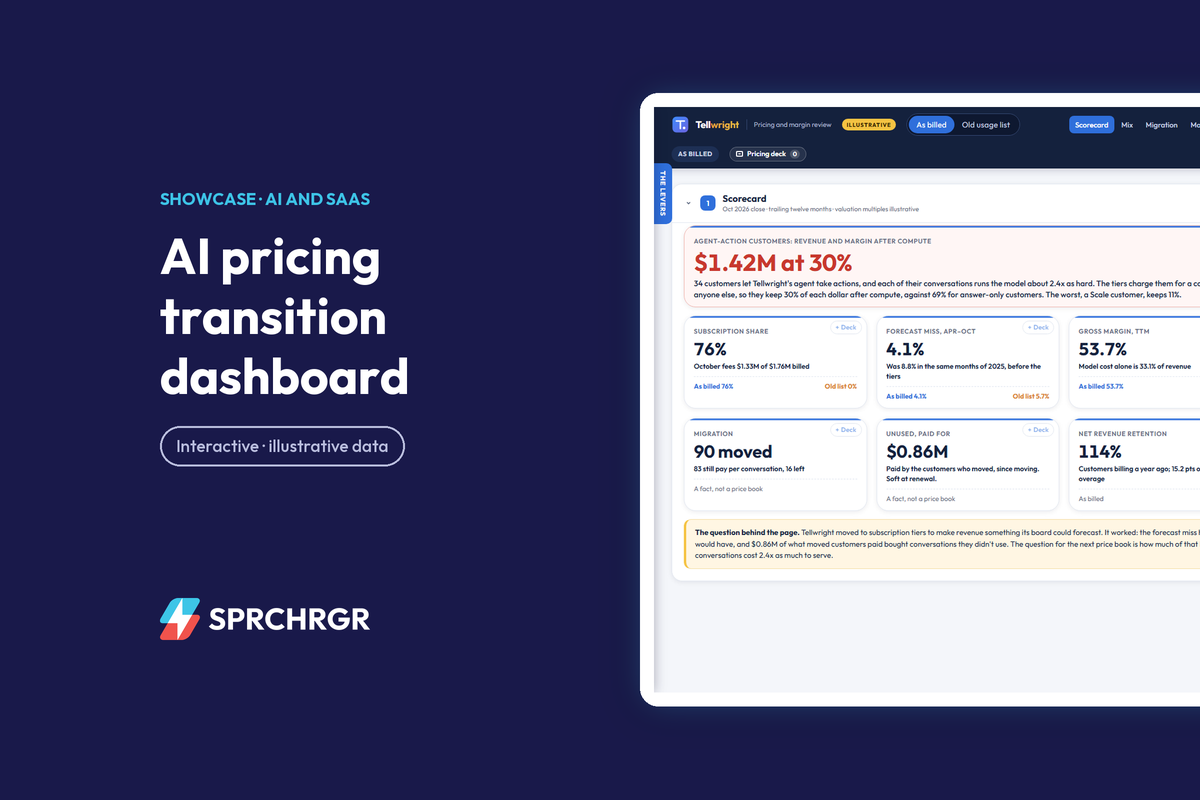
So here's how I'd walk a founder through it, using a working sample dashboard we built for a fictional AI support-agent company called Tellwright. The company, the customers and the numbers are invented. The patterns are ones I see in real books. Tellwright moved from billing per conversation to three subscription tiers in January 2026, and a switch at the top of the page reprices every closed month on the old list, so you can see both at once.
The quarter in three sentences
This is the paragraph at the top of the page, written the way I'd want the CEO to say it to a board member:
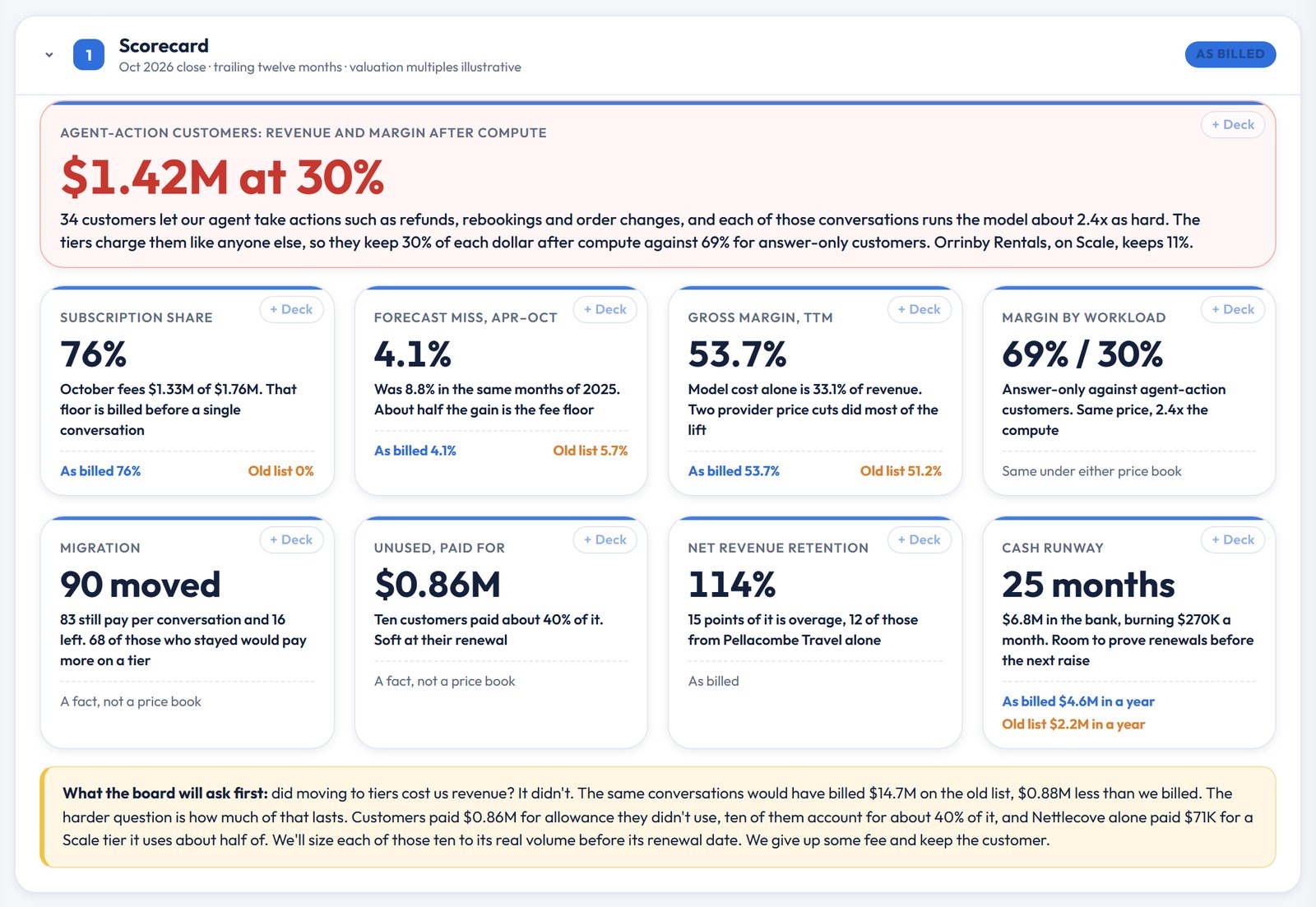
We earned $5.1M from August through October, 14% more than the quarter before, and 71% of it was subscription fees we could count on from the first of the month. Over the year the tiers billed $0.88M more than the old price list would have, but customers also paid $0.86M for conversations they never used, and the annual payers among them start renewing in January. The January price book is built to keep that revenue honestly.
The first sentence is what a summary gives you. The second needs every customer's conversations repriced on the old list and every unused allowance counted. The third is a decision, and that's the part a board is actually paying attention to.
The uplift is real, and it rests on oversized allowances
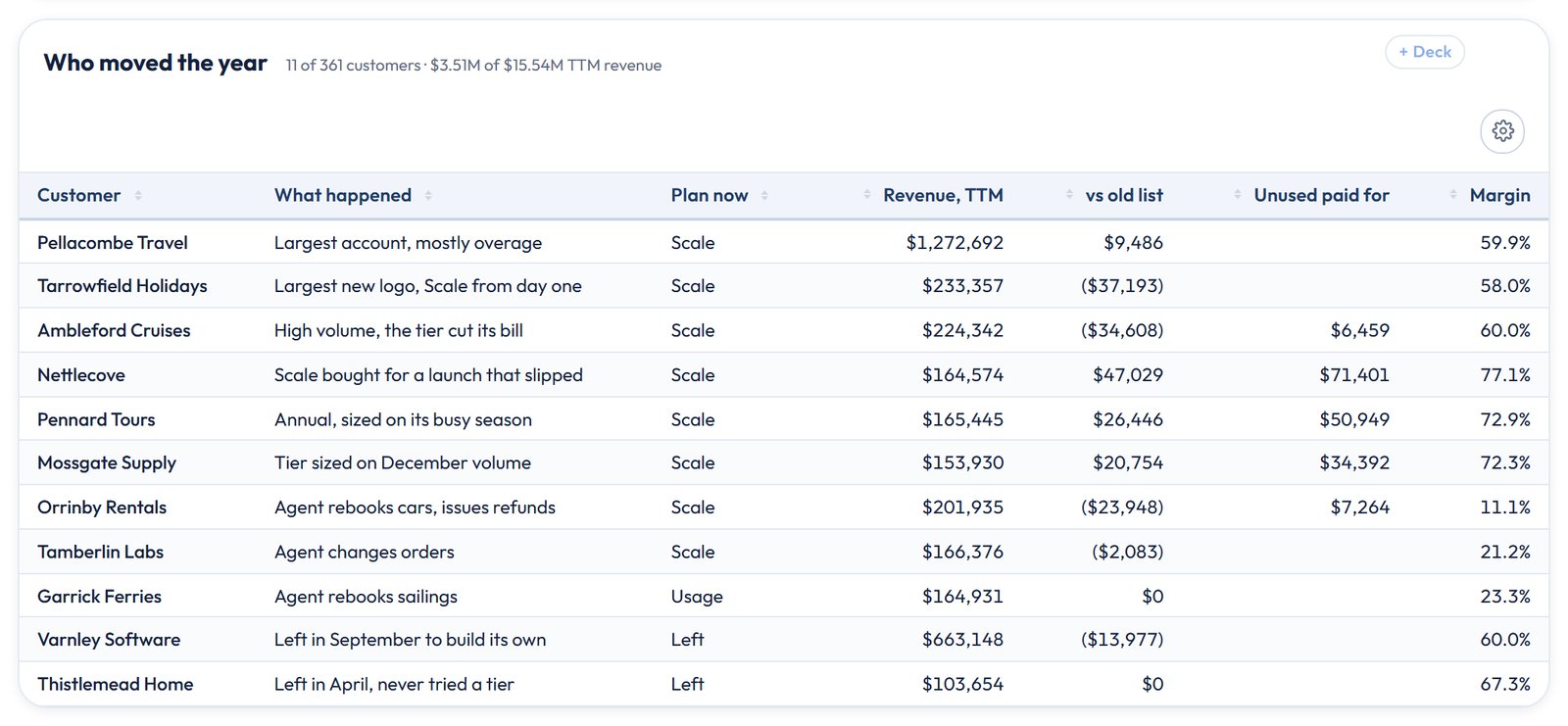
Founders expect tiers to cost them revenue, because the big customers usually get a volume discount. Tellwright went the other way. Customers picked a tier from their last six months of volume, and for online retailers those six months held the holiday peak. Mossgate Supply moved in May, stepped up to Scale in July on volume that included December, and has paid $34K since for conversations it didn't use.
Nettlecove is the extreme case. Their buyer moved them up to Scale in March for a product launch that slipped, and they use about half the allowance. That's $71K of fees that bought nothing. Ten customers account for about 40% of the $0.86M total. None of this is in the P&L. It shows up only when you line up each customer's included conversations against what they actually ran.
The fix is a phone call. Call those ten before their renewal dates, size each to its real volume, and offer seasonal customers an annual allowance. Tellwright gives up some fee and keeps the customer, which is a much better trade than finding out at renewal.
Price the workload, not the conversation
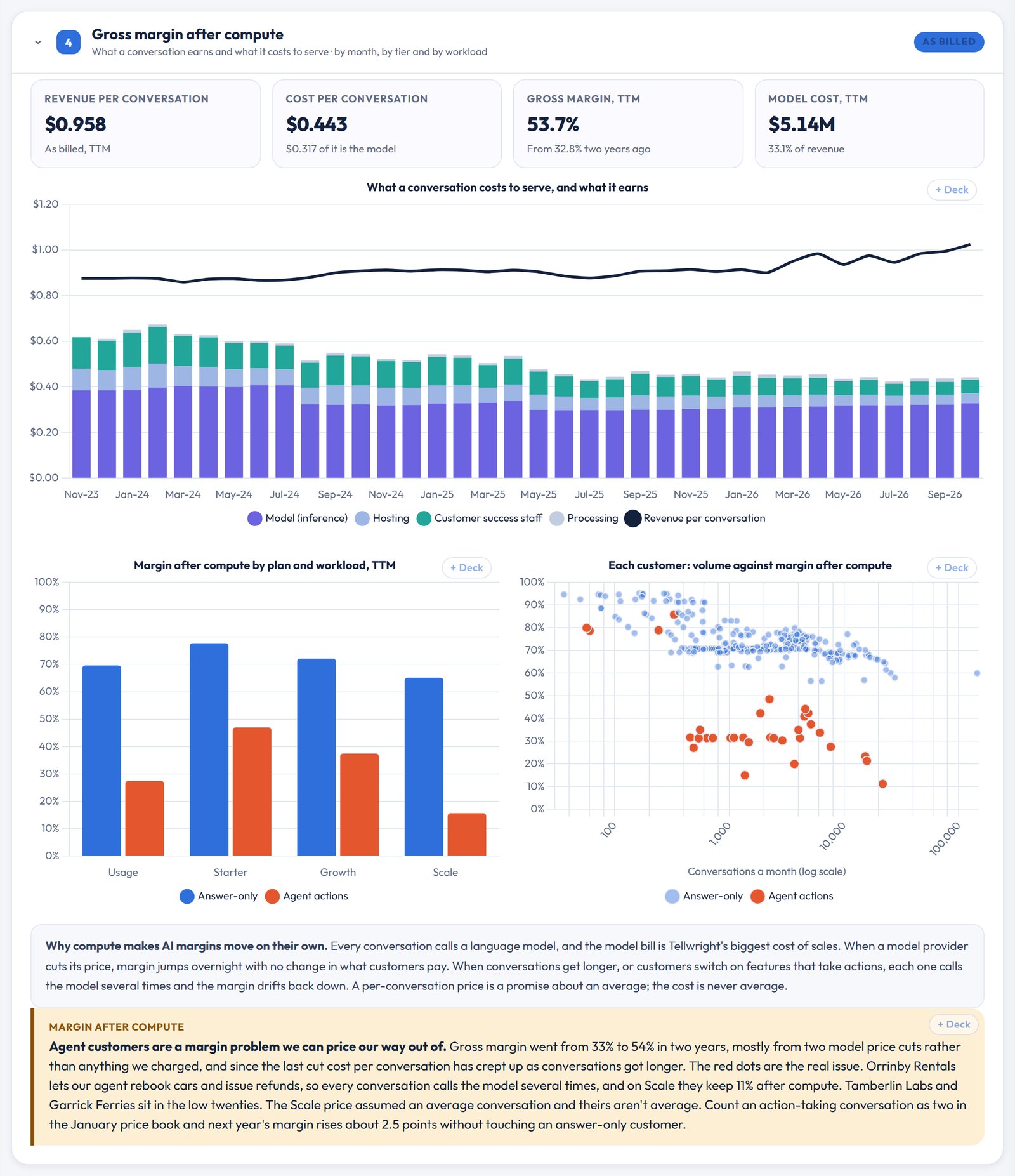
Gross margin went from 33% to 54% in two years, and most of that was two price cuts from the model provider rather than anything Tellwright charged. The bigger issue is the 34 customers who let the agent take actions: refunds, rebookings, order changes. Each of those conversations runs the model about 2.4 times as hard, and the tiers charge them like anyone else.
Orrinby Rentals is the clearest example. The agent rebooks cars and issues refunds, every conversation calls the model several times, and on the Scale tier Orrinby keeps Tellwright 11 cents of each dollar after compute. Tamberlin Labs and Garrick Ferries sit in the low twenties. Counting an action-taking conversation as two in the January price book adds about two and a half points of margin next year without touching an answer-only customer.
The loss that shows where the price book breaks
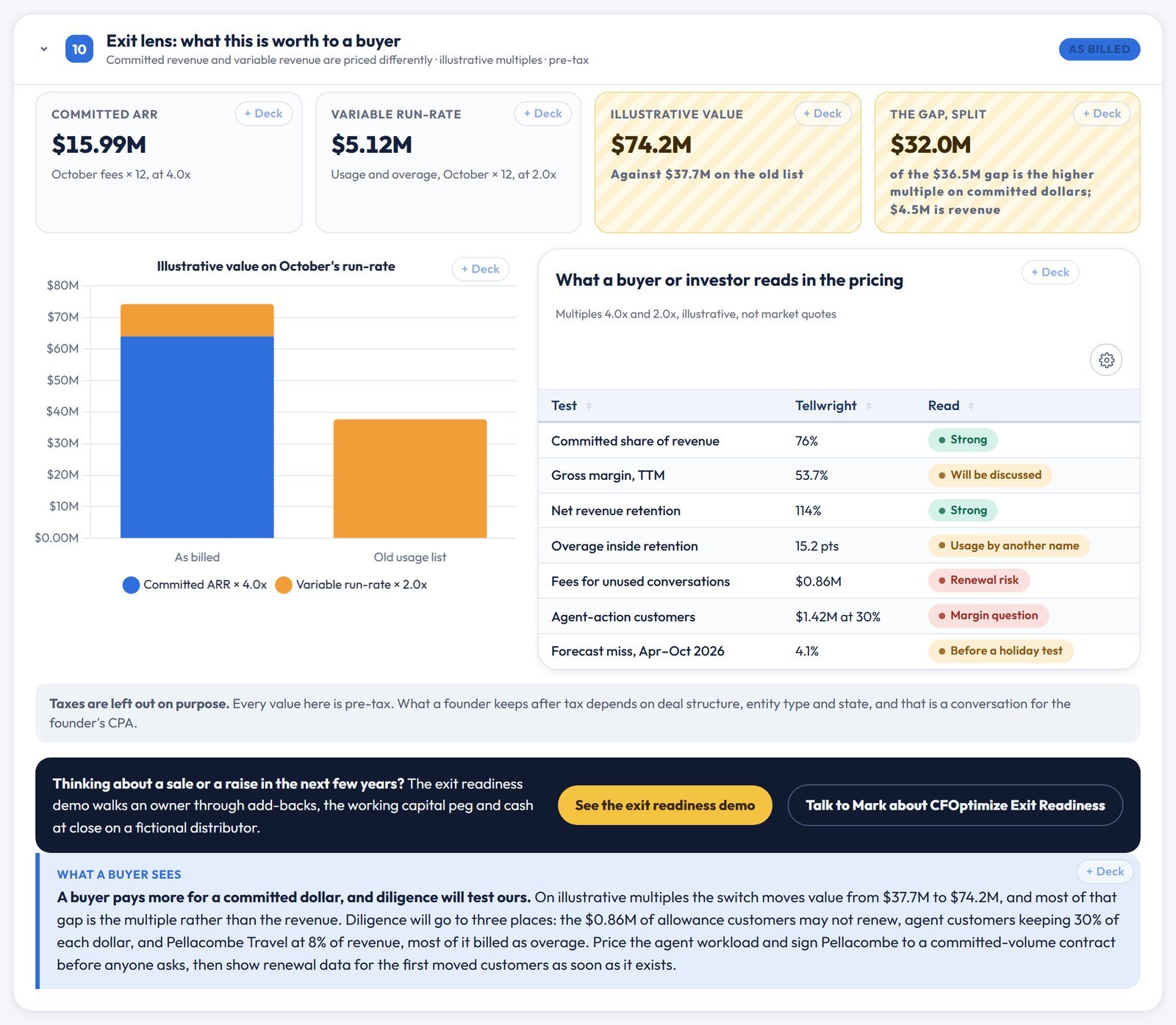
Net revenue retention is 114%, which reads well until you split it. Fifteen points of it is overage, and twelve of those come from one customer, Pellacombe Travel, at 8% of Tellwright's revenue and running about 165,000 conversations a month on a tier that includes 25,000.
That matters because of Varnley Software. Varnley ran about 90,000 conversations a month on the same tier, most of its bill was overage, and at about $70K a month it decided to build its own agent on a model API. It left after September. Pellacombe runs even bigger. Before it does the same math, Tellwright needs a committed-volume price for anyone above 50,000 conversations a month. A buyer will ask about Pellacombe in the first meeting, and it's far better to arrive with that contract signed.
People and payroll: where the next dollar goes
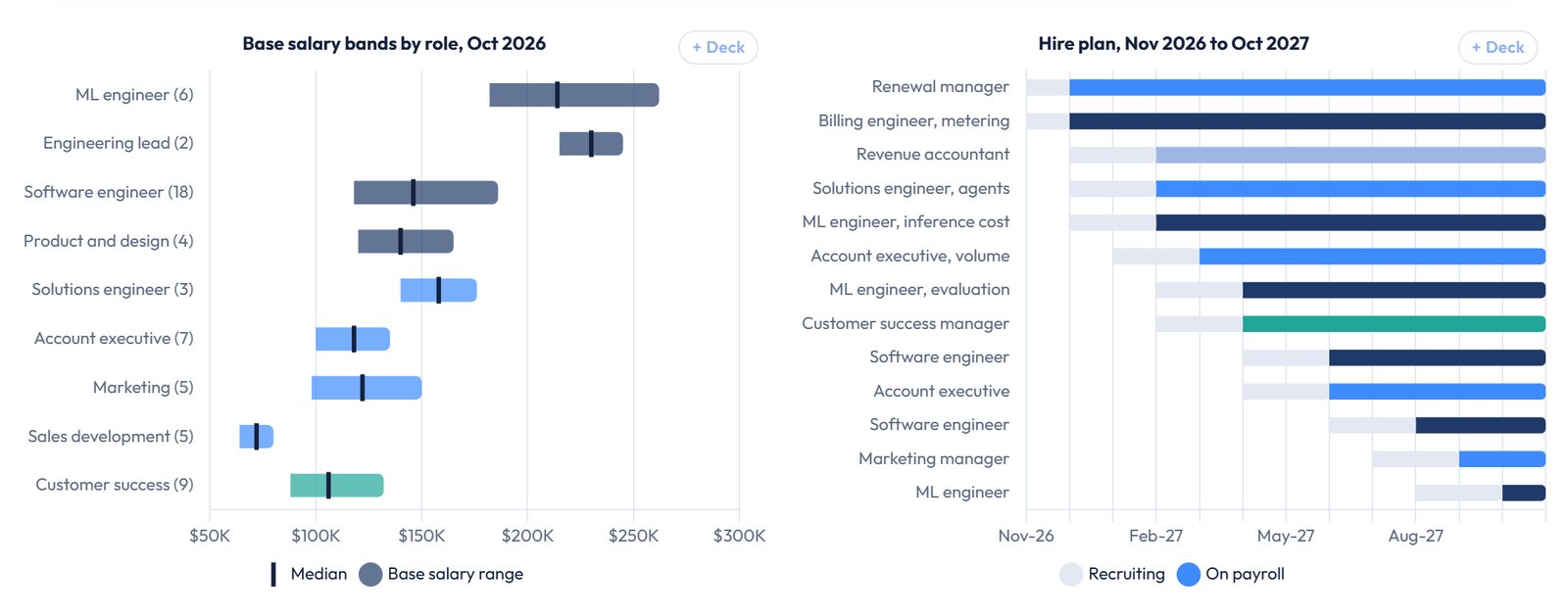
This section is new on the page, because pricing and hiring are the same decision at an AI company. Tellwright has 68 people, and revenue per head went from $217K before the switch to $310K in October. Payroll is $10.5M a year, twice the model bill, so it's the cost that deserves the most attention.
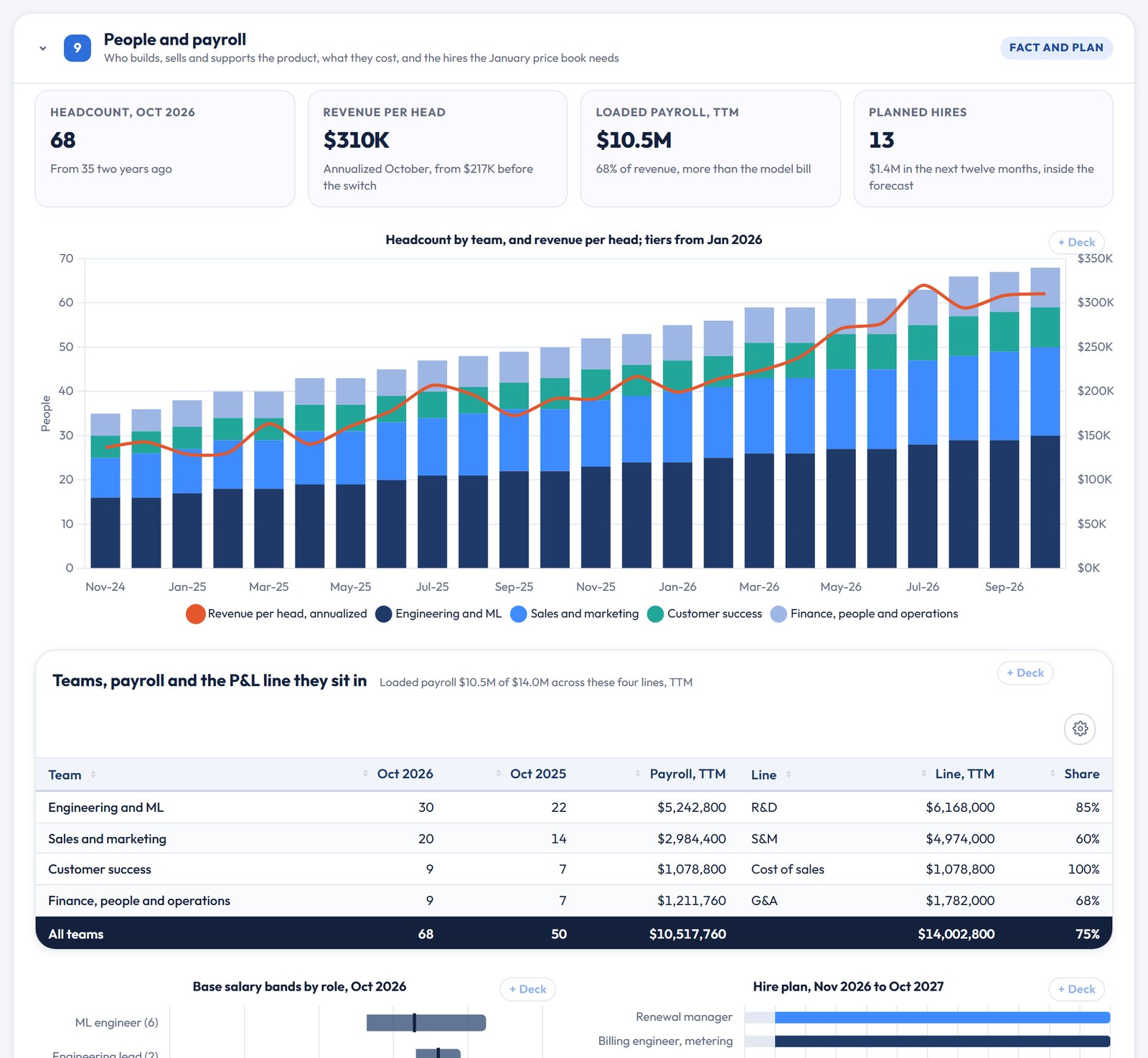
The pay bands make the scarce role obvious. ML engineers earn a median $214K base, and the best-paid of them earns more than either engineering lead. That's still a bargain on Tellwright's numbers: every cent off the model cost per conversation is worth about $162K a year, so a new ML engineer at about $276K fully loaded pays back by cutting under two cents.
The hire plan is tied to the January price book. Thirteen hires over the next twelve months, and the first two start in December: a renewal manager for the January renewals, and a billing engineer to meter agent conversations. The page checks that every start date fits inside the cost trend the forecast already carries, so the plan and the forecast can't drift apart.
The forecast, told honestly
The board moved to tiers to get predictability, and it got some. The average monthly forecast miss from April to October fell from about 9% to 4%. Flip to the old list and the same months would still have improved to about 6%, because 309 customers are steadier than half as many. So the honest version is half fee floor, half scale. The real test is November and December, the months Tellwright always missed by most.
Scenarios and the board deck
The levers on the left act on the next twelve months only, with a new price book from January 2027. On today's terms Tellwright reaches $26.1M of revenue next year and ends it with $4.6M of cash, against $2.2M if nobody had moved off the old list. Set the agent weight to 2.0x and margin next year goes from 55.9% to 58.4%.
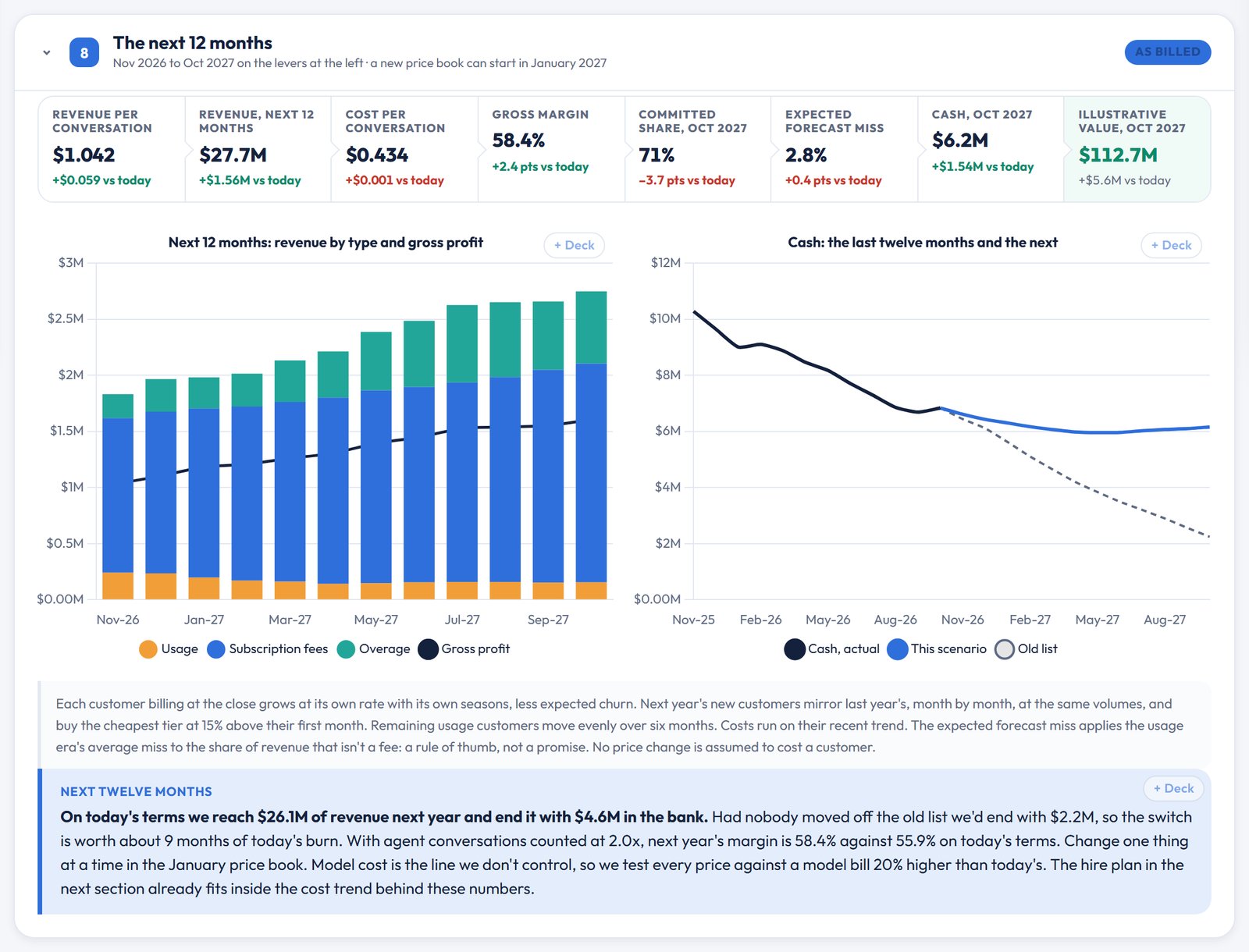
The exit lens puts an illustrative value on it: $74.2M as billed against $37.7M on the old list, most of it from the higher multiple a buyer pays on committed dollars. Every card, chart and table also has a + Deck button, and the pricing review pack builds an editable PowerPoint with speaker notes that record every lever setting.
Why not just do this yourself with AI?
You should use AI. We do, every day. The analysis was never the hard part. Every finding above came from four things a chatbot doesn't have:
- Transaction-level data, kept current. Every customer's conversations, bill and model cost by month, pulled from the billing system, the accounting system, payroll and the model-provider invoices after every close, and tied to the books.
- Context nobody wrote down. That Nettlecove's launch slipped, that Varnley was building in-house, that Orrinby's agent issues refunds. We add that to the data so it sits next to the numbers it explains.
- Somewhere safe to keep it. Read-only connections, a secured warehouse you control and access controls, instead of customer usage files and payroll exports pasted into a chat window.
- Someone accountable for it. A CFO who knows the business well enough to say the uplift is soft, pick up the phone before renewal and change the price book.
What it takes to get this on your own numbers
We connect read-only to your billing system, your accounting system, your payroll provider and your model-provider invoices, rebuild every customer's usage, bill and compute cost by month, and reprice your history on any price book you're considering. From then on it refreshes after every close, so a customer running at thin margin shows up before renewal instead of after it.
That's CFOptimize – accelerate your growth, built for AI companies working out what to charge. If you'd like to see it on your own customers, grab time with me, or browse the other demos in our showcase.
Mark
Tellwright and every customer named in this post are fictional, and every figure in the dashboard and in this post is invented for illustration. Nothing here is drawn from any client's books, prices, customers or payroll. Valuation multiples are illustrative assumptions, not market quotes, and nothing here is tax, legal, accounting or investment advice.
Share