Owners of $5 to 25M companies planning a sale or recap in the next 12 to 24 months, and the advisors who will run that process.
What a buyer will actually pay, how much of it reaches the owner at close, and what an 18-month plan is worth.
The first thing a buyer sends after a signed LOI is a document request list, and it's long. Three items on it decide most of the price: support for every add-back, revenue by customer with the name of whoever manages each account, and a payroll register. Most owners see that list for the first time in week one of diligence, when it's too late to change the answers.
So the question I'd want an owner asking a year or two out isn't "what's my business worth?" It's "what will a buyer's quality of earnings team find, and how much of the price does it move?" AI can summarize a P&L. It can't answer that one, because the answer lives in the add-back receipts, the customer file and the payroll runs, not in the financial statements.
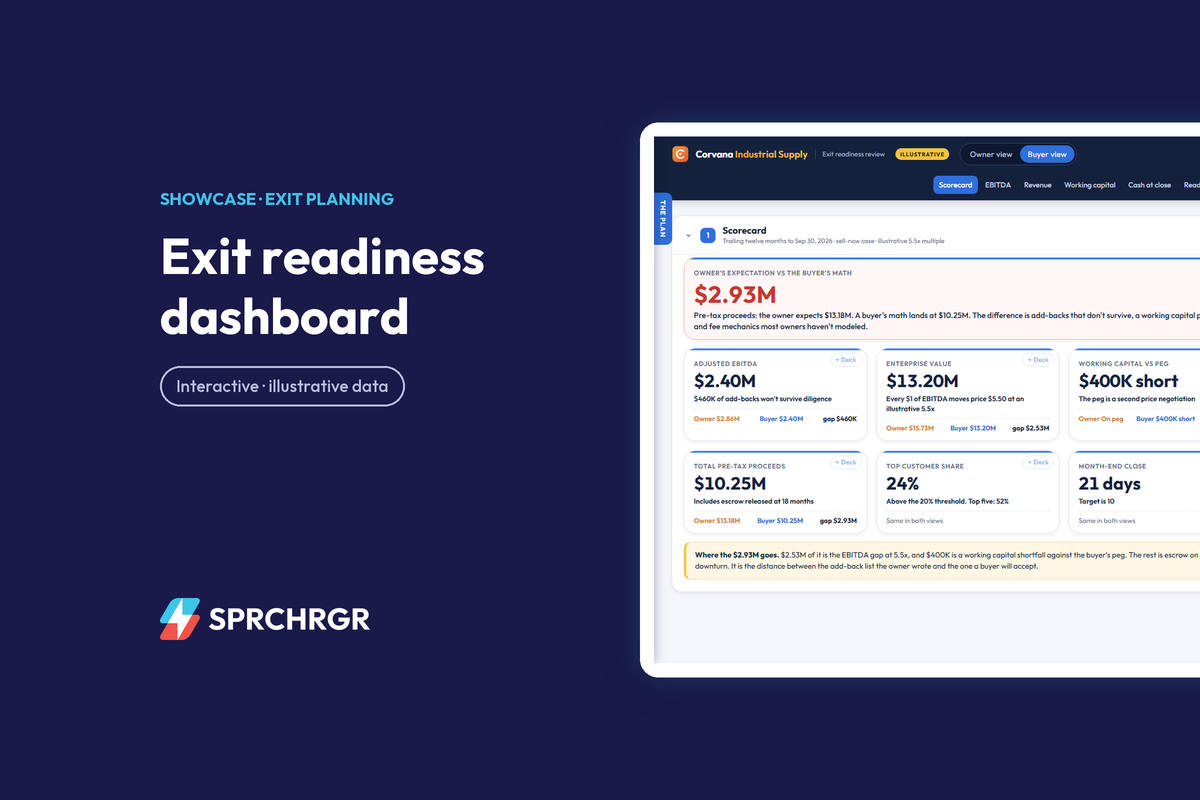
Here's how I'd walk an owner through it using a working sample dashboard we built for a fictional industrial distributor called Corvana Industrial Supply: 22 years old, founder-owned, two warehouses, 64 employees and $18.4M of revenue, with a founder who wants to sell in about 18 months. The company, the customers, the people and the numbers are invented. The patterns aren't. A switch at the top flips every section between the owner's numbers and a buyer's, so open it in another tab and follow along.
The year, the way I'd say it to a banker
This is the paragraph at the top of the page, and it's the one I'd want the owner able to say out loud without looking down:
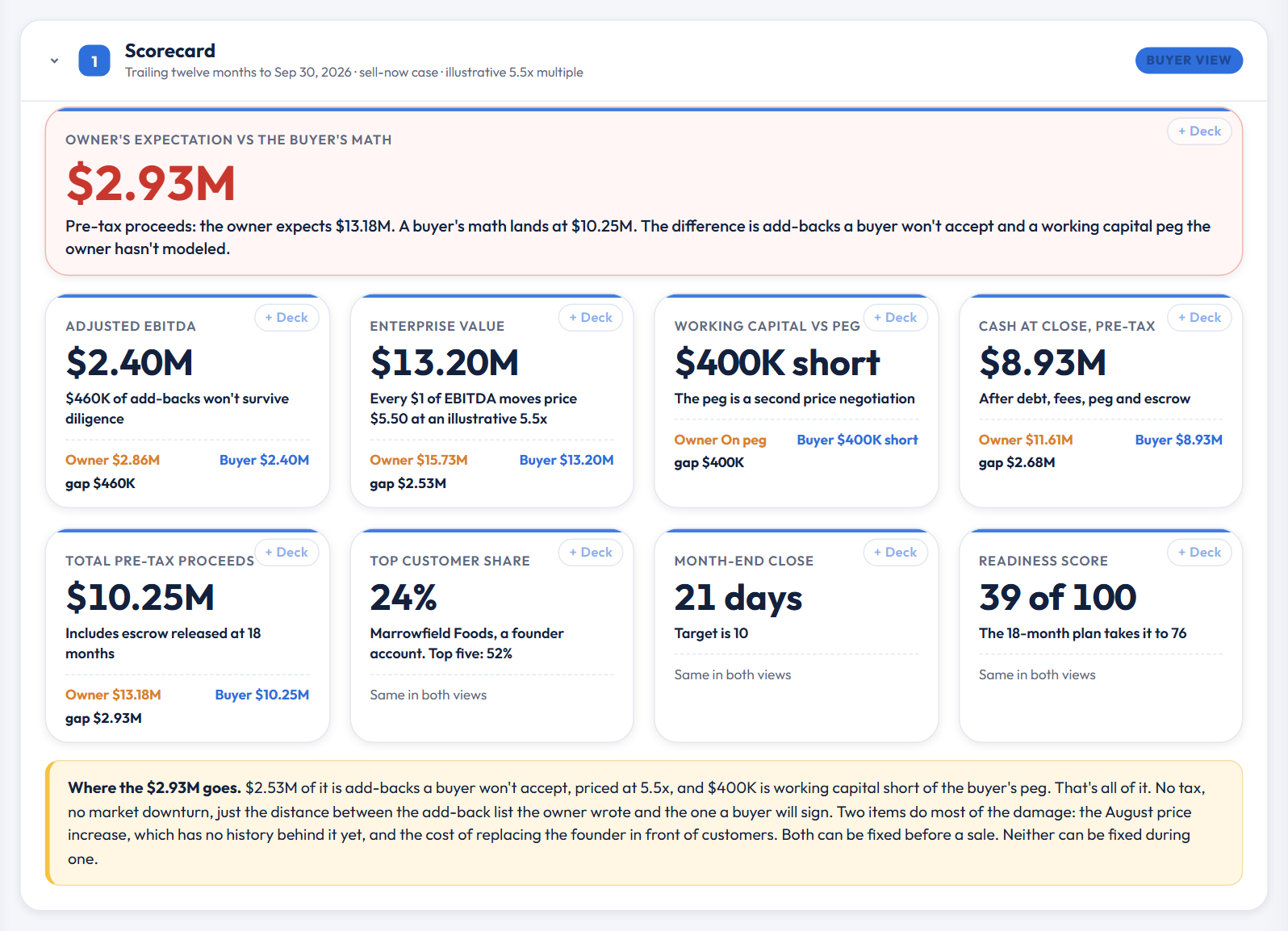
Corvana is worth about $3M less to a buyer than its owner thinks, and most of the fixes are in the owner's hands. Corvana earned $2.1M of EBITDA on $18.4M of revenue in the year to September, and the summer quarter ran 9% ahead of last year. A buyer will underwrite $2.4M of adjusted EBITDA, not the $2.9M on the founder's list, mostly because the founder still holds three of the top five accounts, so at an illustrative 5.5x the $13.2M the owner expects becomes about $10.3M before tax. Eighteen months of preparation wins back about $2.6M, and half of that is earned rather than hoped for.
That gap is $2.93M, and it's worth knowing exactly where it comes from. $2.53M is add-backs a buyer won't accept, at an illustrative 5.5x. The other $400K is working capital short of the buyer's peg. Debt and fees are the same in both models, so that's all of it. No tax and no market downturn, just the distance between the add-back list the owner wrote and the one a buyer will sign.
Which add-backs survive, and the one that's really a hire
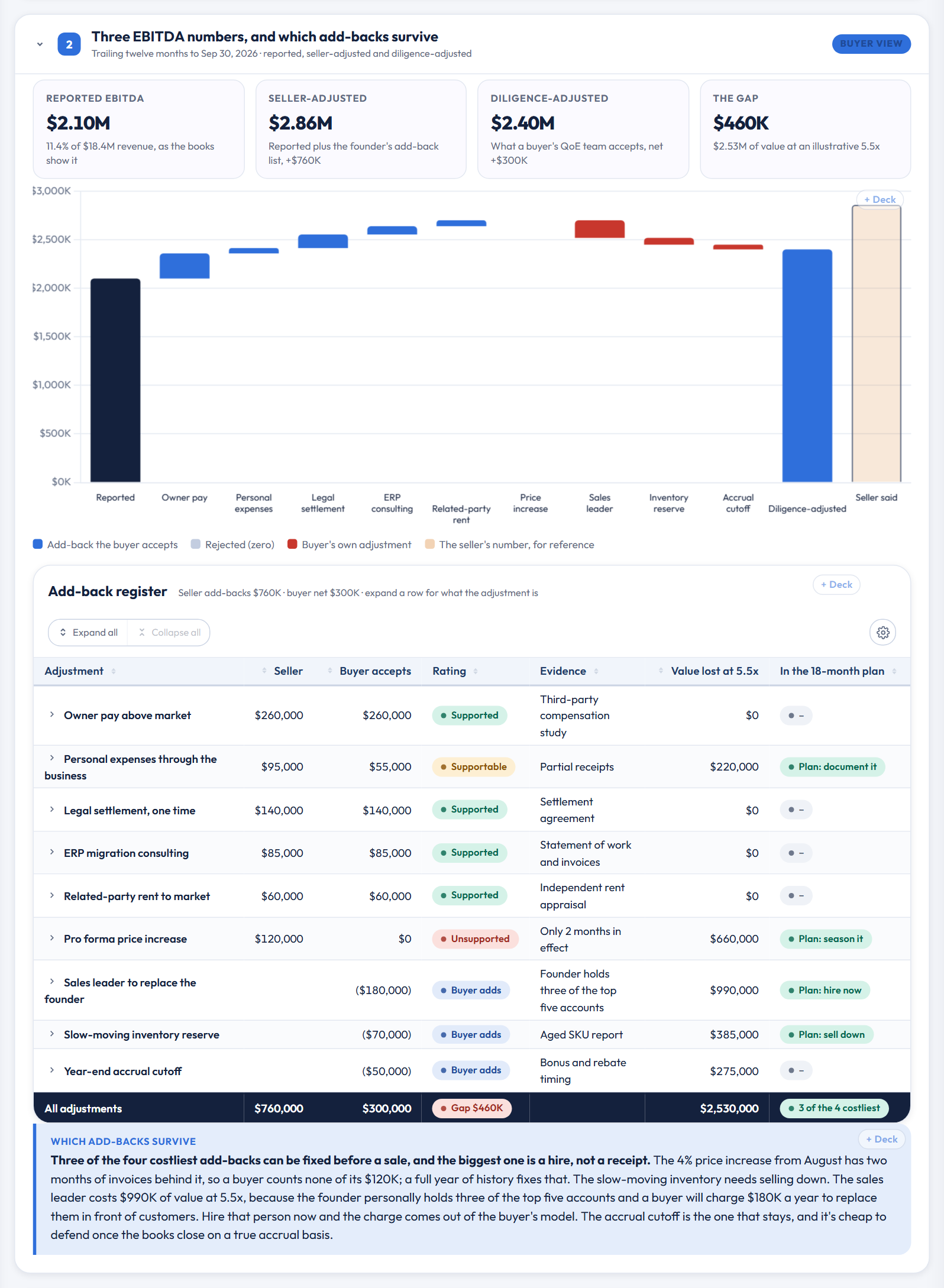
Corvana has three EBITDA numbers. Reported is $2.10M, what the books show. Seller-adjusted is $2.86M once the founder's add-backs go on. Diligence-adjusted, what a buyer's team will accept, is $2.40M. The add-back register on the page rates every line and puts the buyer's own adjustments right beside the seller's.
Two lines do most of the damage. The 4% price increase from August has two months of invoices behind it, so a buyer counts none of its $120K. A full year of history fixes that, and nothing else will. The bigger one is $180K a year for a sales leader to replace the founder, which costs $990K of value at 5.5x. That isn't an accounting problem. The founder personally holds three of the top five accounts, and a buyer charges for the person who'll have to take them over. Hire that person before the sale and the charge comes out of the buyer's model.
Name the accounts, because the buyer will
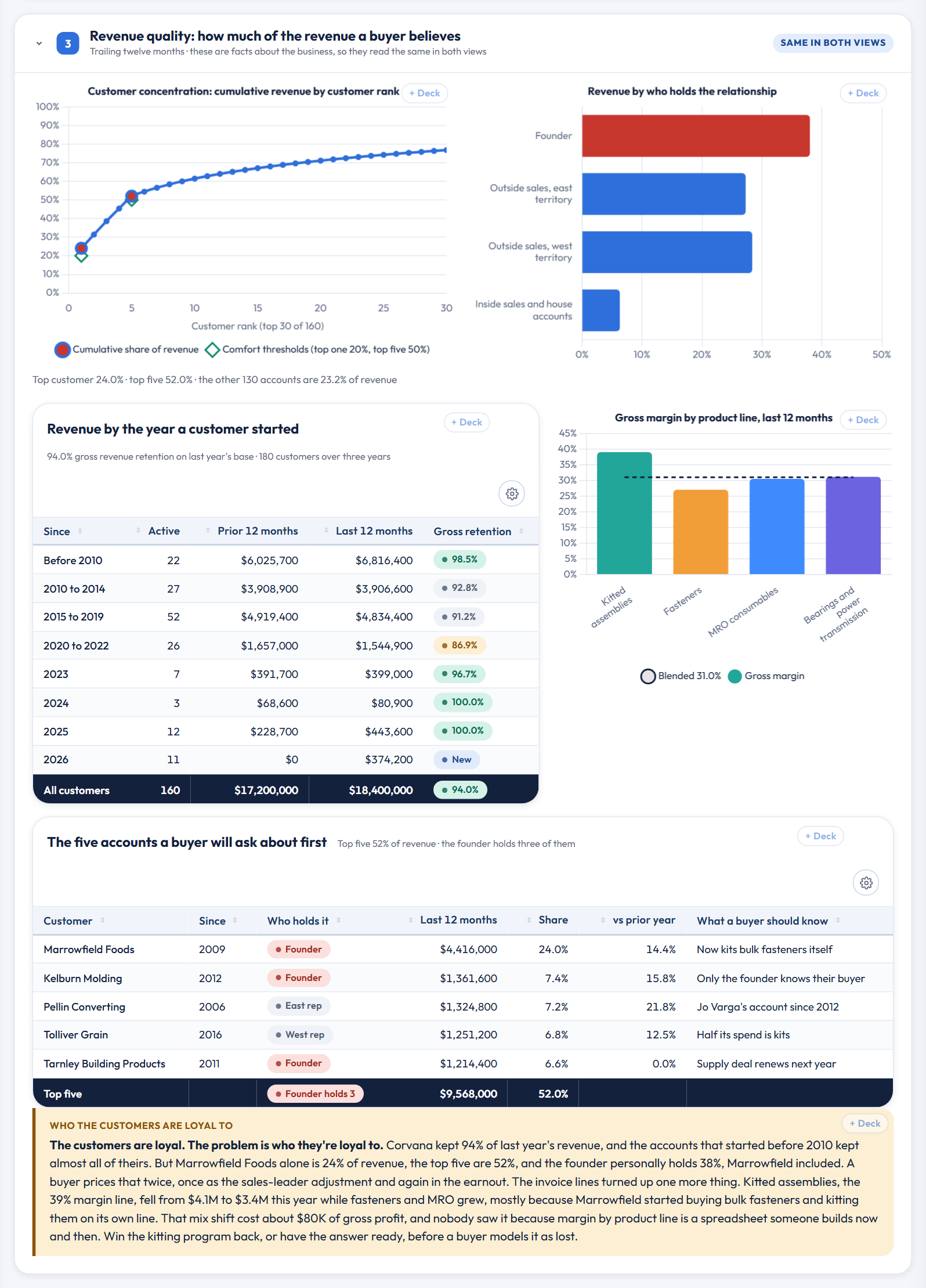
"24% customer concentration" starts a conversation. The buyer's next question is always who. So the revenue section now has the five accounts a buyer will ask about first. Marrowfield Foods alone is 24% of revenue and the top five are 52%. The founder holds Marrowfield, Kelburn Molding and Tarnley Building Products, which is 38% of revenue. A buyer prices that twice: once as the sales-leader adjustment, and again in the earnout.
The invoice lines turned up something the P&L never would. Kitted assemblies, Corvana's best line at a 39% margin, fell from $4.1M to $3.4M this year while fasteners and MRO grew. Most of it is Marrowfield. The account grew 14%, but it started buying bulk fasteners and kitting them on its own line, so Corvana sold more parts at 27% and fewer kits at 39%. That mix shift cost about $80K of gross profit, and nobody saw it because margin by product line is a spreadsheet someone builds now and then. I'd want that kitting program won back, or the answer ready, before a buyer models it as lost.
The people questions nobody prepares for
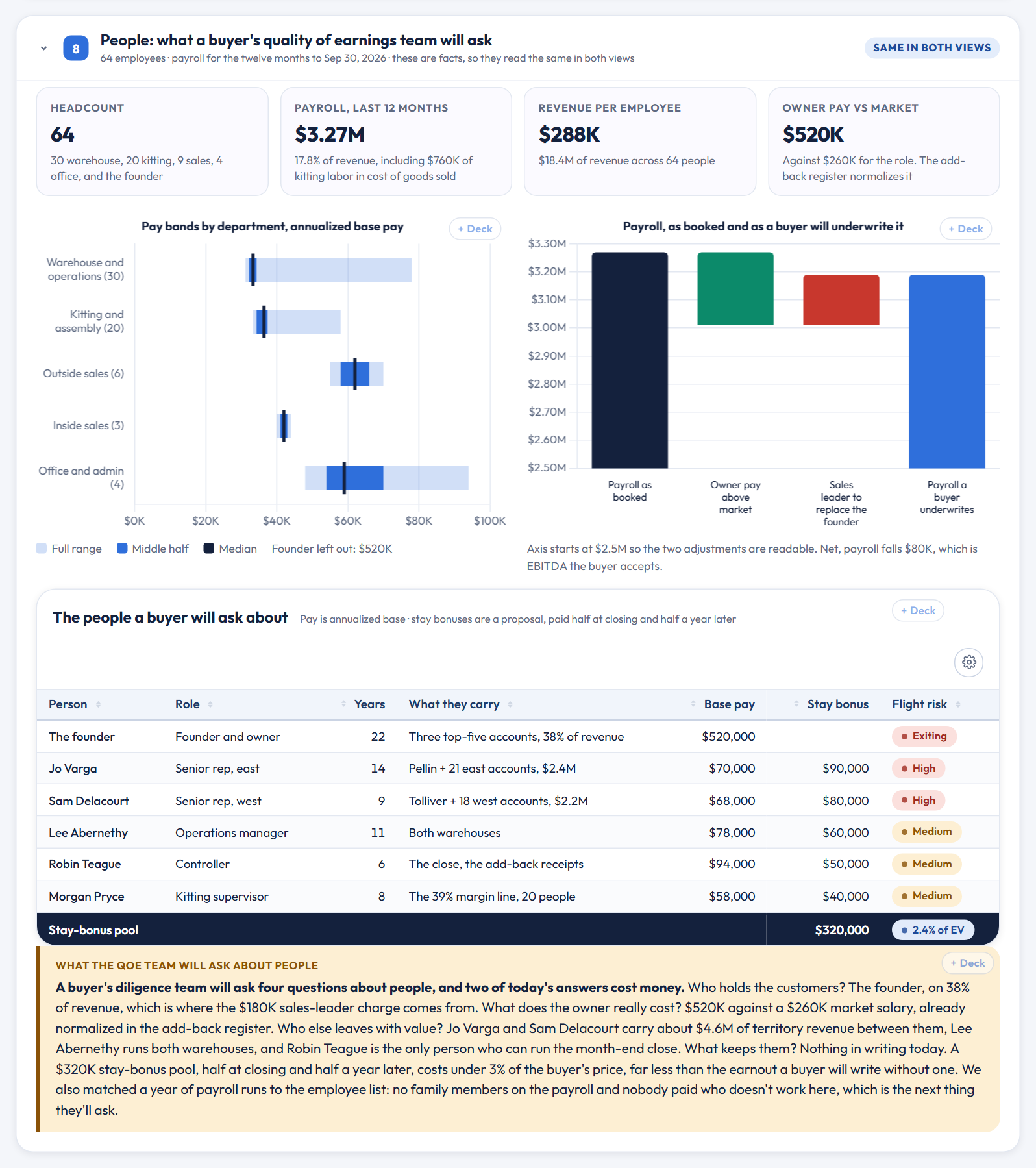
A buyer's diligence team will ask four things about people. Who holds the customers? What does the owner really cost? Who else walks out with value? And what keeps them? The new people section on the page answers each one from payroll, not from memory.
Corvana's payroll is $3.27M, 17.8% of revenue, and $760K of that is kitting labor sitting in cost of goods sold, which is the first thing a buyer's team will want split out. The founder is paid $520K against a $260K market salary for the role; the add-back register already normalizes that. Take out the owner's excess pay, add the sales leader a buyer will insist on, and the payroll a buyer underwrites is $80K lower than what's booked.
Then the part most owners skip. Jo Varga and Sam Delacourt, the two senior reps, carry about $4.6M of territory revenue between them. Lee Abernethy runs both warehouses, and Robin Teague is the only person who can run the month-end close. None of them has anything in writing that keeps them through a sale. A $320K stay-bonus pool, half at closing and half a year later, is about 2.4% of the buyer's enterprise value, and a lot cheaper than the earnout a buyer will write without one. We also matched a year of payroll runs to the employee list: no family members on the payroll and nobody paid who doesn't work there. That's the next question they'll ask, and it's a good one to answer before they do.
Settle the peg before the LOI
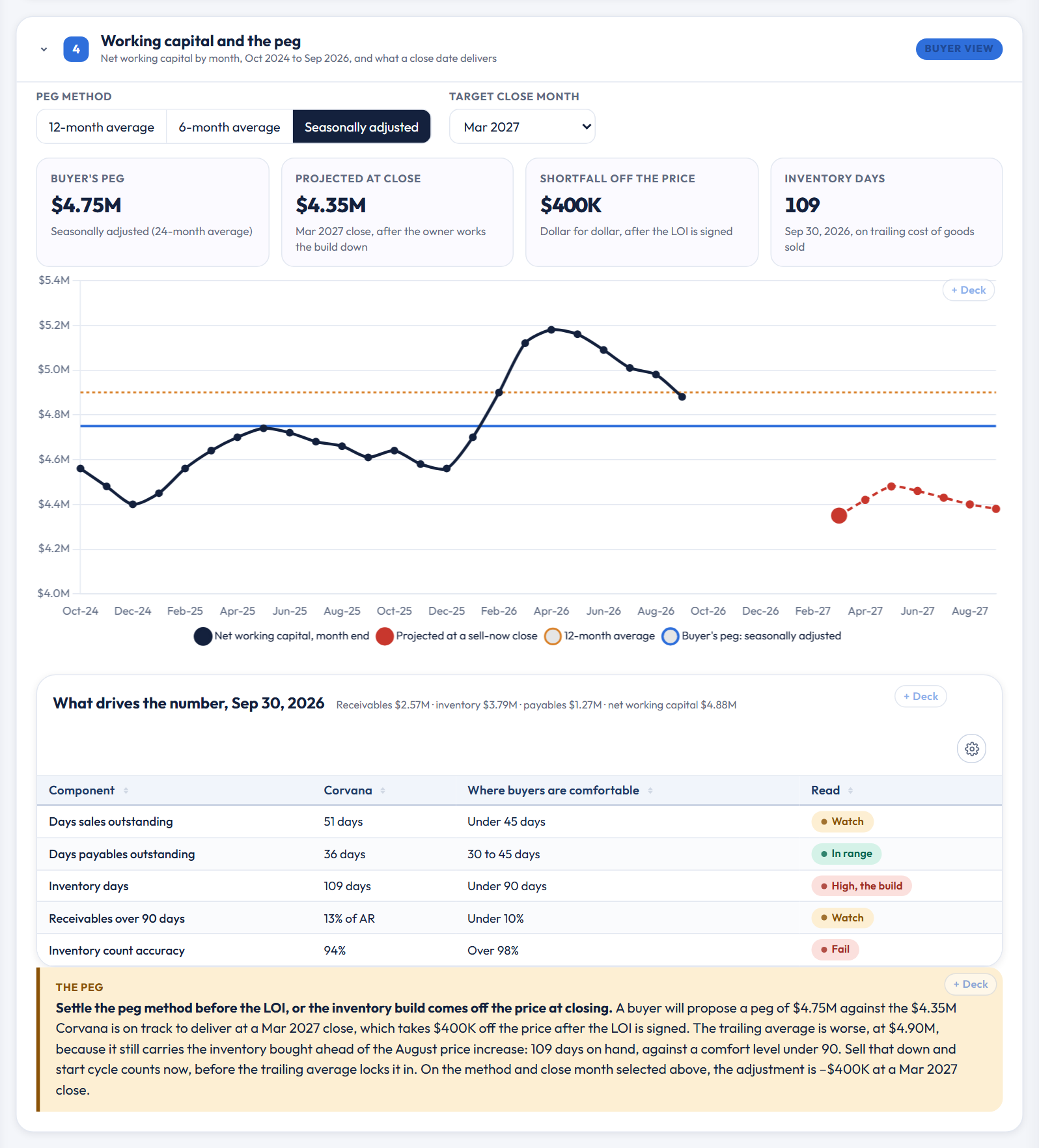
This is the $400K most owners find in week six of diligence. A deal assumes a normal level of working capital is delivered at closing, called the peg, and any shortfall comes off the price dollar for dollar. Corvana's buyer will propose $4.75M on a seasonally adjusted basis. Corvana is on track to deliver $4.35M at a March close. The trailing twelve-month average is worse for the seller, at $4.90M, because it still carries inventory bought ahead of the August price increase: 109 days on hand against a comfort level under 90.
The page lets you switch the peg method and move the close month. The advice doesn't change much with either: agree the method in the LOI while you still have leverage, and sell the inventory down before the trailing average locks it in.
Sell now or later, and the seller prep deck
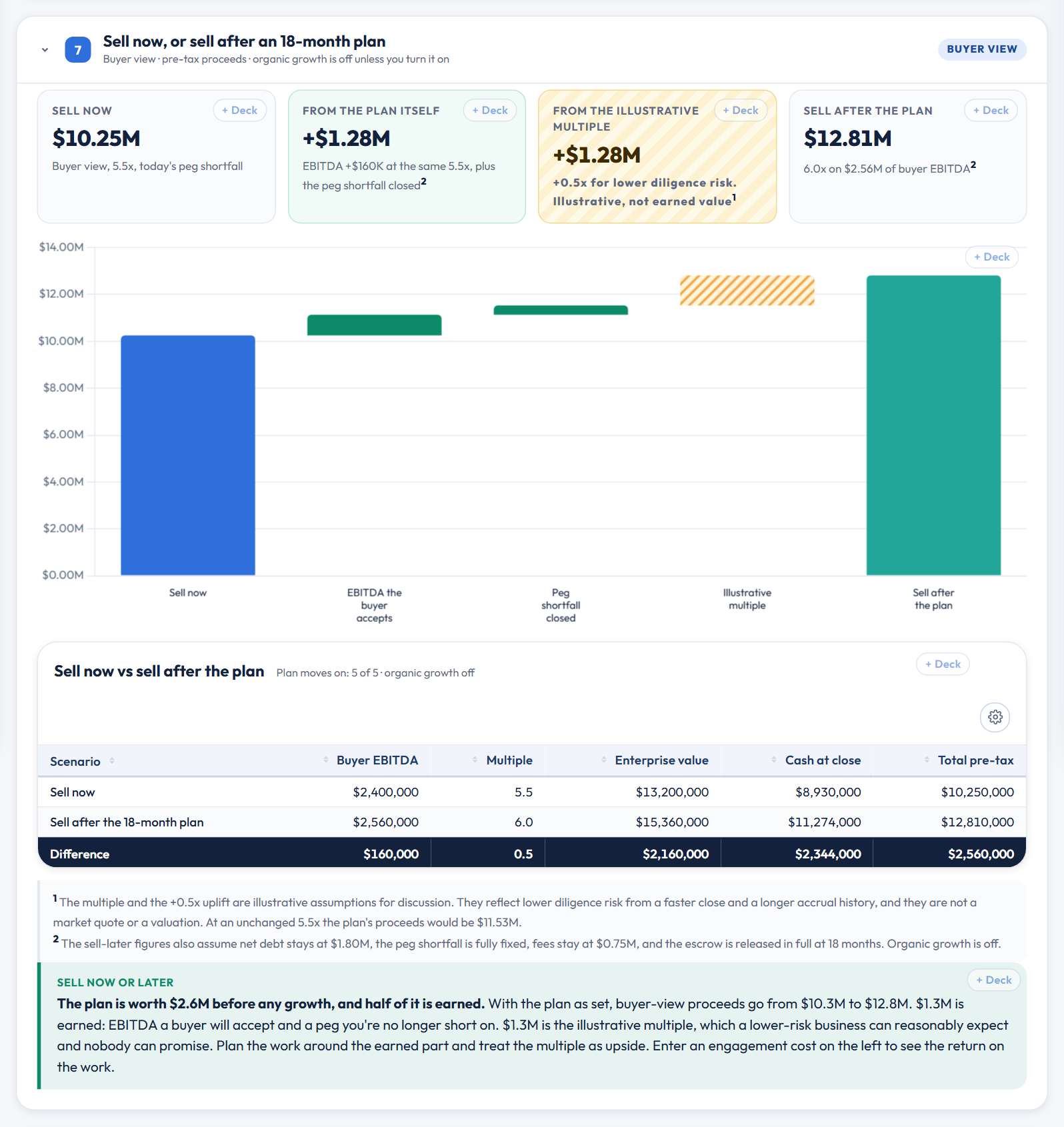
The levers on the left are an 18-month plan, and each one prices a single fix: document the personal expenses, season the price increase, hire the sales leader, sell down the inventory, and fix the close, the accrual history and the forecast. With all five on, buyer-view proceeds go from $10.25M to $12.81M. Read that in two halves. $1.28M is earned, EBITDA a buyer will accept and a peg you're no longer short on. The other $1.28M is an illustrative move to 6.0x for a lower-risk business, which is a reasonable thing to expect and not something anyone can promise. The readiness score goes from 39 to 76 alongside it. Organic growth stays off unless you turn it on, so the plan's value never hides inside growth.
Every card, chart and table also has a + Deck button. Use the seller prep pack loads the set an owner usually brings to a banker or attorney and downloads it as an editable PowerPoint, with speaker notes that record which view and plan moves were on.
Why not just do this yourself with AI?
You can do a fair amount of it yourself, and you should use AI. We use it every day. The analysis was never the hard part. Every finding above came from four things a chatbot doesn't have:
- Transaction-level data, kept current. Invoice lines by product, every customer's revenue and who manages it, payroll runs and the add-back receipts, pulled automatically after every close and tied to the books.
- Context nobody wrote down. That a top account started kitting its own fasteners, that a price increase is too new to count, that one person runs the close. We add that to the data so it shows up next to the number it explains.
- Somewhere safe to keep it. Read-only connections, a secured warehouse and access controls, instead of a payroll register and a customer list pasted into a chat window a year before you've told your team you're selling.
- Someone accountable for it. A CFO who has sat across the table from a buyer's quality of earnings team and knows which answers move the price.
Put those in place and the AI gets a lot more useful too, because it's finally reading the right data.
What it takes to get this on your own numbers
We connect read-only to your accounting system, payroll and CRM, rebuild 36 months on an accrual basis (Corvana only has 20, which is its own readiness gap), and put every add-back in one register with the evidence attached. Then we price each gap the way a buyer will and rank the fixes by dollars at stake and months to close.
That's CFOptimize Exit Readiness, and it ends with a ranked plan and a timeline you can take to your banker or attorney. If you'd like to see it on your own numbers, grab time with me and we'll walk through them together. You can also browse the other demos in our showcase.
For the thinking behind each section, see our 3-pillar transaction readiness guide (the thresholds behind the readiness tests), 9 things you should know before due diligence, the 11-step exit framework and 5 common exit deal pitfalls (worth reading before any LOI).
Mark
Corvana Industrial Supply and every customer and person named in this post are fictional, and every figure in the dashboard and in this post is invented for illustration. Nothing here is drawn from any client's books. Multiples are illustrative assumptions, not market quotes, and nothing here is tax, legal or investment advice.
Share